DbcultAccessing Vault...
7.4/10
Senior Film Conservator
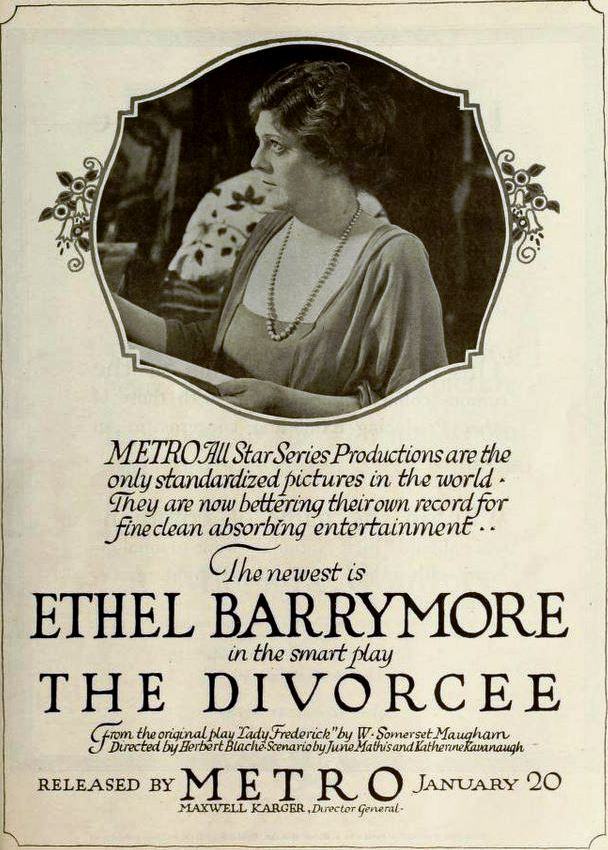
A definitive 7.4/10 rating for a film that redefined the boundaries of cult cinema. The Divorcee remains a cornerstone of transgressive art.
The year 1919 stood as a precipice in cinematic history, a moment where the industry shed its nickelodeon infancy to embrace a more literary, nuanced architectural form. At the heart of this metamorphosis was The Divorcee, a film that served as a vessel for the formidable Ethel Barrymore to bridge the chasm between the proscenium arch and the silver screen. Adapted from W. Somerset Maugham’s 1907 theatrical triumph, Lady Frederick, the film meanders through a landscape of social artifice with a grace that few of its contemporaries could muster.
Ethel Barrymore, often hailed as the 'First Lady of the American Theater,' brings an almost tactile weight to the role of Betsy O’Hara. While many silent actresses of the era relied on the exaggerated pantomime seen in productions like The Hidden Hand, Barrymore operates with a restrained interiority. Her Betsy is not a victim of circumstance but a strategist of the soul. The narrative, penned for the screen by the legendary June Mathis and Katharine Kavanaugh, retains the caustic wit of Maugham’s original text, ensuring that the dialogue—conveyed through ornate intertitles—stings with the precision of a rapier.
The plot’s central tension revolves around Betsy’s mounting debts and her tenuous position within the social hierarchy. Unlike the pastoral innocence found in Rebecca of Sunnybrook Farm, The Divorcee dives headlong into the murky waters of financial desperation and moral ambiguity. Betsy is a woman who understands that in the theater of the elite, appearance is the only currency that truly matters. When she is pursued by the young, idealistic Lord Mereston, she does not simply reject him; she deconstructs the very illusion of her beauty in a scene of breathtaking honesty that remains one of the most radical moments in early cinema.
When juxtaposed with other releases of the period, such as the more straightforward moralism of The Promise, The Divorcee feels startlingly modern. It eschews the binary of 'virtue versus vice' to explore the grey areas of human motivation. The supporting cast, including Joseph Kilgour and Naomi Childers, provides a sturdy framework for Barrymore’s luminosity. Kilgour, in particular, captures the essence of the worldly-wise suitor, a man whose affection is tempered by a cold understanding of the world’s transactional nature.
Consider the thematic depth here compared to a film like Opportunity. While the latter focuses on the external machinations of success, The Divorcee is preoccupied with the internal cost of maintaining a facade. The cinematography by the uncredited but capable hands of the Metro Pictures crew utilizes light and shadow to mirror Betsy’s fluctuating fortunes. The opulent sets of Monte Carlo are rendered with a shimmering clarity that contrasts sharply with the claustrophobic tension of the blackmail subplots.
The involvement of June Mathis cannot be overstated. As one of the most powerful women in Hollywood at the time, her ability to structure a narrative was unparalleled. In The Divorcee, she manages to condense Maugham’s three-act play into a fluid visual experience that never feels stage-bound. There is a kinetic energy to the editing that one might find lacking in slower-paced dramas like The Heritage or the somewhat static A föld embere.
The film’s pacing is a masterclass in tension. The revelation of the letters—the classic MacGuffin of the piece—is handled with a sophistication that avoids the frantic melodrama of Yachts and Hearts, or The Opium Smugglers. Instead of focusing on the scandal itself, the film focuses on the psychological leverage the letters provide. It is a game of chess played with emotions, where the stakes are nothing less than total social annihilation.
"In the grand theater of 1919, Ethel Barrymore didn't just perform; she inhabited the very essence of Maugham's cynical romanticism, turning a story of debt into a manifesto of feminine agency."
One of the most arresting sequences involves Betsy O’Hara’s morning toilette. In an era where leading ladies were expected to be perpetually ethereal, Barrymore allows herself to be shown without the artifices of makeup and hair styling. This 'unmasking' serves a dual purpose: it is a plot point intended to dissuade a youthful suitor, but it also serves as a meta-commentary on the performance of gender. This level of self-awareness is rarely seen in 1910s cinema, perhaps only occasionally glimpsed in the more whimsical The Goose Girl or the eccentric Mrs. Plum's Pudding.
This scene elevates the film from a mere adaptation to a piece of social critique. Betsy O’Hara is a woman who has been 'divorced' not just from a husband, but from the illusions that society imposes upon her sex. She is weary, witty, and profoundly human. Compared to the more conventional roles in Married in Name Only, Betsy is a revolutionary figure. She does not seek redemption; she seeks autonomy.
While the film lacks the slapstick dynamism of Keep Moving or the athletic vigor of The Fly Ball, it compensates with an atmospheric richness. The costume design is particularly noteworthy, reflecting the transition from the restrictive corsetry of the Edwardian era to the more fluid silhouettes of the burgeoning 1920s. Each gown Barrymore wears is a piece of armor, a sartorial declaration of her intent to remain relevant in a world that discards women of a certain age and status.
The direction by Herbert Blaché (though the prompt focuses on the cast and writers) is invisible in the best way possible. He allows the performances to breathe, avoiding the frantic cutting that characterized many of the lesser 'society dramas' like The Question. There is a confidence in the staging that suggests a deep respect for the source material. The film doesn't feel the need to 'cinematize' Maugham with unnecessary stunts; it trusts the strength of the characters and the irony of the situations.
Looking back from a century’s distance, The Divorcee remains a fascinating artifact of a lost world. It captures the twilight of the European aristocracy and the dawn of a new kind of cinematic stardom. While films like The Hayseeds' Melbourne Cup offered broad, populist entertainment, The Divorcee targeted a more discerning audience, one that appreciated the nuances of social maneuvering and the bittersweet reality of romantic compromise.
The film also serves as a reminder of the power of the female voice in early Hollywood. Between Mathis’s scenario and Barrymore’s performance, the production is infused with a perspective that challenges the male gaze. Even in a world that seems to be A World Without Men’s antithesis—a world dominated by male creditors and suitors—Betsy O’Hara remains the master of her own fate. She is the architect of her own survival, using the very tools of her oppression to carve out a space of her own.
To watch The Divorcee today is to engage with a sophisticated piece of storytelling that refuses to age. The themes of debt, reputation, and the performative nature of social life are as relevant now as they were in 1919. The film stands as a testament to Ethel Barrymore’s unique screen presence—a blend of regal authority and vulnerable humanity. It is a work of quiet brilliance, a film that doesn't shout to be heard but speaks in the eloquent, measured tones of a woman who has seen the world and isn't afraid to laugh at its absurdities.
In the vast ocean of silent cinema, where so many films have been lost to the ravages of nitrate decay and time, The Divorcee emerges as a beacon of literary intelligence. It is a reminder that even in the earliest days of the medium, film was capable of the highest levels of artistic expression. It is not merely a 'romance' or a 'drama'; it is a sophisticated dissection of the human condition, wrapped in the elegant silks of a bygone era and delivered with the sharp, unsentimental wit of W. Somerset Maugham.
Technical Note: For those tracing the evolution of the 'fallen woman' genre, compare the nuanced portrayal here to the more histrionic examples of the early 1920s. The restraint shown by Mathis and Barrymore is a precursor to the sophisticated comedies of manners that would later define the pre-Code era.
IMDb 5.7
1930
Community
Log in to comment.