DbcultAccessing Vault...
6.9/10
Senior Film Conservator
A definitive 6.9/10 rating for a film that redefined the boundaries of cult cinema. The Dust of Egypt remains a cornerstone of transgressive art.
Stepping back into the nascent days of cinema, one occasionally unearths a true curio, a cinematic artifact that, despite its age, retains a surprising vivacity and charm. Such is the case with The Dust of Egypt, a film that, even a century after its creation, manages to captivate with its whimsical premise and delightful execution. It's a testament to the ingenuity of early filmmakers that they could craft such intricate and amusing narratives, often with a simplicity that belies their underlying thematic depth. This particular feature, a silent-era gem, invites its audience into a world where the line between reality and the subconscious blurs, delivering a comedic spectacle born from the clash of millennia.
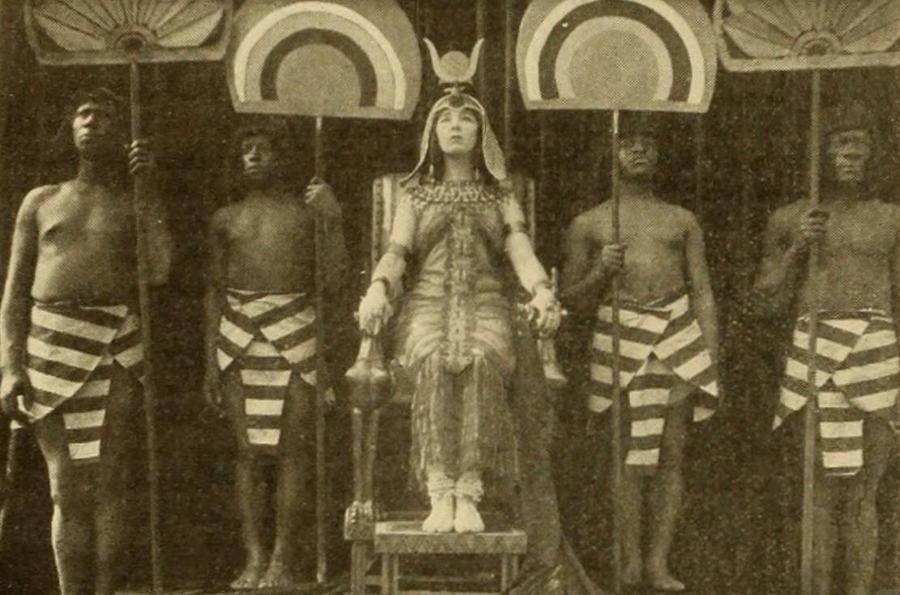
At its core, The Dust of Egypt presents a narrative conceit that is as audacious as it is endearing. We are introduced to a young man, whose quiet evening takes an unexpected turn when he is entrusted with the temporary guardianship of an ancient Egyptian mummy. What seems like a rather mundane, if slightly macabre, overnight duty quickly transmutes into something far more extraordinary. As the veil of sleep descends, his imagination, clearly stoked by the enigmatic presence of the preserved pharaoh, conjures an elaborate fantasy. In this vivid dreamscape, an imperious Egyptian princess, dormant for three millennia, is dramatically reanimated. This isn't a gentle reawakening; it's a grand, theatrical resurrection that catapults her directly into the bewildering whirl of the modern world. Her ancient sensibilities, her regal bearing, and her absolute conviction in her own authority become instant sources of comic friction against the backdrop of contemporary society. The ensuing 'comic havoc' is not merely slapstick; it’s a delightful exploration of cultural dissonance, a playful jab at the absurdities that arise when the past collides with the present. The film masterfully navigates this fantastical premise, leveraging the dream device to grant it an almost boundless creative freedom, unburdened by the strictures of everyday logic.
In the silent era, the onus of storytelling fell squarely on the shoulders of the performers, whose every gesture, every facial contortion, had to convey volumes. Edith Storey, in the demanding role of the awakened Egyptian princess, delivers a truly memorable performance. Her portrayal is a delicate balance of ancient grandeur and bewildered confusion. She doesn't just walk; she glides with a palpable sense of inherited authority, her eyes conveying a timeless imperiousness that is both awe-inspiring and utterly out of place in a bustling modern city. The humor often stems from her unwavering conviction in her own royal status, even as the world around her refuses to acknowledge it. Her interactions with the bewildered populace, captured through broad, expressive movements typical of the era, are a constant source of amusement. Imagine a queen demanding obeisance from a streetcar conductor, or attempting to impose ancient laws upon a startled shopkeeper – Storey sells every moment with an admirable commitment to her character's anachronistic dignity.
Nicholas Dunaew, as the young man whose dream generates this entire spectacle, plays a crucial, if often reactive, role. His expressions of wonder, alarm, and sometimes exasperation, anchor the fantastical elements within a relatable human experience. He is the audience's surrogate, witnessing the absurdity unfold. The supporting cast, including familiar names like Hughie Mack, George Stevens, Charles Brown, Jack Brawn, William Shea, J. Herbert Frank, Jay Dwiggins, Ethel Corcoran, Naomi Childers, Antonio Moreno, Edward Elkas, Mr. Sneeze, Mr. Pluto, and Cissy Fitzgerald, all contribute to the vibrant tapestry of the dream world. Their reactions – ranging from shock to comedic exasperation – serve to amplify the princess's disruptive presence, painting a vivid picture of a society delightfully upended. Each actor, in their own way, contributes to the film's kinetic energy and its ability to elicit genuine laughter without uttering a single word. The physical comedy, a cornerstone of silent film, is executed with precision, making the most of the princess's misplaced regal demands and the modern world's inability to comprehend them.
Beyond its overt comedic intentions, The Dust of Egypt subtly explores fascinating thematic territory. The most apparent is the perennial clash between the ancient and the modern. The princess, a living relic, embodies a bygone era's values, hierarchy, and understanding of the world. Her interactions force a humorous, yet thought-provoking, comparison with the fast-paced, democratized, and often bewildering landscape of early 20th-century life. This cultural collision serves as a delightful satirical lens through which to view both periods. It's a whimsical commentary on how much, or how little, humanity truly changes over millennia, filtered through the lens of a dream.
The film's ultimate revelation—that the entire escapade is merely a dream—is not a cop-out but rather a clever narrative device. It allows the filmmakers, and by extension, the writer Alan Campbell, to indulge in unrestrained fantasy without needing to provide logical explanations for the princess's resurrection or her subsequent antics. This 'it was all a dream' trope, while sometimes maligned, is employed here to excellent effect, underscoring the power of the subconscious mind to conjure elaborate narratives from the most mundane stimuli. It transforms a simple mummy into a catalyst for an epic, if internal, adventure. This approach can be seen in other films where the fantastical elements are rooted in personal perception or desire, much like the wish-fulfillment scenarios explored in films such as The Brass Bottle, where magical occurrences often lead to comedic chaos that is ultimately contained or explained away. The dream provides a safe space for the impossible, a playground for the imagination where societal norms can be inverted and explored without real-world consequences.
For a film of its vintage, The Dust of Egypt demonstrates a commendable level of craftsmanship. While detailed records of its production might be scarce, one can infer much from the surviving footage. The costumes, particularly for the princess, must have been meticulously designed to convey her ancient lineage and striking difference from the contemporary attire. The sets, whether depicting ancient Egyptian chambers or bustling modern streets, would have been crucial in establishing the contrasting worlds. The director, whose name is often overshadowed by the larger studios of the era, skillfully orchestrates the comedic sequences, ensuring that the visual gags land effectively. The use of intertitles, an indispensable tool of silent cinema, would have been pivotal in conveying dialogue, character thoughts, and crucial plot points, often adding another layer of humor through witty or ironic statements. The pacing, a critical element in silent comedies, would have been carefully managed to build comedic tension and deliver satisfying payoffs, creating a rhythm that keeps the audience engaged without relying on spoken word.
The film's visual language, relying heavily on exaggerated expressions and physical comedy, would have been immediately accessible to audiences of the time. The contrast between the princess's stoic, anachronistic demeanor and the bewildered reactions of the modern populace forms the backbone of the visual humor. This kind of fish-out-of-water scenario was a popular trope in early cinema, allowing for broad comedic strokes that translated well without sound. Films like A Lady of Quality or Wildflower, while perhaps more dramatic in tone, also explored characters navigating unfamiliar social landscapes, albeit with different comedic or dramatic aims. Here, the focus is purely on the delightful absurdity of the situation, enhanced by robust performances and clear, effective visual storytelling.
The genius behind the fantastical premise of The Dust of Egypt lies with its writer, Alan Campbell. In an era when screenwriting was still evolving, Campbell demonstrates a sophisticated understanding of narrative structure and comedic timing. His script cleverly sets up the mundane reality only to explode it into a vibrant dream, allowing for maximum comedic impact before elegantly returning to the starting point. This cyclical structure is not only satisfying but also highlights the imaginative power of the human mind. Campbell doesn't just craft a series of gags; he builds a cohesive, if dream-logic-driven, world where the humor arises organically from the characters' inherent traits and the improbable situations they find themselves in. The balance between the princess's unwavering resolve and the modern world's utter unpreparedness for her demands is a testament to his keen eye for comedic potential. His ability to weave a narrative that is both wildly improbable and utterly engaging speaks volumes about his craft, setting a precedent for future comedic fantasies.
The Dust of Egypt, while perhaps not as widely known as some of its contemporary blockbusters, holds a significant place in the tapestry of early cinema. It represents a particular strand of storytelling that embraced fantasy and comedy as means to explore broader cultural themes. The fascination with ancient Egypt was palpable in the early 20th century, spurred by archaeological discoveries and exoticism, and this film taps into that popular interest, albeit with a humorous twist. Unlike more serious historical epics such as Julius Caesar or religious dramas like The Life of Our Saviour; or, The Passion Play, which sought to recreate history with solemnity, this film playfully subverts expectations by injecting ancient royalty into a modern, comedic scenario. It’s a delightful departure from the more dramatic fare of the period, such as The Dead Secret or The Fighting Hope, which often delved into mysteries and melodramas.
The film's use of the dream sequence as a primary narrative driver also places it within a lineage of cinematic works that explore the surreal and the psychological. It’s a precursor to later films that would delve deeper into the subconscious, demonstrating that even in its nascent stages, cinema was capable of intricate narrative structures beyond simple linear storytelling. Its lighthearted approach to a fantastical premise makes it a charming counterpoint to the more intense serials like The New Exploits of Elaine, or grim dramas such as The Long Arm of the Law. The film stands as a testament to the diverse range of genres and narrative experiments that characterized early filmmaking. It's not merely a historical artifact; it's a vibrant piece of entertainment that continues to resonate with its clever concept and spirited performances.
In an era dominated by grand spectacles and burgeoning narrative complexity, The Dust of Egypt emerges as a delightful anomaly. It is a film that doesn't take itself too seriously, yet delivers a profound commentary on the enduring clash of cultures and the boundless reach of the human imagination. Its charm lies in its simplicity, its reliance on strong physical performances, and its ingenious use of the dream device to unleash a torrent of comedic brilliance. For connoisseurs of silent cinema, or indeed anyone with an appreciation for clever storytelling and historical whimsy, this film is an absolute must-see. It serves as a vivid reminder that long before the advent of sound and elaborate special effects, filmmakers possessed an innate ability to transport audiences to extraordinary realms, proving that the most potent magic often resides within the confines of a well-spun yarn, even if that yarn is ultimately a dream. It solidifies its position not just as a relic, but as a vibrant, engaging piece of cinematic art that continues to entertain and provoke thought, transcending its silent origins with an enduring, infectious spirit of fun.
IMDb 6
1930
Community
Log in to comment.