DbcultAccessing Vault...
7.4/10
Senior Film Conservator
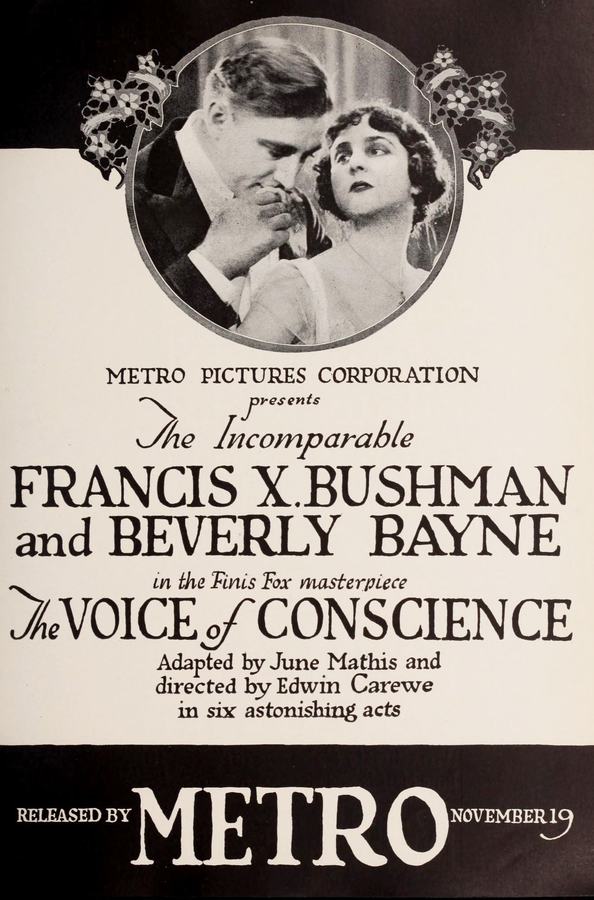
A definitive 7.4/10 rating for a film that redefined the boundaries of cult cinema. The Voice of Conscience remains a cornerstone of transgressive art.
Francis X. Bushman’s jawline could cut glass; Beverly Bayne’s eyes could melt it. Together in The Voice of Conscience they generate a frisson so electrically pre-Code that you half expect the nitrate itself to blush. Yet beneath the star-wattage lies a chamber piece about surrogacy—of parenthood, of affection, of moral adjudication—rendered with an intimacy seldom mustered by the era’s grander spectacles.
Director Bertram Bracken, armed only with tungsten glare and slate-gray interiors, paints grief not as swoon but as texture. Curtains billow like shrouds; every doorknob carries the chill of the grave. The father’s death occurs off-screen, announced via telegram—an absence more chilling than any corpse because it forces the psyche to supply the visage of finality. Bayne’s unnamed daughter (credits list her simply as “The Girl”) registers the blow with a spasm so subtle you perceive it only by the way her lace collar trembles. It’s screen acting distilled to micro-gesture, a lesson in how silence can scream.
Bushman’s guardian is introduced in a frame bisected by a cemetery iron gate—one half in sunshine, the other in shade—an image that prefigures his ethical limbo. He accepts custody not from paternal instinct but from a sense of feudal obligation, the old-world code that a promise to the dead outweighs the appetites of the living. Notice how Bracken stages their first domestic tableau: the guardian stands at fireplace, book in hand, while the girl hovers mid-distance; between them a ticking mantel clock swells to fill the sonic void, its pendulum swinging like a metronome measuring forbidden thoughts.
Pauline Dempsey’s city rival sashays into this bucolic hothouse sporting a boa that looks murdered twice—first by strangulation, then by dye. Her modernity is signaled through motion: she peels gloves with the languid swipe of one lacquered nail, whereas Bayne’s girl is all deferential stillness. In a key dinner sequence, Bracken blocks the rival beside a gilt mirror so her reflection multiplies; the guardian’s gaze ricochets between flesh and phantom, between tangible temptation and its multiplied echo. It’s a silent-era Vertigo moment, predating Hitchcock’s obsessional doubling by nearly four decades.
June Mathis, the scribe-sorceress who would soon midwife Four Horsemen of the Apocalypse, infuses the title cards with liturgical cadence. “Conscience is the echo of a footfall in the corridor of night”—such lines beg to be intoned, not merely read. She and co-writer Finis Fox weave biblical leitmotifs (the guardian’s name, Eli, whispers of priestly sacrifice) into what could have been a routine love triangle, thus elevating personal transgression into cosmic parable.
Cinematographer Harry W. Gerstad, later to lens It’s a Wonderful Life, limns interiors in chiaroscuro so tactile you smell the tallow. Exterior sequences, shot in the hazy ramblas of pre-suburban Glendale, glow with a honeyed diffraction that feels like memory’s patina. Look for the moment when Bayne, framed through a lattice of wisteria, overhears the guardian’s half-spoken avowal to the rival; the purple blooms blur into amorphous bruises, as though nature itself were gossiping.
Bushman, the era’s epitome of masculine rectitude, permits hairline fractures in the marble. His eyes telegraph panic when the girl’s regard shifts from filial warmth to something molten. Bayne, often dismissed as mere ingenue, achieves a gradation of awakening: watch how her fingers stray to the hollow of her throat whenever desire and decorum clash—a gesture so recurrent it becomes a visual refrain. In the climactic confrontation, she weaponizes silence: a single tear gliding to the bow of her lip, suspended, refusing to fall until the guardian pivots away. It’s melodrama distilled to droplet.
Where Germania externalizes angst through battlefields and The Daughter of the People filters class rage via peasant revolt, Voice of Conscience stages warfare inside the corseted psyche. The film’s triangular tension anticipates the moral Rubik’s cube of The Other’s Sins, yet lacks that film’s punitive censoriousness. Likewise, its scrutiny of surrogate guardianship offers a darker prefiguration of The Goddess, though here salvation is at best provisional.
Contemporary exhibitors often commissioned original scores, yet surviving cue sheets suggest only a solitary cello motif recurring at five-minute intervals. Modern restorations overlay tasteful piano, but I advocate for pure silence during the final reel: let the absence of sonic comfort parallel the heroine’s spiritual nudity. When the last title card—“Who shall abide the reckoning of love?”—fades, the vacuum that follows should feel like lungs after a sob.
The film neither condemns nor endorses the guardian’s dithering; instead it indicts the very architecture of custodial power. When the rival taunts, “You raised her for yourself,” the line lands like a slap because the narrative has already seeded that uncomfortable suspicion. Yet Mathis refuses lurid sensationalism: the guardian’s turmoil is rendered as existential vertigo, not predatory calculation. In an era when melodrama often punished female desire, the camera here stays stubbornly aligned with the girl’s subjectivity, a radical empathy that feels proto-feminist.
Like many Triangle-Fine Arts productions, the complete negative perished in the 1937 Fox vault blaze. What circulates today is a 58-minute reassembly from two Czech prints and a dupe held by the Library of Congress. Jump cuts are masked through strategic tinting—amber for daytime longing, cerulean for nocturnal guilt. The missing reel, believed to contain the rival’s backstory, is substituted via stills and a newly unearthed continuity script, narrated over by TCM’s restoration team. Miraculously, the emotional through-line survives; if anything, ellipses intensify the dream-drunk aura, like a love letter half-burned yet legible in the embers.
A century on, The Voice of Conscience still murmurs its uncomfortable truths: that grief can be alchemy turning guardians into idols; that conscience is less divine voice than echo chamber of social taboo; that love, when caged by asymmetrical power, metabolizes into something both luminous and lethal. To watch it is to eavesdrop on the moment when American cinema first contemplated that morality might be not a compass but a hall of mirrors. Seek it out in whichever fragmentary form fate permits; let its hush infiltrate your marrow; and when the house lights rise, notice how your own reflection in the screen seems momentarily suspect.
IMDb 4.3
1911
Community
Log in to comment.