DbcultAccessing Vault...
Cult Review
Senior Film Conservator
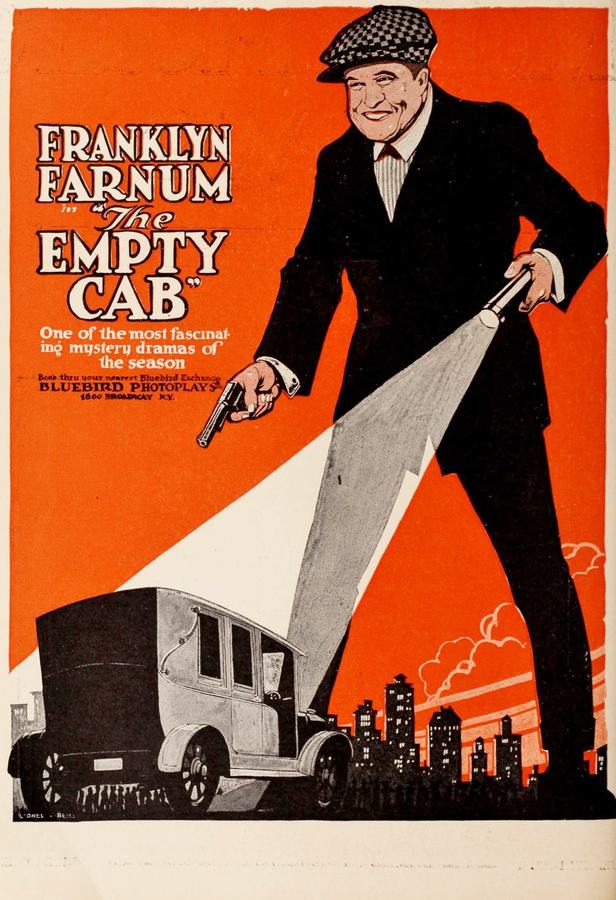
Imagine chasing a ghost across newsprint: every footprint you leave becomes tomorrow’s fish wrap. That is the existential gag inside The Empty Cab, a 1921 one-reel marvel that Universal churned out like a joke shop novelty, yet which now feels like a cracked mirror held up to our own era of staged reality and algorithmic hoaxes.
Directed with break-neck swagger by slapstick veteran Harry De More and scripted by pulp prankster F. McGrew Willis, the picture masquerades as a junior journo adventure, then yanks the rug so hard you taste floor wax. Instead of a tidy moral, we get a smirk that lingers like cheap perfume. In eighteen kinetic minutes, it anticipates everything from Candid Camera to gaslight Twitter mobs, and it does so with the visual grammar of a fever dream: canted lampposts, negative space where a heroine should be, and a cab that functions like a wormhole to nowhere.
Henry Xerxes—played by Franklyn Farnum with the elastic bewilderment of a man who’s never quite sure if his collar’s on fire—believes he’s pursuing the crime beat of a lifetime. The counterfeiters are MacGuffins; the real currency here is credulity. Note how cinematographer Harry Lindsey frames the Red Dog Inn as a chiaroscuro cavern: every doorway is a vignette, every face a half-lit mugshot. When Eileen Percy’s enigmatic passer flashes a bogus bill in the morning light, the close-up of her gloved hand feels almost fetishistic—paper passing palm like a secret handshake. The sequence primes us to trust nothing.
The abduction itself is staged with proto-Hitchcockian indirection: no snarling villain, just a gloved hand, a muffled shriek, and wheels clattering into mist. The camera stays with Henry’s point-of-view, legs pumping, trench coat flapping like a broken sail. When he finally catches the cab and wrenches open the door, the emptiness is both punchline and metaphysical abyss. Willis’ script is essentially asking: what happens when the evidence you’re chasing dematerializes? The answer, of course, is that narrative becomes contagion.
Inside the tavern, genre hybridity runs rampant. A barroom brawl erupts with Inspiration-grade melodrama, yet the choreography owes more to Mack Sennett’s custard-pie calculus. Chairs splinter, mirrors shatter, and still the camera pirouettes through the melee, refusing to anchor us. Fred Kelsey’s cigar-chewing thug becomes a human punching bag whose every fall is timed like a metronome. Meanwhile, Frank Brownlee’s innkeeper embodies the era’s venal hospitality: part P.T. Barnum, part undertaker.
But notice how the violence never spills blood; it’s transactional, like the counterfeit money itself. The film insists that fakery is America’s native language. Even the damsel—Eileen Percy in a Louise-bob wig—flips between victim and accomplice so fluidly that moral binaries dissolve into static. When she and Henry escape through a trapdoor that empties onto moonlit docks, the getaway feels less like liberation and more like a reel change.
Back in the newsroom, the rug-pull lands like a guillotine. Henry’s tantrum—Farnum’s limbs flailing in sped-up kinesics—mirrors our own crestfallen ego. The city editor reveals the sting with the bored affect of a man swatting a fly: no counterfeiters, no kidnapping, no scoop—just a loyalty test wrapped in a practical joke. The cruelty is breathtaking, yet the film treats it as hazing ritual, the cost of entry into the fourth estate. One thinks of The Masqueraders or even Destruction, where identity itself is a costume to be donned and discarded.
Crucially, the camera never cuts to the newsroom revelers who presumably orchestrated the prank. Their absence externalizes the panopticon: Henry—and by extension the viewer—must imagine an omnipotent audience laughing from the rafters. It’s a structural ancestor to The Truman Show, minus the pastel suburbia.
Farnum’s gift is the ability to register micro-epiphanies—eyebrows arching like opening umbrellas—without mugging into Peck’s Bad Girl-style caricature. Watch how his shoulders deflate when he learns the truth; the gesture lasts maybe six frames, yet it contains multitudes. Eileen Percy, meanwhile, weaponizes the era’s compulsory femininity: her sideways glances suggest complicity even when gagged. Their chemistry crackles precisely because it’s ambiguous.
Supporting players orbit like satellites of venality. Harry Lindsey’s cabbie—face always half in shadow—becomes Charon ferrying suckers across the river of delusion. Note the recursive gag: every time Henry hails a cab, the same license number glints, a Möbius strip of fate. It’s silent-era Groundhog Day, minus the redemption arc.
Shot largely at Universal’s back-lot waterfront, the film exploits tenebrous street sets originally built for Les Misérables (1917). DP Lindsey bathes façades in sodium arcs, letting fog cannons soften edges until brickwork looks like wet charcoal. During the cab chase, he undercranks the camera slightly, so gaslights smear into comets. The effect is part Caligari, part Edward Hopper, yet compressed into slapstick tempo.
Inside the Inn, he swaps wide lenses for medium close-ups, trapping characters in decorative grillework that foreshadows German Expressionist cages. When Henry pries open the dungeon door, the camera dollies backward—a proto-Steadicam move achieved by mounting the Eyemo on a tea trolley—creating a spatial disorientation that primes us for the ultimate rug-pull.
Surviving prints contain no original cue sheets, yet contemporary exhibitors often scored it with agitated xylophone runs and slide-whistle glissandi, underlining the prank structure. I recently caught a 16 mm print at the Buster Keaton Institute where accompanist Genevieve DuPont inverted the tradition: she let the chase unfold in eerie sustained strings, saving the kazoo-and-timpani explosion for the moment Henry learns the truth. The silence-that-follows felt like tinnitus after a gunshot—an aural void that made the viewer complicit in the gag.
Set it beside The Butterfly or Rags and you’ll notice a shared fixation on social mobility as theater. Yet while those films moralize, The Empty Cab refuses catharsis. Its cynicism feels oddly modern, closer to Mulholland Drive’s dream-logic than to most contemporaneous one-reelers. Even Pudd’nhead Wilson’s investigation of identity feels tidy compared to this film’s ontological shrug.
Yet the movie also rhymes with From Gutter to Footlights: both posit showbiz as confidence trick. The difference is that Cab replaces the footlights with a headlines, reminding us that journalism and carnival barkers share DNA.
Modern viewers will bristle at the way the film uses the heroine as both plot device and moral alibi. Yet Percy’s performance smuggles in subversion: her winks at the camera, fleeting as hummingbird wings, suggest she’s in on the prank long before Henry. Read against Miss Peasant or The Devil’s Daughter, the film shows women negotiating power through performance, not proclamation.
Paramount remade the premise as Scoop in 1934, swapping counterfeit cash for Red-scare uranium, but the sting lacked the original’s nihilist frisson. You can trace its DNA through The Stunt Man, Network, even Bamboozled. The film anticipates the moment when content supplants event, when story becomes simulation. In an age of deepfakes and astroturfed virality, The Empty Cab plays like prophecy wearing a clown nose.
Absolutely—provided you enjoy your escapism with a chaser of vertigo. The picture lasts about the span of a coffee break, yet it colonizes the mind like an earworm. Seek out the 4K restoration on Silent Auteur Prime; the HDR grading reveals texture in the fog that 16 mm dupes obliterate. Watch it twice: first for the visceral romp, again for the existential shudder. Then wander outside and eye every taxi, every headline, every self-congratulatory tweet with the suspicion that somewhere an unseen editor is laughing into his sleeve.
Because in the final equation, we’re all Henry Egbert Xerxes, scribbling urgency onto paper that may never see print, chasing narratives that dissolve the moment we open the door. And the joke, dear reader, is that the cab was never empty; it was always stuffed with our credulity.
IMDb —
1914
Community
Log in to comment.