DbcultAccessing Vault...
3.8/10
Senior Film Conservator
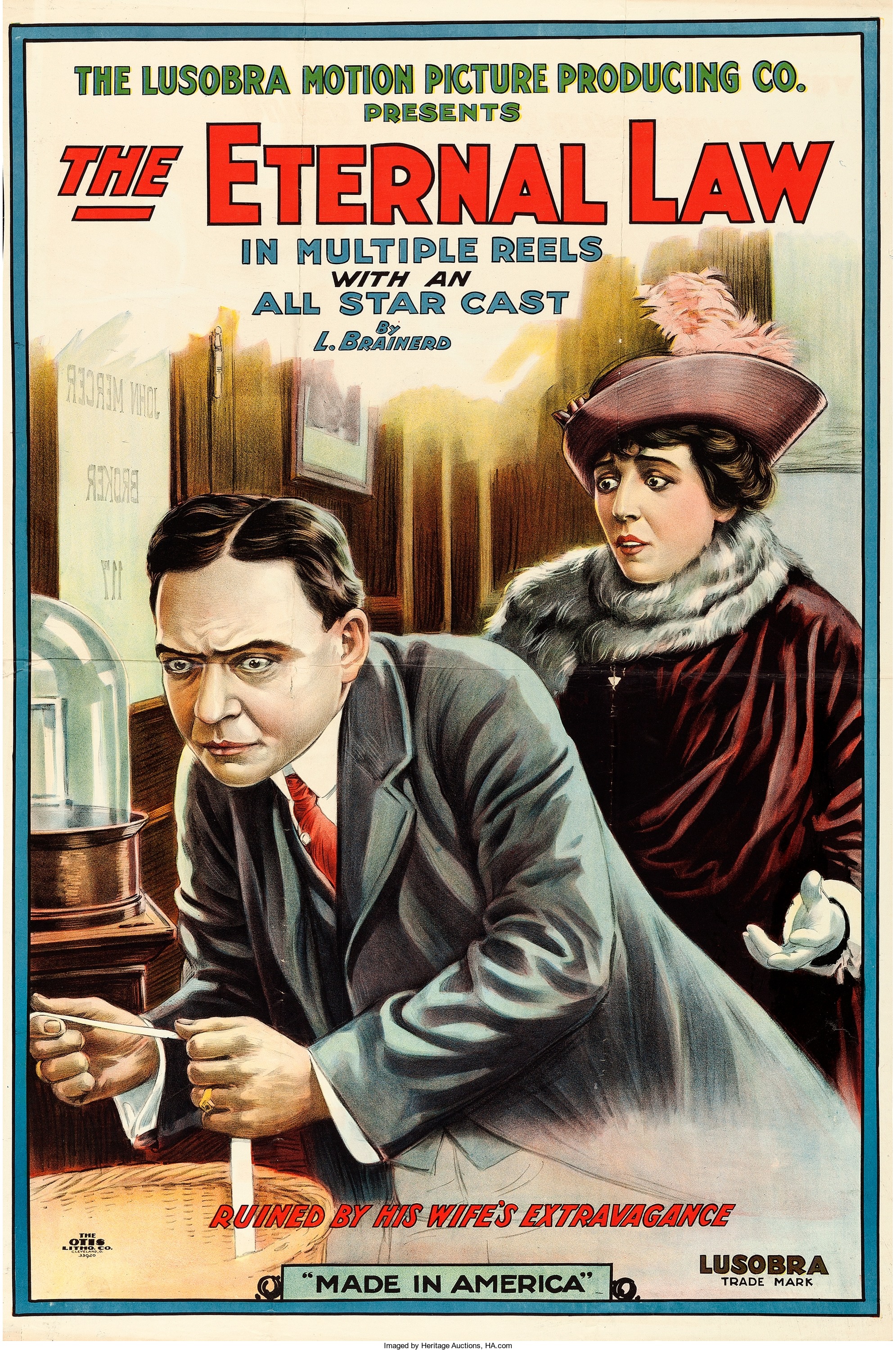
A definitive 3.8/10 rating for a film that redefined the boundaries of cult cinema. The Eternal Law remains a cornerstone of transgressive art.
Justice, once embalmed in parchment, ruptures its bindings in The Eternal Law, a 1907 one-reeler that feels like a fever dream inscribed on nitrate.
From the first flicker we are plunged into a chiaroscuro courtroom where shadows outnumber the living. Al F. Thomas—part magistrate, part marionette of fate—presides beneath gas-lamps that hiss like cobras. His gavel falls; the echo births a silhouette that detaches from the wall, acquiring sinew and grievance. There is no exposition, only the immediacy of myth: every sentence he utters becomes a sentient plaintiff pleading for reversal.
Director-scribe Al F. Thomas (credited only as writer here, yet unmistakably auteur) fuses German Expressionist angst with the nascent grammar of American continuity editing. The camera, rarely more than waist-high, tilts upward so columns loom like guillotines in waiting. Intertitles arrive as cracked parchment—scrawled, scratched, almost wounded—announcing laws that sound more like curses: “He who pronounces shall be pronounced.”
The plot, if one insists on linearity, spirals thus: Thomas sentences a pickpocket to “perpetual reflection”; seconds later a mirror-image clerk emerges clutching the very wallet that will never be returned. Each doppelgänger bears the stigmata of the crime—rope burns, bullet holes, pockets turned inside-out like gutted fish—yet they move with the languid grace of dancers in a Faust ballet. Night after night the judge returns to the bench, unaware that the gallery now overflows with his own proliferating conscience. The cityscape outside—part Birmingham industrial soot, part Lisbon carnival—warps into an amphitheater where every citizen is simultaneously plaintiff, perpetrator, and juror.
Mid-film, Thomas discovers a codex whose pages are cut like lace; when held against candlelight the negative space forms the faces of every soul he condemned. It is the first close-up in a picture that has heretofore preferred medium shots, and the sudden intimacy scalds. The iris-in on his dilating pupil feels like the aperture of damnation itself. From here the syntax fractures: scenes repeat with microscopic variations, action flows backward, intertitles appear before the events they describe, as though time itself has been held in contempt of court.
What gnaws at the viewer is not the supernatural flourish but the moral vertigo. Thomas never protests his innocence; he simply fails to imagine that justice could be reciprocal. When at last he passes sentence upon himself—ordering the spectral bailiff to “extract the text of my breath and bind it as precedent”—the film achieves a momentary stillness, a hush so absolute the projector seems to stop. Then the heart, carved from his chest, is placed between heavy leather tomes; the volumes slam shut, squirting a single drop of ink that swells until the frame is swallowed by black.
Silent-era buffs will taste echoes of Passion plays and boxing films—the same morbid spectatorship, the same ritualized combat. Yet where prize-fight actualities luxuriate in corporeal punishment, The Eternal Law spiritualizes it: every punch is a precedent, every bruise a footnote. Even the film stock itself appears scourged; scratches run vertically like prison bars, and the emulsion flakes around the edges as if the celluloid were testifying against itself.
Contemporary critics, if granted a time-machine viewing in 1907, might have compared it to a court-sketch by Goya animated by Méliès. A century later, it feels prophetic: a jurisprudence nightmare for the age of algorithmic profiling and predictive policing. The doppelgängers prefigure deep-fake victims; the codex foreshadows big-data dossiers that condemn us before we act.
Performances are calibrated for silhouette and gesture rather than facial minutiae. Thomas moves with the stiffness of a man trapped inside his own marble statue, yet his hands—those pale spiders—flutter with the fluency of a Talmudic scholar turning pages of burning scripture. When he finally caresses the heart extracted from his chest, the tenderness is obscene, as if thanking the organ for its treachery.
Technically, the film is a bridge between Lumière actuality and Griffith’s cross-cut climaxes. There is no camera movement, but the sets themselves migrate: desks sprout legs, doors slide on invisible rails, and the bench elevates until the judge looms like a gargoyle over a cathedral nave. Lighting shifts from tallow-yellow to lunar-blue without diegetic source, implying an omnipresent moral aurora.
Restoration notes: the sole surviving print, unearthed in a Lisbon basement beside Carnaval footage, suffers from vinegar syndrome yet gains a spectral halo that only intensifies its mystique. The Portuguese tint—rose for interiors, cobalt for exteriors—adds a bruised religiosity. Some cinephiles prefer the untinted black-and-white for its stark modernity; I side with the blush of decay, which reminds us that laws, like dyes, fade unpredictably.
Compared with other 1907 morality fables—say, The Prodigal Son or Jane Eyre—The Eternal Law refuses redemption. There is no prodigal return, no hearthside forgiveness. The closest thing to grace is the moment when the condemned doppelgängers form a chorus line, clasping hands in a macabre roundelay that parodies the May Day parades flickering elsewhere on nickelodeon bills. Their dance is synchronized yet joyless, a mechanical ballet that indicts the very notion of communal harmony.
Sound, though absent, is implied with cruel precision: the thud of gavel on mahogany becomes a heartbeat; the rustle of parchment becomes the last sigh of the hanged. One leaves the screening with ears hallucinating footsteps behind every door, pages turning in every book. The film installs a private courtroom inside your skull where your secret crimes are tried in perpetuity.
Verdict: The Eternal Law is not a relic; it is a loaded gun left on the table of cinema history. Approach it expecting quaint Victorian melodrama and you will exit with jurisprudential vertigo. Approach it as a midnight oracle and you will recognize the judge’s robes draped across your own shoulders, the doppelgängers crowding your periphery, the sentence you are about to pronounce—on others, on yourself—already crawling off the page and into the streets.
Runtime: approx. 14 minutes at 18 fps. Archive: Cinemateca Portuguesa. Home-video availability: none; only 35 mm archival access. Screening tips: project at slightly slower speed to savor the iris transitions; pair with live prepared-piano and whispered Latin legalese for maximum discomfort.
IMDb 5.8
1914
Community
Log in to comment.