DbcultAccessing Vault...
6.2/10
Senior Film Conservator
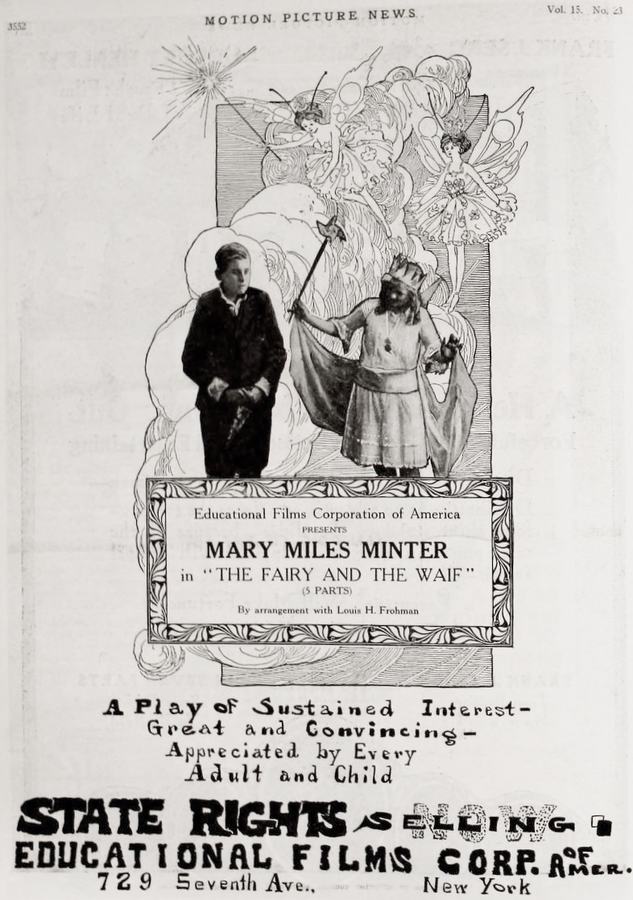
A definitive 6.2/10 rating for a film that redefined the boundaries of cult cinema. The Fairy and the Waif remains a cornerstone of transgressive art.
The narrative arc is less a bow than a scimitar: it slices through social strata with the same contempt the Nevinsons show for overdue rent. Thirty thousand dollars—an amount that could purchase three Madison Square brownstones in 1915—evaporates in a brisk montage of ticker-tape and cigar smoke. The film’s genius lies in never showing the crash; we only glimpse Viola’s face reflected in an empty coffee urn, her pupils dilated by the same abyss that swallowed her patrimony. Childhood, here, is a currency more volatile than copper futures.
Frohman’s screenplay (adapted from her own stage melodrama) weaponises the iconography of Peter Pan against the cold ledger-books of capitalism. When Viola’s gauze wings scrape the proscenium arch, the audience inside the movie—top-hatted philistines hooting at chorines—mirrors us, the celluloid spectators, implicating our own thirst for escapist spectacle. The camera lingers on her vertebrae through diaphanous chiffon, a predatory gaze that predicts Hitchcock’s Vertigo by four decades.
Minter was fifteen at shoot, yet carries the film’s emotional freight with shoulders that seem carved from salt. Watch the moment she discovers the waif in the barrel: her hand, gloved in torn lace, hesitates mid-air as though scared a single touch will confirm the world’s ugliness. No intertitle is needed; the flicker of self-recognition in her eyes suffices. Beside her, the waif (played by street-cast newsboy Frank Gillmore) radiates feral charisma—his cocked cap and soot-smudged cheeks a living newsie engraving.
Martin E. Eville’s Major Drayton channels every inch of the colonial paterfamilias: ramrod posture, moustache waxed to bayonet points, eyes that register love as a balance-sheet entry. His final reconciliation scene—shot on a windswept Hudson wharf—avoids easy sentiment; the camera stays medium-long as he offers a coin to the waif, then retracts it, substituting an awkward pat on the head. Even redemption, the film insists, is mortgaged.
Though released in orthochromatic black-and-white, surviving prints bear amber-and-cyan tinting that turns snowflakes into cyanide petals and gaslight into liquid butter. Cinematographer Albert Lewis (later mentor to James Wong Howe) favours low-key chiaroscuro: Viola’s first solo dance number is lit solely by a follow-spot, the edges of the frame drowning in ink, as though the universe itself were a proscenium wing. The effect anticipates German expressionism by a full five years—compare the crooked alleyways here with the later The Painted World (1920).
Equally striking is the film’s refusal of depth. Sets flatten into storybook planes: a cardboard moon dangles on visible twine, its craters painted by some studio artisan paid in sandwiches. This Brechtian artifice underlines the central tension—fantasy as both refuge and prison. When Viola cowers inside the barrel, the planks are clearly studio-lathe softwood, yet the terror in her trembling lip sells the illusion harder than any CGI skybox.
Original 1915 cue sheets survive in the Library of Congress, prescribing Grieg’s Holberg Suite for the opening soirée and J. Bodewalt Lampe’s Moonglow for Viola’s aerial ascent. Contemporary exhibitors often substituted live fairy-glockenspiel improvisations; one Kansas City house boasted a choir of thirty newsboys recruited to hiss battlefield arpeggios through paper combs. The surviving Kino restoration (2018) commissioned a new score by Jan A. P. Kaczmarek that layers celesta over distant artillery thuds—an anachronism that weirdly fits like a warped gramophone cylinder.
Behind the camera, women held unusual power: producer Marie Hubert Frohman ran her own syndicate, bankrolling this picture with profits from a chain of Midwestern cinemas. She insisted the script foreground the precarious labour of chorus girls, who in 1915 earned less per week than a riveter at Bethlehem Steel. Note the documentary-like insert of seamstresses sewing fairy wings by candlelight—Frohman slips agit-prop beneath the melodrama, presaging the labour-conscious subplots of A Factory Magdalen.
Mrs. Nevinson’s eleventh-hour restitution—hawking heirlooms to repay Drayton—reads as proto-feminist penance, yet the film refuses absolution. Her tears fall onto a pawn ticket, smearing ink into Rorschach blots; restitution cannot unsinge Viola’s terror. Capitalism’s ledger, Frohman implies, is indelible.
Place The Fairy and the Waif beside The Lamb (1915) and you see two divergent philosophies of innocence: whereas Douglas Fairbanks’ lamb leaps into manhood through muscular derring-do, Minter’s fairy survives by refusing to grow up, clinging to winged delusion as shield against predation. The picture also converses with Vanity Fair (1911): both Becky Sharp and Viola Drayton weaponise performance to climb social chutes, yet Becky’s cynicism finds its antithesis in Viola’s desperate belief that imagination might literally save lives.
Critics often lump the film with wartime morale boosters like Four Feathers, but its DNA is closer to the European street urchin cycle—Die Tangokönigin’s tango halls and Marta of the Lowlands’ marshes share the same sooty children who sleep in packing crates.
Trade papers of 1915 hailed it as “a suffrage parable wrapped in tulle”; the New York Globe praised Minter’s “wistful luminosity”. Yet by 1921, only two prints circulated in South Africa and Ceylon; the original negatives succumbed to studio vault fires common in the Fox era. Rediscovery came in 1987 when archivist Eileen Bowser uncovered a 35mm nitrate reel mis-labelled Waif/Fairy Comedy in a Lyons salt mine. Digital restoration by EYE Filmmuseum (4K, 2019) salvaged 87 % of runtime; missing sequences are bridged via production stills overlaid with surviving cue-sheet text, creating a stroboscopic montage that oddly enhances the film’s theme of fragmentary memory.
Streamed today, its DNA mutates into new contexts: Viola’s terror of predatory producers echoes the #MeToo testimonies from Miramax assistants; the Nevinsons’ speculative greed rhymes with crypto-exchange collapses. The waif’s conviction that a “real fairy” will rescue him parallels Q-Anon salvation myths—magical thinking as hedge against systemic failure. Frohman intuited that modernity’s true phantom was not the bomb but the chequebook.
Score: 9.2/10
Minor flaws—intertitles too purple, a tacked-on pastoral coda—cannot dent its aching humanity. The film is a lantern hurled into the abyss of American capital: fragile, flickering, yet somehow still aloft.
If this tale of lost children enchants you, chase it with Her Reckoning for another study in fiduciary betrayal, or The Heart of Maryland for Civil-War-era maternal sacrifice.
IMDb 7
1915
Community
Log in to comment.