DbcultAccessing Vault...
Cult Review
Senior Film Conservator
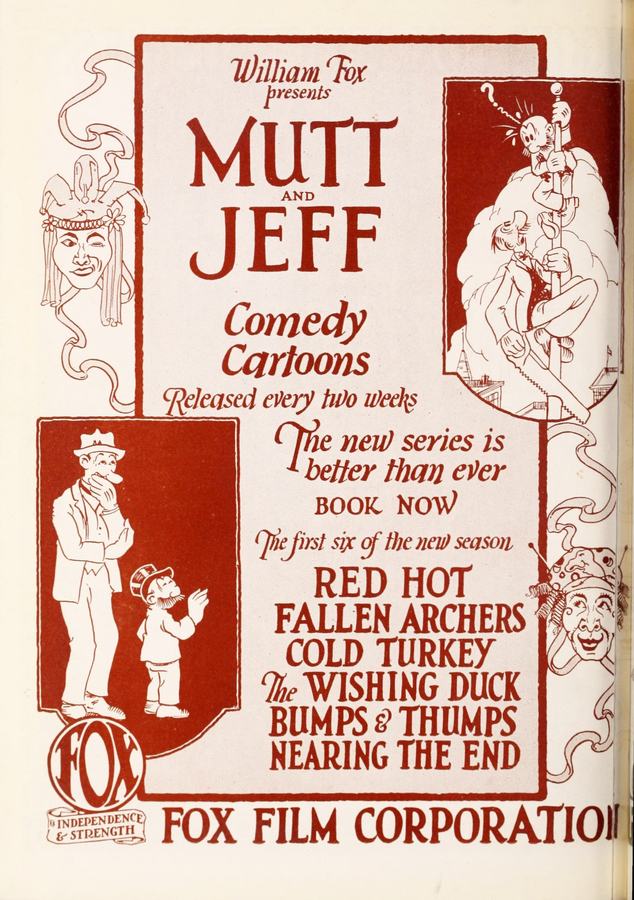
In the burgeoning landscape of early American animation, few figures loom as large or as litigious as Bud Fisher. With The Fallen Archers, Fisher takes his iconic duo, Mutt and Jeff, out of the daily funny pages and thrusts them into a reimagining of the William Tell legend that is as irreverent as it is technically fascinating for its era. While contemporary live-action dramas like The Price were exploring the somber depths of human morality, Fisher was busy proving that a well-placed arrow in a pig's backside could garner just as much cultural resonance, albeit of a decidedly more raucous variety.
The brilliance of this short lies not in its adherence to the source material, but in its exuberant dismissal of it. The 1919 cinematic milieu was one of transition. We see this in the contrast between the slapstick kineticism of animation and the burgeoning psychological complexity found in films such as Wee Lady Betty. Where live-action sought to ground the viewer in a recognizable reality, The Fallen Archers revels in the elasticity of the drawn line. The characters' movements are jagged, rhythmic, and inherently musical, even in the silence of the medium.
To appreciate The Fallen Archers, one must understand the Herculean labor of the Raoul Barré studio, which handled the heavy lifting of Fisher’s animated output. The 'slash system' of animation was in full swing here, allowing for a efficiency that rivals the industrial output of contemporary features like High Speed. This technique, while primitive by today’s standards, allowed for a fluidity of background and character interaction that was revolutionary. When Mutt draws his bow, the tension isn't just in the narrative—it's in the very ink on the cel.
The visual language of the film is stark. The high-contrast black and white palette provides a clarity of action that is often lost in the more experimental European works of the time, such as Serdtse dyavola. Fisher’s characters are defined by their silhouettes—Mutt’s elongated, spindly frame and Jeff’s diminutive, stout stature. This dichotomy is the engine of their comedy. In the context of 1919, where films like The Great Romance were pushing for epic scope, Fisher found power in the minutiae of a failed archery attempt.
The narrative pivot involving the pig is a stroke of low-brow genius. It subverts the expectation of heroic resolution—a theme often played straight in films like Hope. By shifting the target from the symbolic apple to the literal livestock, Fisher highlights the fallibility of his protagonists. Mutt and Jeff are not heroes; they are survivors of their own incompetence. This resonates with the audience because it mirrors the chaotic uncertainty of the post-war era, a sentiment explored through a different lens in The Clarion.
There is an inherent cruelty to early animation that we often overlook. The pig’s misfortune is played for laughs, a vestige of the vaudeville tradition that birthed these characters. Compare this to the more pastoral, sentimental depictions of nature in Heart o' the Hills, and you see the divergence in how early cinema treated the 'innocent.' In Fisher's world, everything is a prop for the gag. This unsentimental approach is what makes the Mutt and Jeff shorts feel surprisingly modern, even when compared to the melodrama of Maria.
As we look back at The Fallen Archers, we must acknowledge its place in the lineage of the animated short. It lacks the polish of later Disney or Warner Bros. efforts, but it possesses a raw, unbridled energy. It shares a certain 'quick-fire' DNA with shorts like Just a Minute!, where the pacing is dictated by the punchline rather than the plot. While feature-length films like The Gypsy Trail were exploring nomadic romance, Fisher was refining the grammar of the 'take' and the 'double-take.'
The film also serves as a fascinating counterpoint to the racial and social tensions explored in The Green-Eyed Monster. While live-action was beginning to grapple with the complexities of the human condition, animation remained a safe harbor for pure, unadulterated absurdity. Yet, even within this absurdity, there is a reflection of the era's fascination with travel and spectacle, much like the documentary-style allure of The Alaska Cruise. Mutt and Jeff's world is one of constant movement and occasional violence, a microcosm of a world in flux.
One cannot ignore the international context. While American audiences were laughing at Fisher's archers, Swedish cinema was producing works like Stormfågeln, which utilized the environment as a character in its own right. In The Fallen Archers, the environment is merely a stage, a flat plane upon which the characters perform their quixotic rituals. This stylistic choice emphasizes the 'cartoonishness' of the endeavor, a self-aware acknowledgement of its own artifice that predates postmodernism by decades. Even the Italian adventure Le ultime avventure di Galaor feels more grounded in traditional storytelling than the anarchic spirit found here.
The enduring appeal of The Fallen Archers is found in its simplicity. It doesn't require a deep understanding of Swiss history to appreciate the comedic timing of a missed shot. It is a testament to Bud Fisher’s understanding of his audience. He knew that Mutt and Jeff were more than just characters; they were archetypes of the human struggle against gravity and logic. In an era of grand cinematic statements, this short remains a refreshing reminder of the power of a simple, well-executed joke.
As a critic, I find myself drawn back to the sheer audacity of the animation. There is a grit to the lines, a flicker to the frame that reminds us of the medium's tactile origins. It isn't 'clean' in the way modern digital animation is, and that is its greatest strength. It feels alive, breathing with the effort of the artists who sat at lightboxes nearly a century ago. When we watch Mutt fail his archery test, we aren't just watching a character; we are watching the birth of a visual language that would eventually conquer the world. The Fallen Archers is not just a cartoon; it is a historical document of joy, a celluloid artifact that captures the moment when the world decided that sometimes, the arrow should miss the apple and hit the pig instead.
IMDb —
1918
Community
Log in to comment.