DbcultAccessing Vault...
Cult Review
Senior Film Conservator
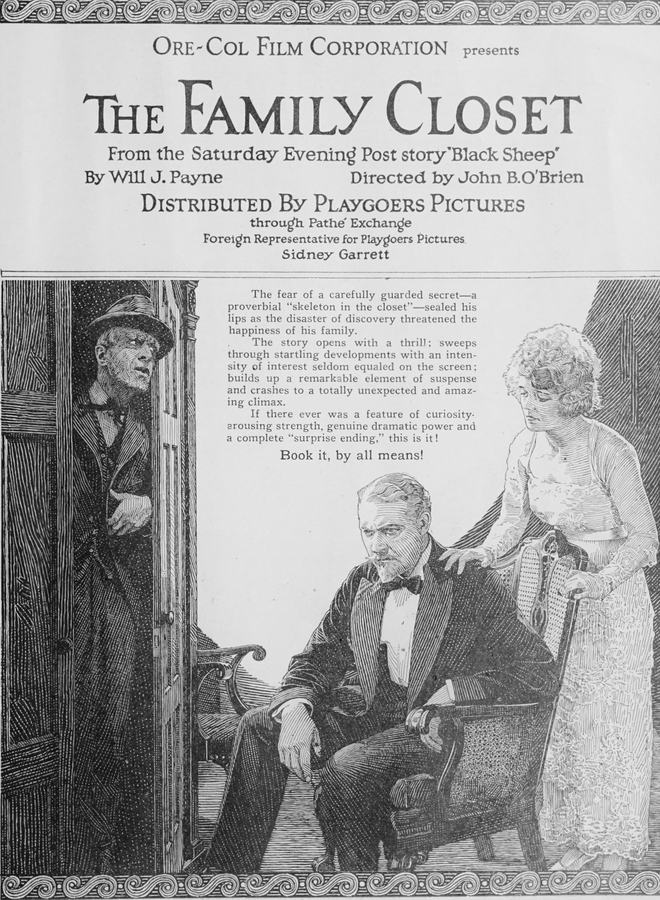
Alfred Dinsmore’s libel lawsuit against *The Leader* is not merely a legal dispute but a collision of egos, ideals, and buried sins. From its opening frames, *The Family Closet* (1934) establishes itself as a taut, cerebral drama that navigates the treacherous waters of political rivalry and human frailty. The film’s premise—a man’s refusal to retreat from a defamation case—unfolds with the precision of a chess match, each move calculated, each countermove revealing layers of vulnerability beneath the characters’ polished exteriors.
At the heart of the narrative is the enigmatic Charles Purcell, the editor of *The Leader*, whose recruitment of McMurty as a private investigator sets the plot in motion. McMurty, played with a blend of sly charm and moral ambiguity by Kempton Greene, becomes the audience’s surrogate in a world where truth is a commodity. His investigation hinges on a single, incendiary detail: a scar on the chin of a man resembling Dinsmore, a scar that links him to the infamous Tom Wilson, a bank robber long presumed dead. This revelation, though initially a weapon for blackmail, ultimately becomes a mirror for the characters’ own hypocrisies and fears.
What distinguishes *The Family Closet* from its contemporaries in the political thriller genre is its unflinching examination of identity. Dinsmore’s beard, a literal and metaphorical mask, symbolizes the ease with which individuals can obscure their pasts—and the inevitability of truth’s resurgence. The film’s climax, in which Dinsmore removes the beard to reveal his clean-shaven, innocent face, is a masterstroke of visual storytelling. It is not a confession but a catharsis, a moment where the weight of guilt or innocence is resolved through a physical act. This scene echoes the broader theme of the film: the precariousness of reputation in a society obsessed with appearances.
The dynamic between Dinsmore and Purcell is the film’s emotional core, a battle of wits and wills that evolves into reluctant mutual respect. May Kitson’s portrayal of Dinsmore’s wife adds a layer of quiet resilience, her character serving as both moral compass and emotional anchor. Walter Ware’s Purcell, meanwhile, embodies the complexities of leadership—his initial manipulation of McMurty giving way to genuine remorse. These performances are elevated by the script’s sharp dialogue, which crackles with the tension of a society on the brink of self-examination.
The film’s secondary narrative—the forbidden romance between the children of the antagonists—functions as a balm for the audience. Their union, initially met with resistance from their parents, becomes a testament to the possibility of reconciliation. This storyline evokes the classic trope of star-crossed lovers but subverts it by tying their fate to the resolution of the adults’ conflicts. It is a narrative device that avoids sentimentality, instead grounding the emotional payoff in the characters’ growth. The children’s defiance is not romanticized but framed as a necessary act of solidarity against the corrosive effects of parental rivalry.
Technically, *The Family Closet* is a triumph of its era. The cinematography, with its stark shadows and chiaroscuro contrasts, enhances the film’s mood of tension and moral uncertainty. Scenes set in the newspaper office are shot with a documentary-like realism, while the courtroom sequences employ tight close-ups that amplify the characters’ emotional stakes. The score, though understated, complements the film’s cerebral tone, its motifs recurring like leitmotifs in a symphony of doubt and resolution.
Comparisons to other works of the period are instructive. Like *One-Thing-at-a-Time O’Day* (1935), *The Family Closet* explores the intersection of personal and professional ethics, but where the former leans into slapstick, the latter maintains a somber, almost tragic tone. The blackmail subplot echoes the moral dilemmas of *Princess Romanoff* (1934), yet *The Family Closet* distinguishes itself by framing the deception as a catalyst for self-discovery rather than a means to an end. These parallels underscore the film’s place within a broader cinematic tradition of moral inquiry.
The performances, however, are what elevate *The Family Closet* from a competent period piece to a compelling study of human nature. Kempton Greene’s McMurty is a far cry from the one-dimensional detectives of the time; his character’s internal conflict—between loyalty to Purcell and his own ethical code—adds depth to what could have been a mere plot device. May Kitson’s portrayal of Dinsmore’s wife is particularly noteworthy, her restrained performance conveying volumes through glances and silences. These actors, though often overlooked in historical retrospectives, deliver work that resonates with the era’s social anxieties.
The film’s exploration of identity and power is perhaps most prescient in its treatment of the media. Charles Purcell’s manipulation of the press reflects the growing influence of journalism in shaping public opinion—a theme that remains relevant today. The libel suit serves as a microcosm for larger societal tensions, where truth is not merely discovered but constructed. This thematic layer, though not overtly stated, lingers in the background, giving the film an undercurrent of existential unease.
Visually, the film is a study in contrasts. The opulent settings of the Dinsmore estate—cluttered with books and antiques—stand in stark contrast to the stark, functional office space of *The Leader*. These spatial choices reinforce the characters’ ideological divide: Dinsmore, rooted in tradition and individualism, versus Purcell, a modernist driven by public perception. The use of mirrors and reflections is particularly effective in scenes where characters confront their own duality—most notably in the courtroom, where the judge’s stern gaze is mirrored in a glass pane, symbolizing the inescapability of judgment.
The resolution of the film—Dinsmore’s withdrawal of the suit and the tacit agreement between Purcell and Dinsmore—is not a victory but a truce. The children’s love, though celebrated, is presented as a fragile hope rather than a definitive solution. This ambiguity is the film’s greatest strength, refusing to offer easy answers in a world where morality is as malleable as the identities its characters so carefully construct.
In the context of 1930s cinema, *The Family Closet* is a product of its time yet transcends it through its nuanced characterization and thematic depth. It shares DNA with *The Shadow of a Doubt* (1943) in its exploration of moral ambiguity, though it lacks the latter’s psychological intensity. Its similarities to *La fiamma e la cenere* (1935) in structure are evident, but *The Family Closet* differentiates itself by grounding its drama in the public sphere rather than the private.
In conclusion, *The Family Closet* is a film that rewards patience. Its deliberate pacing and focus on dialogue over action may test the modern viewer, but for those willing to engage with its themes, it offers a rich tapestry of human experience. The film’s legacy lies in its ability to balance political intrigue with personal drama, creating a narrative that is as much about the machinery of power as it is about the fragility of identity. It is a testament to the era’s filmmakers that they could craft such a layered work within the constraints of the Hays Code, using subtext and symbolism to explore complex moral questions.
Ultimately, *The Family Closet* is not merely a period piece but a timeless meditation on the masks we wear and the truths we seek. Its enduring relevance lies in its refusal to simplify the human condition, instead presenting a world where choices are rarely clear-cut and redemption is a process, not an event. For cinephiles and historians alike, it remains a vital artifact of a cinematic era defined by its intellectual rigor and emotional nuance.
IMDb 4.8
1933
Community
Log in to comment.