DbcultAccessing Vault...
Cult Review
Senior Film Conservator
The Primordial Flicker
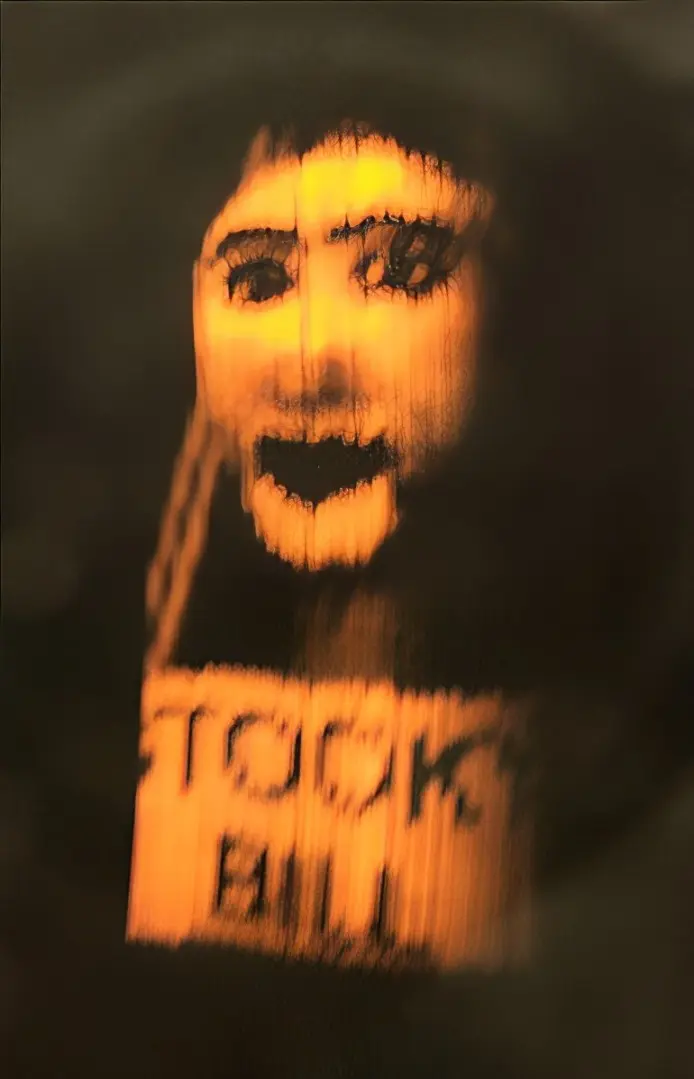
To scrutinize The First Television Picture with a Greyscale Image is to engage in a form of media archaeology that borders on the sacred. We are not merely observing a grainy loop of a ventriloquist’s dummy; we are witnessing the exact moment the 20th century truly began. While traditional cinema of the era, such as the atmospheric The Isle of the Dead, relied on the chemical alchemy of silver halide and the physical transport of film reels, John Logie Baird was experimenting with something far more ephemeral: the conversion of light into a stream of electrons. This 1925 experiment represents a radical departure from the narrative structures found in contemporary works like The Branded Woman. It is a work of pure, raw science that inadvertently created a new aesthetic of the uncanny.
The apparatus Baird employed—a sprawling, precarious assembly of bicycle lenses, darning needles, and sealing wax—seems almost laughably primitive by modern standards. Yet, the conceptual brilliance of the Nipkow disk scanning system is undeniable. By dissecting an image into thirty vertical lines, Baird achieved a halftone depth that transformed the silhouette into a portrait. In this flickering greyscale, we find a texture that feels more atavistic than the polished cinematography of Broadway Gold. There is a visceral struggle between the light and the darkness, a mechanical rasping for clarity that mirrors the human condition itself.
"The dummy’s face did not just appear; it materialized through a sieve of time and space, a haunting precursor to the digital saturation of the 21st century."
The choice of a ventriloquist’s dummy, affectionately known as Stooky Bill, was a pragmatic necessity born of the extreme heat generated by the thousand-candlepower lamps. A human subject would have suffered significant burns during the prolonged exposure required to calibrate the selenium cells. Consequently, the first 'star' of television was an inanimate object—a hollow-eyed marionette that occupies a space in the 'uncanny valley' far more effectively than any modern CGI. When we compare this to the human-centric dramas like The Runt or the explorations of Christopher Columbus, Baird’s achievement feels like a descent into a dreamscape where the inanimate is granted a flickering, electric life.
The transition from the dummy to the first human subject, William Edward Taynton, is a narrative of accidental heroism. Taynton, an office boy in the building, was essentially bribed into the spotlight. His initial failure to appear on screen—due to his backing away from the terrifying heat of the lights—highlights the physical toll of early innovation. Unlike the staged perils of Trapped by the London Sharks, Taynton’s ordeal was a genuine confrontation with a new kind of technological frontier. When his face finally registered on the receiver in the next room, it wasn't a performance; it was a biological transmission. The greyscale gradations captured the sweat, the squinting eyes, and the palpable discomfort, creating a realism that was, paradoxically, utterly phantasmagoric.
Consider the visual density of Green Eyes or the narrative complexity of Syndig Kærlighed. These films operated within a known visual language. Baird, however, was inventing a new alphabet. The 30-line image is a masterclass in minimalism; it forces the viewer’s brain to fill in the gaps, to bridge the interstices between the scanning lines. This cognitive engagement is far more demanding than the passive consumption of a high-budget feature like The Shuttle. It is a form of 'impressionist' engineering.
There is a profound philosophical shift occurring in this footage. For the first time, an image was not a static record (like a photograph) or a sequence of static records (like film), but a constant, fluid process of becoming. The greyscale image is never 'there' in its entirety; it is always being drawn and redrawn by the spinning disk. This mirrors the fluidity of human perception. While a film like A False Alarm might deal with the transience of events, Baird’s television makes the very act of seeing transient. The image is a ghost that requires a machine to keep it from vanishing back into the void.
The lexical diversity of this visual medium—if we can call it that—resides in the subtle variations of grey. In a world that was previously captured in stark blacks and whites, the introduction of tonal range allowed for a psychological depth. We see the contours of the jaw, the hollows of the eyes, and the subtle shifts in expression that define human identity. It is a far cry from the slapstick chaos of Loose Lions or the structured comedy of Sadhu Aur Shaitan. This is the human face rendered as a topographic map of light and shadow.
As we look back from an era of 8K resolution and ubiquitous streaming, it is easy to dismiss Baird’s greyscale image as a mere curiosity. However, that would be a grave error. This was the 'Big Bang' of our visual universe. Every pixel on your smartphone, every frame of every digital broadcast, owes its existence to the frantic spinning of that Nipkow disk in 1925. The experiment was a triumph of the individual spirit—Baird, the 'Runt' of the scientific community, outpaced the giants of industry through sheer, dogged persistence. His work lacks the polish of Seven Bald Pates, but it possesses an authenticity that no studio production could ever replicate.
The historical weight of this moment cannot be overstated. It is the bridge between the naturalist observations of In a Naturalist's Garden and the globalized, interconnected world of today. Baird didn't just build a box; he opened a window that would eventually look into every home on the planet. The greyscale image was the first light to pass through that window, a pale, flickering dawn that heralded a new epoch of human communication. Even if the subjects were 'married in name only' to the technology, as in the metaphorical sense of Married in Name Only, the union of man and machine was finally consummated in that Soho attic.
Ultimately, The First Television Picture with a Greyscale Image is a masterpiece of the accidental. It is beautiful not because of what it shows, but because of what it signifies. It is the visual equivalent of a first breath—ragged, desperate, and miraculous. The sea blue glow of our modern screens is merely a distant echo of the orange-tinted neon lamps that Baird used to illuminate the first faces of the television age. We are all inhabitants of the world he scanned into existence, line by flickering line. To watch this footage is to return to the source, to the primordial greyscale from which all our modern technicolor dreams have emerged. It is a haunting, beautiful, and profoundly human achievement that deserves its place at the very pinnacle of media history.
Reviewer's Note: The 1925 demonstration at Selfridges and the subsequent 1926 Royal Institution lecture remain the twin pillars of Baird's legacy. While the resolution was low, the impact was infinite. This is the genesis of the tele-visual age.
Community
Log in to comment.