DbcultAccessing Vault...
Cult Review
Senior Film Conservator
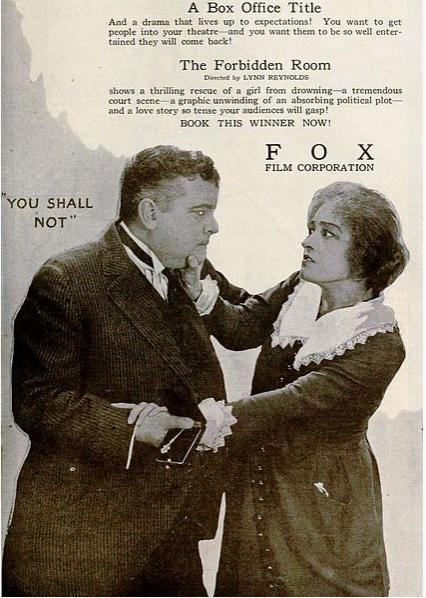
To understand the cinematic landscape of 1919 is to recognize a medium in the throes of a profound metamorphosis. The Forbidden Room, directed by the burgeoning W.S. Van Dyke, stands as a stark, monochromatic testament to the era's burgeoning obsession with the intersection of private morality and public office. While many contemporary features were content with the pastoral escapism of Betty and the Buccaneers, Van Dyke’s work here dives headlong into the murky waters of municipal rot and the precarious position of the working woman.
The film introduces us to Ruth, played with a searing, understated intensity by Gladys Brockwell. Ruth is not the ethereal damsel often found in the works of Griffith; she is a pragmatist. When her employer, the Chief of Police, mistakes her professional shorthand for a personal invitation, her exit is swift and decisive. This act of defiance sets the stage for a narrative that is as much about the reclamation of agency as it is about the courtroom drama that ensues. By placing Ruth in the office of Anthony Curtis (Robert Dunbar), the District Attorney, Van Dyke creates a friction point that exposes the systemic fractures within the city's power structure.
Gladys Brockwell, often heralded as the "Woman of a Thousand Faces," delivers a performance that anchors the film’s moral weight. In an age where acting was often characterized by grandiloquent gestures and exaggerated pantomime, Brockwell utilizes a vocabulary of micro-expressions. Her eyes, frequently caught in tight close-ups, convey a profound sense of the claustrophobia inherent in her social position. Unlike the theatricality seen in Mistress Nell, Brockwell’s Ruth is a study in restrained fire.
Her chemistry with Robert Dunbar is built on a foundation of mutual professional respect—a rarity for the cinema of the late 1910s. Dunbar’s Curtis is a man of the law, but he is not a caricature of virtue. He is weary, his shoulders seemingly burdened by the litigious battles he wages against a police force that views him as a traitor to their fraternity. This tension is palpable, mirroring the real-world anxieties of a post-war America grappling with the Prohibition era's impending shadow and the corruption it would inevitably breed.
Long before he earned the moniker "One-Take Woody" at MGM, W.S. Van Dyke was refining a visual shorthand that prioritized narrative momentum over stylistic indulgence. In The Forbidden Room, the camera work is remarkably fluid for 1919. The use of shadows within the eponymous room creates a chiaroscuro effect that rivals the expressionistic leanings of Das verwunschene Schloß. The room itself becomes a character—a repository for the secrets that the city's elite would rather keep interred.
The pacing is relentless. Van Dyke eschews the languid transitions common in films like Love Never Dies, opting instead for a rhythmic editing style that heightens the sense of impending peril. Every cut serves to tighten the noose around Ruth and Curtis as the police department’s vendetta transitions from professional obstruction to physical threat. The film’s climax, a masterclass in silent tension, relies not on title cards to explain the stakes, but on the spatial relationship between the characters within the frame.
One cannot discuss The Forbidden Room without addressing its surprisingly modern critique of law enforcement. The film posits that the badge can often serve as a shield for the basest of human impulses. J. Barney Sherry, as the Chief of Police, embodies a specific type of bureaucratic machismo. He views the law not as a set of rules to be followed, but as a tool to be wielded. His resentment toward the District Attorney is not ideological; it is personal. Curtis represents a check on his absolute power, and Ruth represents the one thing he could not possess.
This thematic core resonates with other contemporary works that examined the darker side of the American dream, such as A Wall Street Tragedy. However, while that film focused on economic ruin, The Forbidden Room focuses on the ruin of the soul. The "forbidden" nature of the room is not just about the physical space, but about the moral lines that, once crossed, cannot be uncrossed. It is a precursor to the noir sensibilities that would dominate cinema decades later.
When placed alongside Spotlight Sadie, which explores the performative nature of female identity, The Forbidden Room feels significantly more grounded in the harsh realities of the workforce. Ruth’s struggle isn't about finding fame or fortune; it’s about finding a workplace where her dignity isn't a commodity. Similarly, while Fighting Blood utilizes physical conflict to resolve its narrative arcs, Van Dyke’s film relies on the psychological toll of systemic pressure.
The film also shares a certain gravitas with Otets Sergiy, though it swaps the Russian spiritual asceticism for American civic duty. Both films deal with individuals attempting to maintain their integrity in the face of overwhelming institutional temptation. In The Forbidden Room, the temptation is to simply yield—to look the other way, to accept the Chief’s advances, to let the corruption continue unabated. Ruth’s refusal to do so is the film’s true heroic act.
As a Fox Film Corporation production, the movie benefits from a certain level of technical polish. The interior sets are opulent yet oppressive, reflecting the wealth built on the backs of the city’s exploited citizens. The lighting, particularly in the scenes involving the District Attorney’s office, uses naturalistic light sources to create a sense of honesty that contrasts with the shadowy, clandestine meetings of the police hierarchy. This visual dichotomy reinforces the film’s central conflict between light and dark, truth and obfuscation.
The supporting cast, including Lillian West and Virginia Lee Corbin, provide a necessary texture to the world. They represent the various strata of society affected by the central conflict—the wives, daughters, and colleagues who are often the collateral damage in the wars between men of power. Their performances, while smaller in scope, are no less vital to the film’s success. Even in the more action-oriented sequences, such as those found in The Blue Bandanna or The Square Deal Man, the human element is never lost.
What remains of The Forbidden Room today is more than just a relic of the silent era. It is a foundational text for the legal thriller genre. It established tropes that are still in use: the crusading prosecutor, the corrupt cop, the witness who knows too much, and the secret that can topple an empire. While it may lack the religious fervor of Life and Passion of Christ, it possesses a secular morality that is perhaps more relevant to the modern viewer.
The film’s exploration of the "forbidden"—that which is hidden behind closed doors, whether it be a physical room or a metaphorical secret—is a recurring theme in Van Dyke’s filmography. He understood that the most compelling stories are not about what is shown, but what is suggested. In the silence of the 1919 theater, the audience was forced to fill in the blanks, to hear the unspoken threats and feel the weight of the characters' decisions. It is this engagement that makes the film a lasting piece of art.
In the final analysis, The Forbidden Room is a triumph of narrative economy and thematic depth. It manages to be a searing social critique, a tense drama, and a character study all within the constraints of the silent format. It stands alongside The Avalanche (1919) as a highlight of its year, proving that even in the infancy of cinema, the medium was capable of tackling complex, adult themes with sophistication and grace. For those willing to look past the absence of sound, there is a roar of conviction in every frame of this forgotten masterpiece.
Historical Note: Many films from this era, like Blind Man's Luck or The Mints of Hell, have faced the ravages of nitrate decomposition. The Forbidden Room remains a vital touchstone for archivists and historians seeking to map the evolution of W.S. Van Dyke’s influential career.
IMDb —
1927
Community
Log in to comment.