DbcultAccessing Vault...
Cult Review
Senior Film Conservator
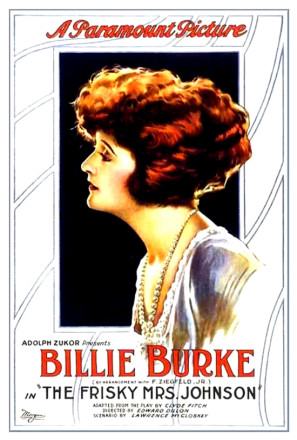
There is a peculiar ache that arrives only when you fall in love with a ghost. The Frisky Mrs. Johnson is such a ghost—four reels of nitrate laughter that once caught the light in 1920 and now survives only in the smoky after-image of lobby cards and breathless Motion Picture Herald adjectives. Yet the ache is delicious, because what we do know feels like a champagne cork popped inside a velvet satchel: irreverent, effervescent, hopelessly muffled by time.
Let us begin with the poster: Billie Burke posed in a mauve tea-gown, one finger pressed to her lips in a conspiracy of delight. The tagline—“She risked her reputation for a perfectly wonderful scandal!”—promises a vehicle custom-built for the actress whose doll-face and tremulous soprano had already bewitched Broadway. Paramount’s publicity mill touted the picture as “the fastest comedy ever filmed,” a claim that, even accounting for hyperbole, lands with the clack of tap shoes on a parquet floor.
Fitch’s original play had been a corseted satire of Gilded Avenue manners, a drawing-room demolition derby in which every character clings to propriety the way a drunk clings to a lamppost—for support, not illumination. The screen adapter, Lawrence McCloskey, trimmed the three-act structure into a sprint of set-pieces: Newport yacht races, Fifth Avenue hat-shopping montages, a moonlit roof-garden where Burke’s heroine rehearses her own downfall like an operetta. The result is less narrative than a firefly swarm of social embarrassments, each glowing for an instant before the next buzzes into view.
Burke’s Mrs. Eleanor Johnson—married at nineteen, bored at twenty-six—occupies that precarious altitude where wealth has flattened every mountain except the marital one. Her husband (Lumsden Hare) is amiably obtuse, the sort who pores over stock quotations the way monks illuminate manuscripts. Into this emotional tundra swoops the idea of scandal: a perfumed letter addressed to herself, postmarked Paris, signed with the illegible flourish of a nonexistent lover. She leaves it where the butler will find it, then retreats behind a fan of ostrich plumes to watch the household combust.
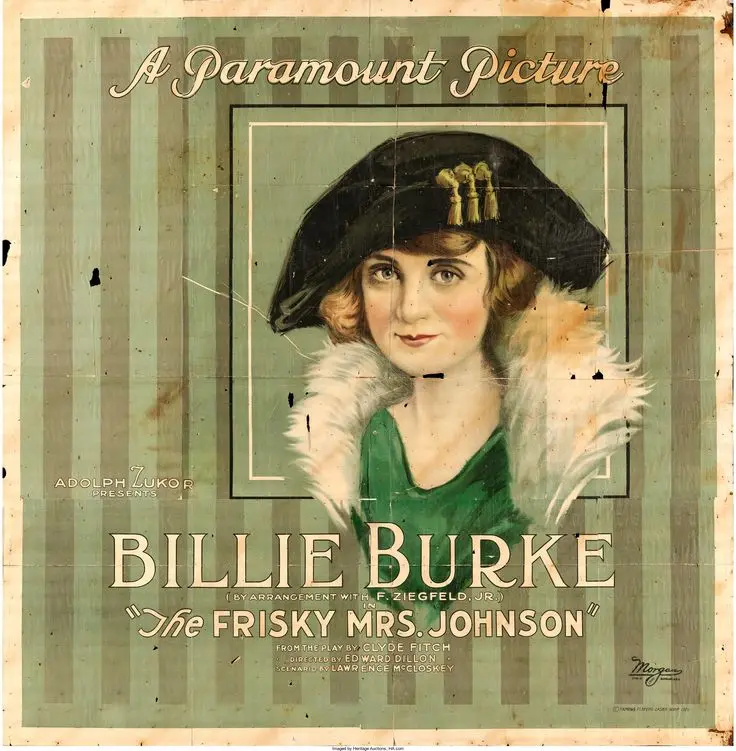
Silent comedy lives or dies on the actor’s capacity for thought made visible. Burke, with her spun-gold hair and eyes that seem forever discovering the punchline half a second early, turns each close-up into a conspiratorial wink. Watch the way she lowers her gaze half an inch when the husband brandishes the incriminating envelope: the micro-twitch of triumph, the ripple of remorse, the instant recalibration—no, I shall be bolder still. It is a masterclass in what psychologists call duping delight, and the camera, hungry for intimacy, drinks it like absinthe.
Director Edward H. Griffith—years before he would sculpt urbane talkies with Constance Bennett—approaches slapstick with the precision of a cartographer. Note the sequence set in Delmonico’s at high noon: a waiter swerves, a soufflé collapses, Burke’s character ducks behind a menu the size of a schooner’s sail. The gag is textbook, yet the rhythm—held an eighth-note longer than expected—conjures a sigh that almost becomes a gasp. It is the comedy of anticipation, the same torque that Harold Lloyd would weaponize for Safety Last! three years later.
The supporting ensemble operates like a string quartet tuned to deranged syncopation. Emily Fitzroy, as the husband’s spinster cousin, wields moral indignation the way others flourish a rapier—every “Well, I never!” a thrust to the heart of decorum. Ward Crane, the art-dealer cad, sports a moustache so villainously sleek it deserves its own credit line. Huntley Gordon appears briefly as a flustered rector whose collar seems starched by anxiety itself. Each caricature is sketched with the economy of a single stroke, yet the cumulative effect is a mosaic of Manhattan’s upper crust in mid-shiver.
One cannot discuss Frisky Mrs. Johnson without confronting the elephant—or rather, the negative space—in the room: its disappearance. No complete print has surfaced in any archive, private collection, or flea-market shoebox. The last confirmed sighting was a 1931 inventory at the Paramount vaults; after that, silence. Nitrate decomposition, studio house-cleaning, indifference—pick your culprit. What remains are fragments: a lobby card showing Burke reclining on a fainting couch shaped like a swan; a continuity script archived at the Margaret Herrick; a handful of frame enlargements published in Photoplay where the grain resembles frost on stained glass.
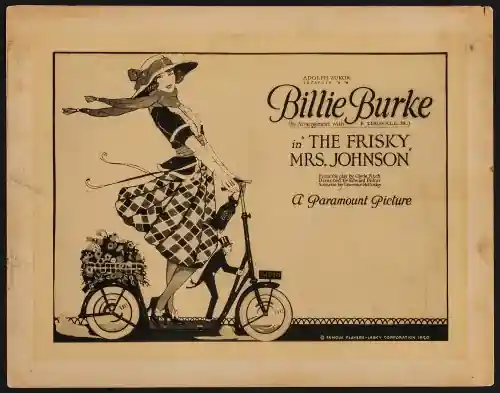
Yet absence can be generative. Cinephiles, like astronomers inferring black holes from bent starlight, reconstruct the film’s orbit through peripheral traces. We know Joseph Urban designed the sets—his signature pastels and mirrored columns—because the Paramount publicity scrapbooks survive. We know the intertitles were tinted lavender, not the standard amber, because a 1920 Moving Picture World review sniffs at the “precious affectation of orchid ink.” Such ephemera become synecdoches for the whole, the way a single glove conjures the vanished hand.
Comparative triangulation helps. Burke’s next feature, Sadie Goes to Heaven, also traffics in the comedy of reputational roulette, though there the stakes are spiritual rather than marital. Conversely, The Safety Curtain explores a wife’s flirtation with infidelity under the shadow of European terrorism—same social class, far graver tone. Place Frisky Mrs. Johnson between them and you glimpse an arc: the comedienne as anarchic Cupid, arrowing holes through the parchment of matrimony until the parchment becomes a lace valentine.
Consider also the cultural moment. 1920: the Nineteenth Amendment freshly minted, hemlines in vertiginous ascent, the word flapper still slangy and delicious. A woman manufacturing her own scandal for sport rather than self-protection felt simultaneously retrograde and radical—a throwback to the “naughty aughties” stage comedies, yet also a wink toward the emergent freedom to define oneself outside male sanction. Burke’s heroine is no proto-feminist firebrand; she wants her husband’s attention, not abolition of the institution. Still, the image of a woman scripting her own narrative, even in jest, vibrates with subterranean electricity.
The film’s reception was, by all surviving accounts, rapturous. Variety declared Burke “the most adorable enabler of apoplexy in screen history.” The New York Tribune raved over “a third-act moonlit pursuit that rivals the best of Sennett”—high praise from a paper that usually reserved column inches for D.W. Griffith’s sociological epics. Ticket sales in Manhattan exceeded The Marble Heart’s previous house record, prompting Paramount to rush prints to secondary markets where “deluxe” theaters slapped on a twenty-cent surcharge for “Burke Belles”—matinee gift fans trimmed with peacock feathers.
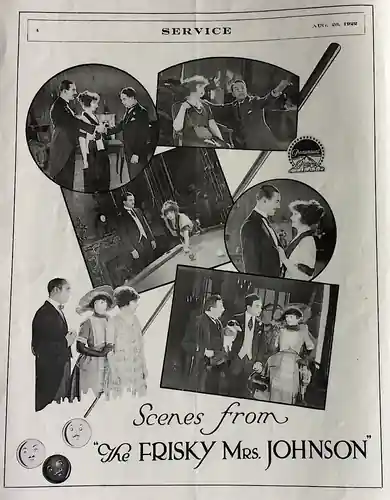
And then—oblivion. The film vanished so thoroughly that even the director, in a 1936 Times interview, misremembered its title as “The Flickering Mrs. J—something.” Such erasure invites the romantic notion that some works are too incandescent to persist, that they burn the very air that preserves them. More likely, the studio simply culled its library to make shelf space for talkie negatives. Still, the metaphor lingers: a movie that danced so close to the edge of propriety perhaps had to dance, finally, off the edge of the world.
What would contemporary eyes glean, should some Portuguese attic yield a vinegar-sweet canister tomorrow? First, the tempo. Silent comedy in 1920 still negotiated the cadences of vaudeville—beats held for the imaginary drum-fill. Griffith’s staging, if reports are accurate, anticipates Lubitsch’s later “touch”: doors sigh shut a heartbeat before the compromising embrace; handkerchiefs drop with the inevitability of fate. Second, the gender optics. A 2023 viewer might bristle at a narrative that frames female agency as prankish, safely contained by marital closure. Yet Burke’s performance—equal parts elf and insurgent—complicates any reductive reading. She is not punished; she is applauded, her husband’s renewed ardor the film’s final curtain-call.
Finally, the texture. Urban’s sets allegedly married art-nouveau arabesques with the rectilinear chic of post-War modernity—rooms where gilt mirrors reflect chrome ashtrays, a visual tension that mirrors the plot’s clash between old codes and new appetites. Cinematographer Hal Young, fresh from shooting The Mysteries of Myra, experimented with overhead key lighting that sculpted Burke’s cheekbones into porcelain sickle moons. Such stylization would soon calcify into the more formulaic glamour of mid-’20s Paramount, but here, supposedly, it still felt experimental—like applying lipstick with a paint-roller and somehow making it work.
Lost films function as cultural oubliettes: drop a stone, count the seconds, never hear the splash. Yet the void can be oddly fertile. Contemporary artists have reimagined Frisky as a graphic novel, a ballet, even an immersive VR whodunit where players piece together plot fragments. Each iteration testifies to our stubborn desire to resurrect what the archive has declared dead. Perhaps that is the ultimate tribute: a movie once dismissed as “a trifle” now inspires new acts of creation, as though the original reels had seeded the culture with spores of mischief awaiting the right humidity of imagination.
Would the film itself live up to such mythic afterlife? Possibly not. Some survivors of 1920 comedies—Hendes ungdomsforelskelse among them—feel stranded in their own era, the jokes as brittle as the nitrate that preserved them. Yet Burke’s screen persona carries a timeless valence: the woman who recognizes that performance is the shortest path to becoming. Even in silence, even in monochrome, that recognition sparks a small, rebellious flame against the dark.
So we haunt the auction sites, the basement vaults, the mildewed trunks of shuttered summer-stock theaters. We scan the margins of old ledger books where a projectionist scrawled “Johnson—last reel jumpy” and wonder if “last reel” might still be coiled in a tin like a serpent of silver. Because somewhere, perhaps, Mrs. Johnson still sprints across a rooftop in pearls and pyjamas, laughter muffled by a century of dust, beckoning us to follow her over the edge of propriety and into the generous, perilous air of the unknown.
IMDb 6.5
1930
Community
Log in to comment.