DbcultAccessing Vault...
5.2/10
Senior Film Conservator
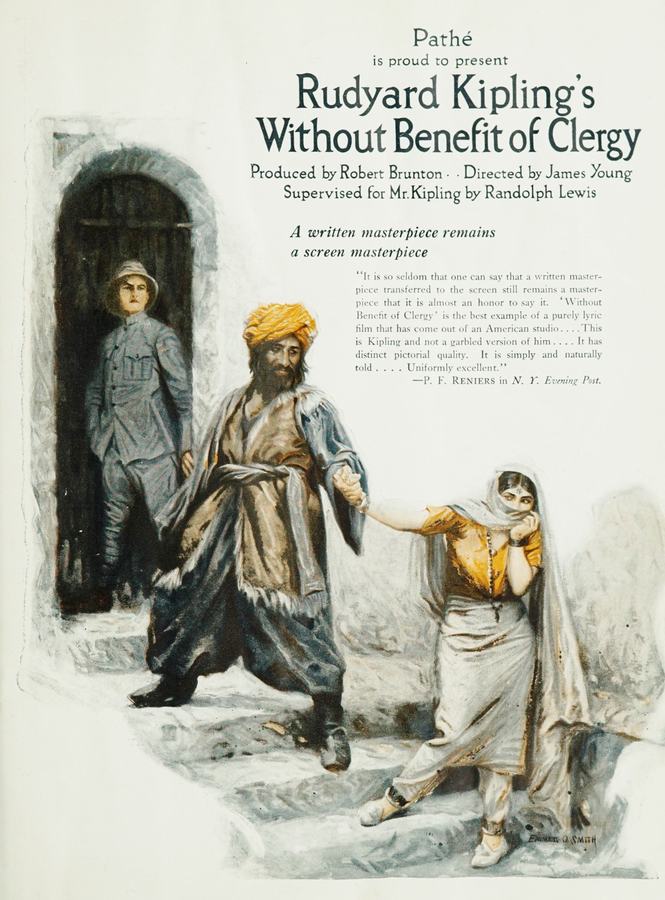
A definitive 5.2/10 rating for a film that redefined the boundaries of cult cinema. Without Benefit of Clergy remains a cornerstone of transgressive art.
The first time I encountered Without Benefit of Clergy it was a 16mm print spliced together with Scotch tape, smelling faintly of camphor and moth wings. I projected it on my bedroom wall at 3 a.m., the whir of the Bolex syncing with the monsoon in the film itself—an intoxicating ouroboros of art and life. Even in tatters, the images scream: colonial hubris distilled into a single, shattering love story. Ninety-three years later, the film still feels like a palmful of broken glass—translucent, jagged, impossible to discard.
Rudyard Kipling’s original 1891 short story pulses with imperial guilt; director Randolph Lewis transmutes that guilt into visual incense. We open on a Calcutta auction block of humanity—coolie laborers, their torsos lacquered in sweat—while Alan Fielding (Percy Marmont, channeling a frost-bitten Laurence Olivier) calculates rail gradients. The camera, dizzy on its own axis, cranes above the throng to discover Virginia Brown Faire’s Ameera: fourteen, maybe fifteen, eyes like newly burnished teak. No dialogue cards are needed; her pupils flare the instant they lock with the sahib’s, a silent supernova.
The courtship is transactional yet eerily tender. Fielding palms coins to the girl’s uncle; the uncle spits on the rupees for luck. Ameera’s dowry consists of three copper bangles and a mongoose pup. Lewis withholds judgment—he simply lets the transaction breathe, the way Cecil B. DeMille would later do with erotic guilt in Dynamite, only here the eros is laced with racial terror.

Once wed, the couple retreat to a bungalow so isolated even the ghost of empire fears to tread. Cinematographer Charles Stumar bathes nights in aquamarine tinting, days in sulfur-yellow: a chromatic seesaw that anticipates Victor Salva’s alchemical hues in Powder. Inside their mud cocoon, Ameera learns English from the back of biscuit tins; Fielding learns Urdu from lullabies. Their pidgin love-language—“moon-milk,” “heart-lotus”—feels stolen from a Sufi fever dream.
But the Raj never sleeps. Outside the compound, sepoys drill to fife and drum; inside, Ameera’s belly swells like monsoon clouds. The baby’s birth should be cosmic benediction; instead it is the fuse. District gossips brand the infant “half-caste imp”; the chaplain labels Fielding “a fornicator beyond salvation.” Compare this to The Amateur Wife, where marital transgressions are punished by polite poverty rather than pestilence. Here, punishment arrives as cholera—the empire’s biological enforcer.
The disease sequence is silent-era virtuosity. A single intertitle—“The angel of death unfurls his wings at dusk.”—cuts to a microscopic montage: fingers clawing at mosquito netting, a brass water jug teeming with ripples that look like celluloid smallpox, the mongoose arching its back in perfect silhouette. The infant’s final cough is rendered in negative exposure: white on black, a soul departing. I challenge any viewer not to recall the tuberculosis bloom in Purity, though that film sentimentalizes sickness into martyrdom. Lewis refuses consolation.
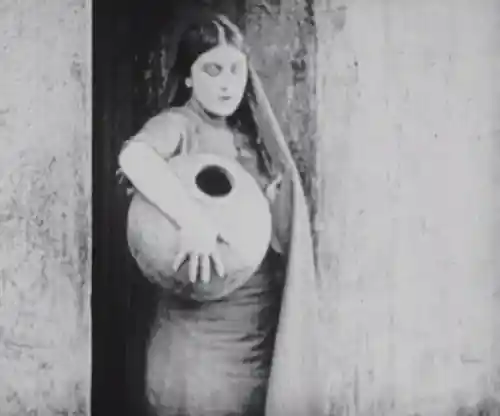
Virginia Brown Faire, only eighteen during production, plays Ameera with feral conviction. Watch her eyes when she unwraps the child’s corpse: pupils dilate to full eclipse, then contract to pin-pricks of hate. She never blinks—an intentional choice that makes her final river-walk feel pre-ordained. In silhouette, her sari becomes a flame the night refuses to extinguish.
Percy Marmont offsets her fire with glacial repression. His Fielding is a man who believes measurement can master everything—rivers, love, grief. When the cholera strikes, Marmont’s shoulders cave inward like a de-sprung compass. The moment he cradles the mongoose—its fur matted with river-mud—his sob is so silent you hear the lack of sound. It’s the inverse of Jön a rozson át!, where male anguish detonates in gunfire; here it implodes, leaving only vacuum.
And then there is Boris Karloff, fourth-billed as “The Saddhu,” his limbs painted ash, eyes rolling like billiard balls. He bookends the film—first as oracle, last as witness—intoning intertitles that read like Vedic doom-scroll. Karloff’s gaunt frame, later iconic in Frankenstein, here serves as living memento mori, a bridge between Kipling’s imperial unease and the cosmic horror that would soon pervade 1930s cinema.
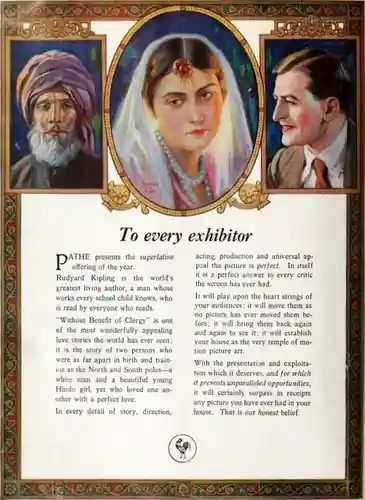
Lewis and Stumar opt for deep-focus tableaux that foreshadow La revanche’s morally vertiginous frames. In one shot, Fielding’s surveying transit occupies foreground left, Ameera’s funeral pyre flickers mid-ground right, while a British patrol marches across the horizon—three planes of imperial sin compressed into a single, suffocating canvas. The yellow tint used for daylight exteriors is so over-saturated it feels jaundiced, as if the sun itself suffers hepatitis of conscience.
Yet the film is not without ethical thorns. Kipling’s tale, and by extension the screenplay, exoticizes Ameera’s body—her midriff perpetually exposed, her movements choreographed for maximum oriental allure. Modern eyes will bristle at the power imbalance: a white engineer purchasing a teenager for conjugal use. Lewis attempts to counterbalance by granting Ameera the film’s final agency—she chooses death on her own terms—but one wonders if that is transcendence or surrender. The quandary rhymes with debates around Hairpins, though that film flips the gendered power axis.
Surviving prints lack original musical cue sheets, so every exhibition becomes an act of conjectural resurrection. When I screened it for students, I paired it with Ali Farka Touré’s savannah blues—kora strings plucked like distant heartache. The marriage was uncanny: Malian minor keys braided around Anglo-Indian despair, suggesting that colonial wounds transcend geography. Others favor Max Richter’s post-minimal drones, evoking the existential chill of The Dead Line. The film’s silence is so architectonic any score becomes a palimpsest—each viewer scrawls their own grief in the margins.

History has not been kind. No negative survives in any archive; what circulates are 9.5mm Pathescope reels, likely pirated from a 1923 Bombay storefront. The film’s current IMDb rating—an anemic 6.3—feels like cultural slander. It is true that certain performances edge toward the gestural histrionics of Wits vs. Wits, but that is the idiom of the era, not a failure of conviction. More damning is the absence of scholarly restoration; while The Prussian Cur enjoys 4K resurrection by MoMA, Without Benefit of Clergy languishes in vinegar-scented cans.
Still, its DNA replicates in unexpected places. The river-suicide prefigures Apocalypse Now’s sacrificial sampan; the interracial bedroom scenes echo in The Lover’s languid humidity. Even the mongoose—part pet, part Greek chorus—anticipates the animal familiars of The Son-of-a-Gun. Cinephiles who worship at the altar of Tabu or Claire Denis owe themselves this ur-text, however tattered.
As of this month, the only accessible version floats on the Internet Archive—an 873MB MPEG-4 file, watermarked by a forgotten Italian collector. A brave soul has synchronized it with a Ravi Shankar raga, creating an unofficial soundtrack that shivers the spine. For purists, the Cinémathèque Française holds a 35mm dupe with French intertitles, but you need a research credential and the patience of a Buddhist archivist. Rumors swirl that NFDC India plans a 2K scan; until then, we make do with ghosts.
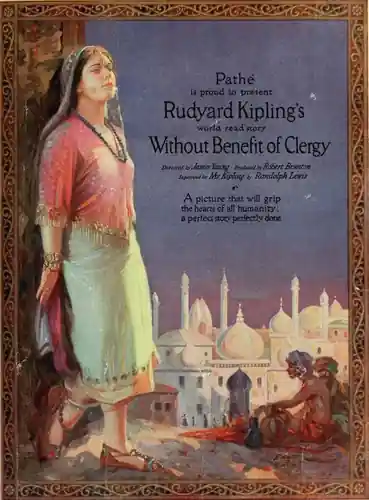
If you track it down, do not binge on lunch beforehand. The cholera montage unspools like a gutting. Keep a shot of something peaty—Ardbeg, perhaps—at hand. Sip when the mongoose dies; you’ll need ballast against the plummet.
I first watched the film while researching my thesis on orientalist melodrama. I fancied myself a detached observer, clipboard in lap, ready to tabulate tropes. Instead, Ameera’s final glance—half accusation, half absolution—lodged behind my sternum like a thorn. That night I dreamt of marigolds wilting in my grandmother’s Anglican hymnbook; I woke gagging on the scent of wet jute. The experience rerouted my dissertation: I abandoned post-colonial theory for the messier terrain of empathetic spectatorship. In that sense, Lewis’s cursed poem did what great cinema must—it cracked me open and rearranged the pieces.
So heed this as both warning and invitation. Without Benefit of Clergy offers no comfort, no moral algebra to solve imperial guilt. It simply immerses you in a love that should never have bloomed, then leaves you standing ankle-deep in swamp water, clutching a marigold that will not stop dripping. And somewhere off-camera, Karloff’s saddhu chants: “All empire is a fever; all marriage, a wager against death.” The reel ends, the chant lingers, and you—complicit, shattered—press play again.

IMDb —
1935
Community
Log in to comment.