DbcultAccessing Vault...
Cult Review
Senior Film Conservator
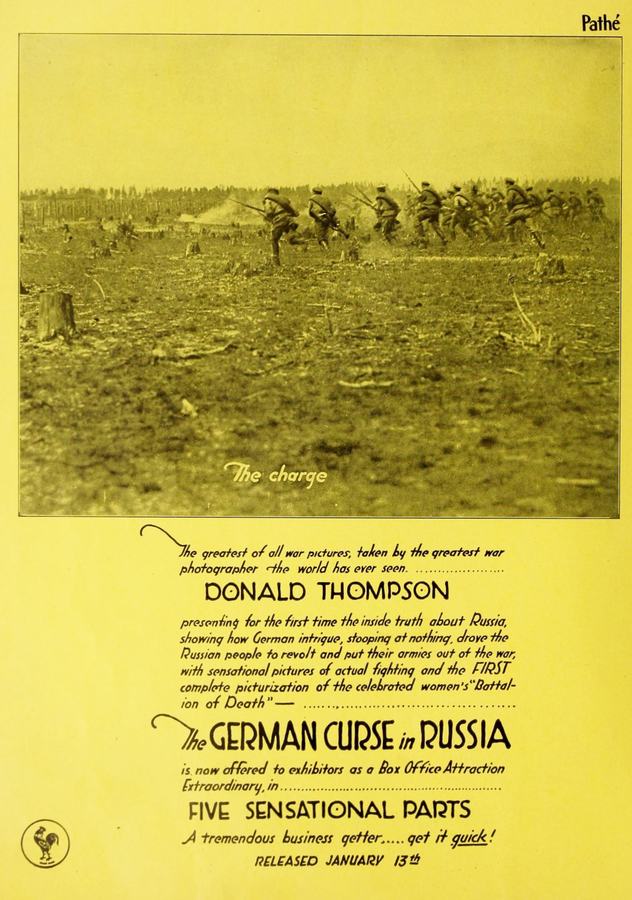
The German Curse in Russia is not merely a documentary; it is an incendiary tract, a cinematic polemic that weaponizes history against a backdrop of geopolitical strife. Released in an era when propaganda was both art and weaponization, this film stitches together archival footage with relentless editorializing to assert a singular thesis: Germany’s treachery precipitated Russia’s descent into chaos. From the opening frames of the Black Sea Fleet’s triumph over Turkish vessels to the closing scenes of anarchists swarming the Duma, the film is a masterclass in emotional manipulation, designed to stoke anger and nationalism.
The narrative is structured like a tragic opera, each act a crescendo of despair. The film’s editors spare no detail in depicting the human toll of war: rows of emaciated civilians huddled in makeshift shelters, their faces gaunt with hunger; a gas attack that turns a field of poppies into a shroud of coughing, stumbling soldiers; a machine-gun maelstrom that atomizes a detachment of troops. These scenes are not presented as isolated tragedies but as symptoms of a larger malady—German perfidy. The film’s most jarring juxtapositions come in its treatment of the Cossacks: once loyal defenders of the Czar, now portrayed as disillusioned pawns in a losing game, their once-proud steeds now dragging carts of the dead.
What elevates this film from mere agitprop is its cinematic audacity. The sequence depicting the Dvinski front’s artillery barrage is a symphony of chaos, with flashes of light and smoke creating a chiaroscuro effect that mirrors the moral ambiguity of the era. The gas attack scene is rendered with a haunting simplicity: soldiers, their faces obscured by crude masks, trudge through a greenish haze, their silhouettes dissolving into the fog like phantoms of a forgotten war. Yet the film’s most potent imagery lies in its quiet moments—a close-up of Czar Nicholas II’s weary eyes as he converses with Grand Duke Nicholas, the silent desperation of a mother clutching a child’s photo in a hospital ward. These intimate vignettes humanize the broader narrative, even as the film’s polemics demand a collective enemy.
The film’s treatment of the 1917 revolution is a masterstroke of ideological framing. Lenin’s speeches are intercut with scenes of Petrograd’s streets, where crowds of workers and soldiers swell toward the Duma like a tide. Trotsky is shown as a cerebral tactician, his sharp angles and piercing gaze embodying the revolution’s intellectual rigor. The attack on the Duma is depicted with a frenetic energy, its editing evoking the chaos of a storm breaking. Even the anarchists’ march of 15,000 is framed not as anarchy but as a calculated march toward a new order—a testament to the film’s ability to recontextualize violence as progress.
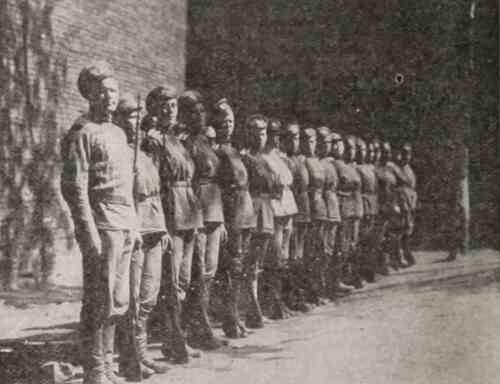
The film’s most controversial element is its portrayal of the “Battalion of Death,” a unit of women warriors led by Yasha Bochkareva. Their inclusion is both a nod to the era’s shifting gender dynamics and a calculated distraction from the film’s central thesis. The women are shown charging into battle with a ferocity that rivals their male counterparts, their uniforms a striking contrast of white and steel. Yet their narrative arc is subsumed by the broader anti-German narrative, their heroism framed as a patriotic counterbalance to Germany’s “unmanliness.” This duality—celebrating female sacrifice while reducing it to a footnote—reveals the film’s fraught relationship with modernity.
Comparisons to other films of the era are instructive. Like The Making of Maddalena, which examines the corrosive effects of war on the individual, The German Curse in Russia uses stark imagery to evoke collective trauma. Yet where Maddalena’s protagonist is a single woman unraveling, this film’s focus is macroscopic—a nation’s collapse. The film also shares thematic DNA with The Sea Wolf, another tale of human survival against insurmountable odds, though its moralizing is far more overt. The editing techniques, particularly in battle scenes, recall the frenetic pacing of The Great Circus Catastrophe, yet here the chaos is not accidental but orchestrated by an unseen enemy.
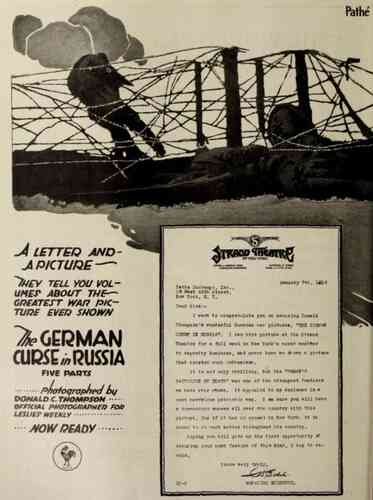
The film’s historical accuracy is a contentious issue. While it correctly documents the Black Sea Fleet’s destruction of Turkish and German forces, its attribution of food riots and hospital overcrowding to German plots is a simplification of complex socio-economic factors. The portrayal of Kerensky’s government as a victim of German scheming overlooks the internal contradictions of the Provisional Government, which itself struggled with war policy and popular support. Yet in the context of 1917, when anti-German sentiment was at a fever pitch, such simplifications were not only acceptable but necessary for the film’s propagandistic aims.
The film’s legacy is as murky as its moralizing. Decades later, it stands as a relic of a bygone era, when cinema was a tool of statecraft rather than art. Yet its aesthetic daring—particularly the use of montage to link disparate events into a coherent narrative—prefigures the Soviet Montage movement of the 1920s. The film’s influence can be seen in later works like Whom the Gods Destroy, which similarly uses war as a metaphor for personal and national decay. Its portrayal of the Duma sessions and Lenin’s speeches also echoes the political realism of Her Own Way, though with a far grimmer tone.
In the final analysis, The German Curse in Russia is a film of contradictions: a callous polemic that humanizes its victims, a simplification of history that revels in its complexity. It is a document of its time, yet its questions—about the cost of war, the fragility of order, and the seductive allure of blame—remain hauntingly relevant. The film’s closing scene, of the Black Sea Fleet’s triumph, is a bittersweet coda. The fleet’s victory is pyrrhic; the larger war, and the revolution it heralds, are already in motion. The curse, it suggests, is not Germany’s, but the human tendency to seek scapegoats in the face of calamity.

IMDb —
1918
Community
Log in to comment.