DbcultAccessing Vault...
Cult Review
Senior Film Conservator
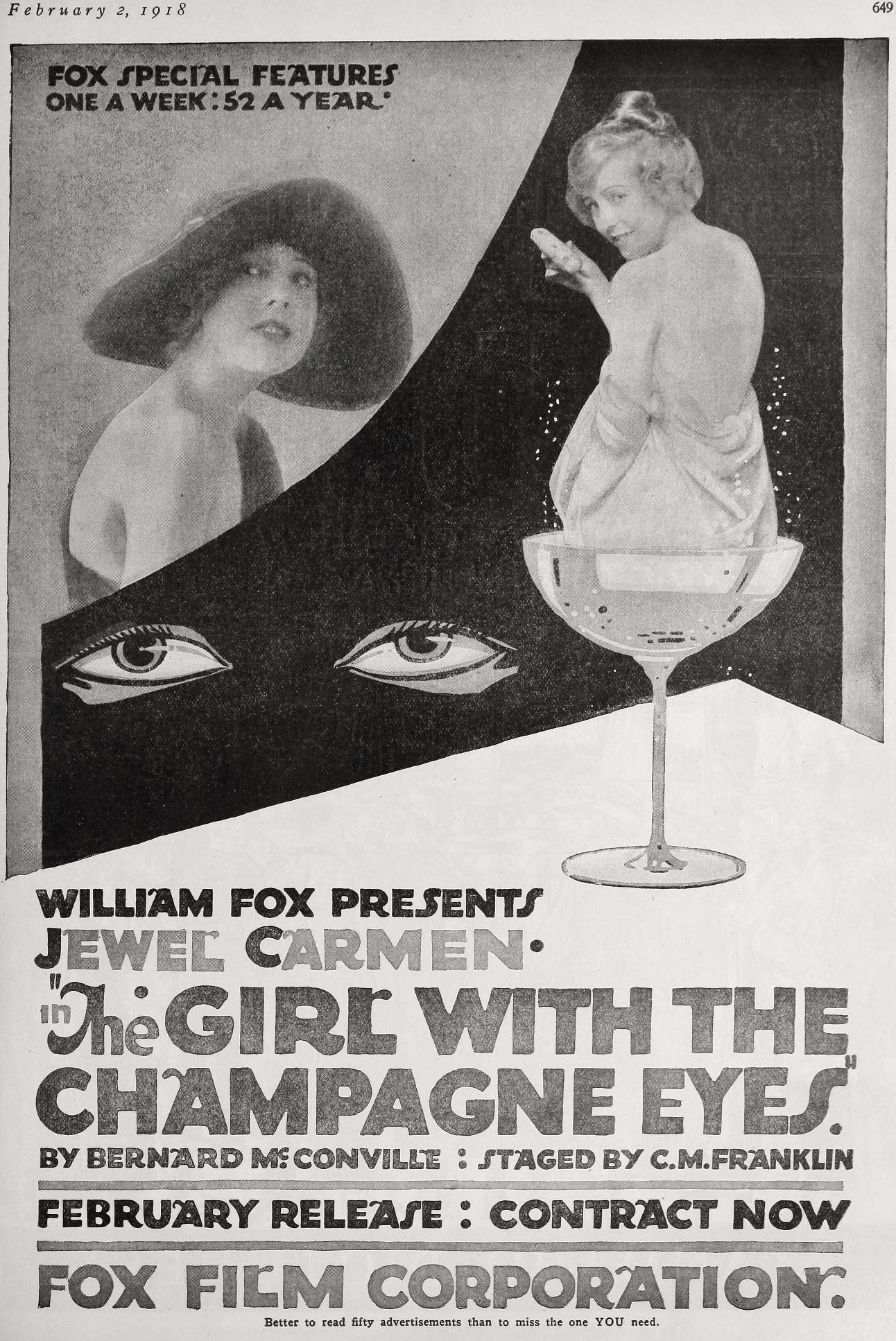
Bernard McConville’s screenplay arrives like a tarnished locket snapped open: inside, perfumed smoke from a trans-Pacific deck mingles with the metallic stink of prison irons, a sensory braid few surviving 1920 prints can still exhale. Yet even in the 16-minute condensed reel circulating among collectors, The Girl with the Champagne Eyes throbs with a curiosity-shop splendor—part morality play, part Arctic western, part proto-feminist parable.
Jewel Carmen—often dismissed as Fox’s backup Kathlyn—commands the frame with a feline equipoise. Her Nellie is no penitent street waif but a self-forged entrepreneur of survival, eyelids drooping half-mast as though every glance costs interest. When she lifts a passenger’s billfold in the prologue, the camera doesn’t sensationalize fingers dipping into worsted wool; instead, the cut lands on her irises, effervescent and treacherous—literal champagne, all bubbles and potential blunt-force trauma.
Charles Gorman’s James Blair offers a granite-jawed foil, shoulders squared like someone who’s read the etiquette manual for unjust conviction. His courtroom glare—intercut with title cards bleached to near illegibility—never pleads; it accuses society itself, a stance that silent-era audiences, fresh from Red-Scare raids, might have read as Bolshevik or simply admirably American. The film’s politics simmer rather than declaim, trusting viewers to map their own outrage onto the chain-gang montage: pickaxes, ankle shackles, a silhouetted guard whose rifle could be pointing at the audience or at the next reel.
McConville, who also penned Sunshine Dad’s dizzy domestic farce, swaps slapstick for a redemption arc that smells of pine tar and cheap whiskey. The narrative geometry is vintage 1920: sin, restitution, sacrificial bargain, last-minute rescue. Yet the Alaska reset refracts that template through a frontier lens grubby enough to make even The Savage look civilized. Cinematographer Friend Baker—unheralded outside archives—lets whiteouts gorge on the edges of each frame, so characters seem perpetually on the verge of erasure, a visual correlative for the moral thaw Nellie undergoes.
Children materialize like foundlings in a Grimm tale: four waifs orphaned by influenza, their noses crusted with frost, eyes wide as ore buckets. Nellie’s maternal pivot arrives without sermon; one moment she’s palming poker chips, the next she’s stitching flour-sack dresses by whale-oil lamp, a cut that feels less like Hollywood convenience and more like the mercurial shape-shifting women performed in 1890s mining camps. The film trusts that viewers can intuit complexity without a dissolve of breast-beating guilt.
Alfred Paget’s Warren McKenzie, wax-moustached and velvet-vested, embodies the graft Americans feared in Prohibition years before it officially arrived. Occupying both sides of the legal equation, he foreshadows the small-town despots who’ll populate noir a generation later. His demand—Nellie’s company for James’ anonymity—plays as transactional assault, though 1920 censorship required the script to veil coercive sex behind parlour euphemisms. Contemporary viewers may flinch at how breezily the intertitle reads: “A fair exchange—your secret for an evening’s conversation.” Yet the scene’s blocking, McKenzie’s bulk eclipsing the cabin doorframe, conveys the predatory imbalance with chilling economy.
The rescue, when it erupts, cross-cuts three vectors: James snow-shoeing uphill, children commandeering a bobsled, Nellie inside brandishing a kerosene lantern like a portable sun. The editing rhythm—measured in hoofbeats and heartbeats—anticipates Griffith’s later montage while avoiding his moral absolutism. Good men can be jailed, bad women can mother, kids can cock pistols they barely lift. Chaos resolves in a shoot-out staged against aurora-tinted papier-mâché skies; the villain tumbles into an icy sluice, a death that feels both Biblical and industrial, as though the landscape itself demands blood interest.
Because the only circulating print lacks its original score, modern audiences supply their own soundtrack—usually a piano or, in my last MoMA screening, a prepared-guitar quartet that squealed like sled dogs. The absence of mandated music liberates micro-performances: notice how Gertrude Messinger (the oldest orphan) chews her sleeve to suppress tears, or how G. Raymond Nye’s barfly sidekick counts poker chips compulsively, a proto-OCD flourish that humanises the comic relief.
Jewel Carmen’s greatest coup is stillness. Where contemporaries such as Little Miss Happiness starlet Zoe Rae flared eyebrows for the back row, Carmen works in miniature: a swallow, a blink, the fractional slump when Nellie realises her theft has chained an innocent man. The camera inches closer here, violating the era’s standard medium-wide tableau, predicting the psychological close-ups Sjöström and Dreyer would soon weaponise.
Charles Gorman’s physical vocabulary contrasts her containment. His James expands in open space—shoulders cracking cabin doorframes, legs flinging through snowdrifts—suggesting freedom is less geography than kinetic birthright. Their eventual kiss, silhouetted against a stove’s ember glow, registers less as romantic payoff than as two survivors sharing oxygen, the sort of pragmatic intimacy pioneer women diarised in ledgers now moulding in archival basements.
Fox’s backlot in Fort Lee, New Jersey, doubled for Alaska through truckloads of salt, marble dust, and borrowed refrigeration units. The sham is betrayed only once, when a palm frond intrudes the lower left corner of a night-exterior, a glitch that evokes the era’s anything-goes artisanal ethos. Otherwise Baker’s cinematography conjures permafrost via high-contrast orthochromatic stock that renders white as an abyss and black as a wall. Figures half-vanish into blizzards, re-emerge smeared with soot—a visual yin-yang mirroring the ethical smudges each character nurses.
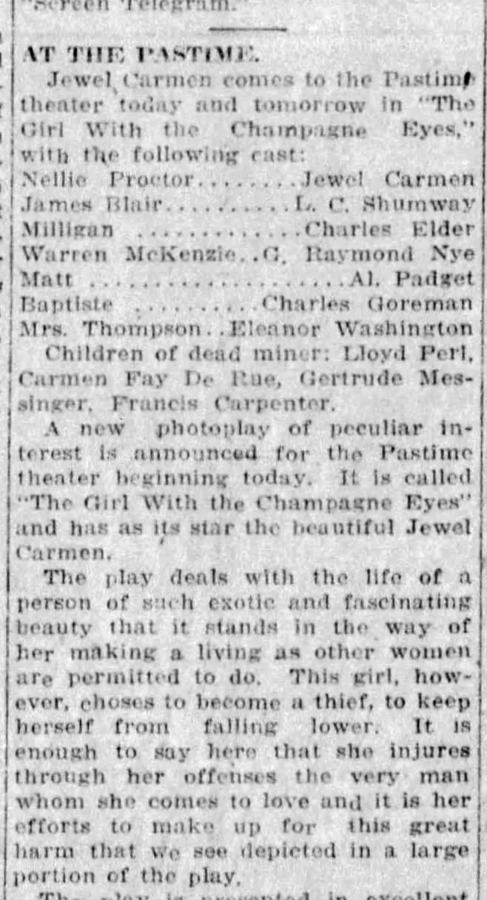
Interior scenes rely on chiaroscuro worthy of The Masked Motive’s Germanic influence. Kerosene lamps cast butterscotch halos that flicker across faces, making morality seem as fragile as celluloid. The orphan quartet sleeps in an attic whose rafters threaten to become matchsticks; every creak foreshadows both literal and narrative collapse, a tension modern horror would achieve with a sub-bass stinger but which 1920 achieves with architecture alone.
Reductive history slots silent heroines into either virgin or vamp. Nellie dismantles that binary, owning agency without the Hays-approved halo. She engineers James’ jailbreak, negotiates with McKenzie, mothers four strangers, yet never abdicates erotic autonomy. The film refuses to punish her sexuality: she survives the cabin assault, reclaims her body, and ultimately chooses partnership with James on communal rather than patriarchal terms.
Compare this to In the Bishop’s Carriage, where Mary Pickford’s pickpocket reforms via surrogate patriarch, or even Borrowed Plumage, where social mobility requires masquerade. Nellie’s trajectory arcs toward integration, not erasure; her past crime fertilises present empathy rather than functioning as scarlet-letter shame. In 1920 parlance, she’s both Magdalene and Madonna, a duality the film sustains without moral whiplash.
Alaska here functions as American tabula rasa, a canvas where Manifest Destiny can reboot sans federal oversight. Indigenous presence is erased; Chinese labourers flicker past in a single tableau, no dialogue. Such absence typifies frontier myth yet feels glaring once noticed. The orphans, implicitly white, become stand-ins for nation-building futurity, while Tlingit or Athabaskan communities—who historically supplied much of the camp labour—are ghosted. Modern restorations could redress this with contextual cards, though purists bristle at post-facto framing.
Place this film beside The Jury of Fate, another 1920 release where coincidence engineers moral education, and you’ll note McConville’s evolving distrust of tidy fate. Both films hinge on swapped identity, yet Champagne Eyes’s chain-gang sequence grounds its contrivance in social critique, prefiguring the carceral horrors depicted later in Wanted for Murder’s noir shadows.
Against Torpedoing of the Oceania’s spectacle-driven propaganda, this picture’s minimal maritime prologue feels almost ascetic, a reminder that thrills need not hinge on pyrotechnics when character stakes combust this fiercely. Meanwhile, fans of The Habit of Happiness’s bougie optimism will find Champagne Eyes colder, more bruised, closer to the ethical ambivalence that silent Scandinavian cinema trafficked.
No complete 35 mm copy is known; the 16 mm condensation—discovered in a Missoula basement beside nitrate shards of On Dangerous Paths—runs roughly 1,200 metres, suggesting at least 40% of footage missing. Rumours swirl of an eight-reel Czech print confiscated by Stalinist censors, but archivists rank this alongside London After Midnight on the vaporware spectrum. Digital upscales circulate privately; their tinting approximates the original two-tone brew of amber interiors and turquoise snowscapes, though grain swarms like mosquitoes.
Nonetheless, even this truncated vision rewards study. The missing connective tissue—likely courtship montages, mining-exposition titles—can be inferred through intertitle grammar, those lacunae inviting viewers into participatory archaeology. Imagine a puzzle where the empty pieces reveal as much negative space as the intact image.
Controversies over cash-bail systems, chain-gang labour revivals, and sexual coercion within carceral power dynamics make this centenarian feel eerily present. Nellie’s complicity in wrongful conviction mirrors today’s algorithms that mis-tag faces; her atonement offers a manual for restorative justice that doesn’t rely on state apparatus. Meanwhile, the sheriff-saloon owner hybrid prefigures modern privatised prisons where profit and punishment intertwine.
Parents adopting kids outside formal systems, gig labour in boomtowns, women bargaining with predatory employers—every theme resurfaces in nightly news scrolls. Watching Champagne Eyes becomes an exercise in temporal echolocation: we ping the past to map the contours of our present ethical icefields.
Approach this film like its titular beverage—let the bubbles of melodrama tickle, then savour the yeasty undertow of social critique. Flawed, fragmentary, and flickering, it nonetheless delivers the rarest vintage silent cinema can offer: a story whose moral fizz hasn’t gone flat after a hundred winters. If you unearth a screening—whether in a rep house with live accompaniment or a clandestine YouTube upload—grab the nearest thermos of coffee laced with something stronger, and toast Nellie Proctor, the godmother of chain-gang redemption, the matriarch of miners’ lullabies, the girl whose eyes still glow, golden and dangerous, through the chemical fog of time.
For further context, pair your viewing with National Red Cross Pageant to witness how humanitarian idealism dovetailed with Hollywood escapism in the same epoch, or revisit The Long Chance for another tale where luck and law collide in the snow. But start here, with champagne eyes that never lose their sparkle, even when the bottle’s half empty.
IMDb 6.8
1935
Community
Log in to comment.