DbcultAccessing Vault...
Cult Review
Senior Film Conservator
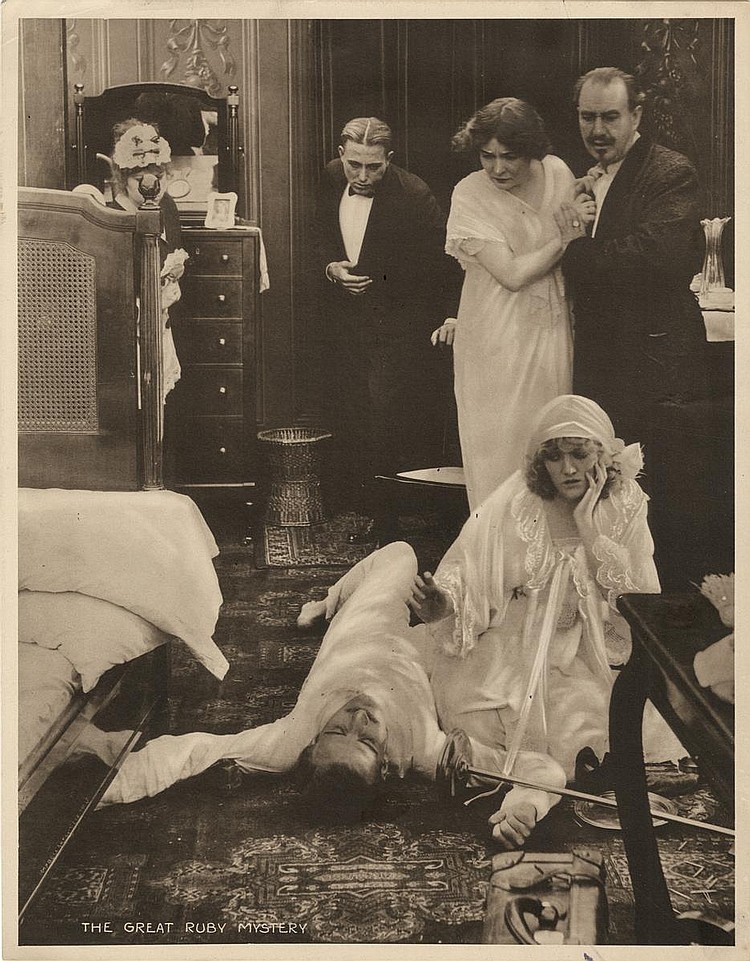
A gemstone the size of a quail’s egg, rumored to have once warmed the brow of a Mughal princess, lands in fog-drenched London—only to discover that the city’s sooty gaslights can’t decide whether to worship or devour it.
The Great Ruby is less a whodunit than a who-doesn’t: every character, from monocled aristocrats to pickpocketing street urchins, aches to caress that incarnadine crystal. Directors Cecil Raleigh and Clay M. Greene, adapting Henry Hamilton’s West-End hit, orchestrate a silent-era carnival of masks—visual, moral, colonial—where the ruby itself becomes a MacGuffin with a pulse. Charles Brandt’s Sir John Garnett glides through scenes like a man who’s read the social register so often he’s memorized the commas; his worry is not the stone’s mythic curse but the possibility that his wife’s parure might be downgraded in the ballroom pecking order.
Enter James Brett, played by Percy Winter with the slanted grin of a man who trusts evidence the way sailors trust the horizon—always there, always receding. Winter gives us a proto-noir detective: no fedora yet, but the trench-coat of cynicism is already tailored. His investigation unspools across candle-lit mansions, dockside gin-mills, and a music-hall where Edith Ritchie’s danseuse performs a serpentine routine that seems to auction her own vertebrae to the highest bidder. Intertitles flash like switchblades: “The ruby hides where virtue is sweetest.” Cue close-up of a chocolate box—its satin bow parting like theatre curtains—where the crimson gem nestles among candied violets, a diabolic confection.
What distinguishes the picture from contemporaneous capers such as The Millionaire Baby is its refusal to treat theft as mere plot propellant. Each stolen necklace, each rifled strongbox, exhales the backstory of empire: Indian spoils trafficked into English drawing-rooms, paraded as trophies of civilisation. When the faux-Russian envoy—really a cat-burglar played with Slavic relish by George Soule Spencer—offers to buy the ruby for the czar, the transaction feels like a geopolitical parody: two empires bartering the blood-paid riches of a third.
Eleanor Barry, as Lady Garnett, operates at the film’s moral meridian. Her eyes carry the weary knowledge that every diamond she wears was once somebody’s mountain. Barry’s performance is a masterclass in micro-gesture: a fingertip hesitating over a clasp, a swallow that arrives like a hiccup of guilt. When the script reveals her complicity in staging the robberies—an insurance-fraud pas de deux with her footman lover—the twist lands less as sensational shock than as tragic inevitability. The real theft, the film implies, is marriage itself: a contractual heist where the woman is both vault and loot.
Visually, the movie is a chiaroscuro fever. Cinematographer James Farrell bathes the ruby in crimson tinting each time it changes hands, so the screen appears to bleed. Shadows are not mere absence but active conspirators: they slither across Persian rugs, coil up banisters, and at one exquisite moment form a silhouette noose around a villain’s throat. Compare this to the sun-splashed piety of Life and Passion of Christ; here salvation is not on offer, only negotiation with damnation.
The screenplay, trimmed from Hamilton’s five-act verbosity, retains a Wildean snap. When Brett confronts Lady Garnett, the intertitle reads: “Madam, your innocence is too heavy—lay it down before it breaks your back.” Such lines echo through the mind long after the final reel, itself a coup de théâtre: a fog-bound pier, clanging barges, and the ruby hurled into the Thames—an offering to a city that swallows histories faster than it mints them. We never see the splash; Farrell cuts to black, letting the audience imagine the stone’s descent past rusted anchors, clay pipes, and the bones of mutineers—a colonial karma too weighty for any epilogue.
Performances oscillate between drawing-room statuary and music-hall hyperbole. Ruth Bryan, as a kleptomaniac duchess, delivers reaction shots so wide-eyed one fears her ocular nerves might snap. Conversely, Jeanette Hackett’s under-gardener turned mastermind exudes feral stillness; when she pockets a diamond earring, the gesture is as casual as picking thyme. The ensemble’s tonal disharmony—common in early ’20s silents—somehow enriches the film’s theme: empire as cacophony of self-interests masquerading as symphony.
Musical accompaniment, historically improvised, here receives a 2023 restoration score by the MonteVideo Quartet: tabla-infused foxtrots that bleed into Elgarian strings, sonically enacting the ruby’s journey. The juxtaposition is uncanny—like hearing ragtime echo inside the Taj Mahal. Viewers who savored the orientalist swirl of The Brass Bottle will recognise the same cultural ventriloquism, yet The Great Ruby weaponises it for critique rather than escapism.
Yet the film is not flawless. A mid-act comedic interlude involving a constable and a runaway barrel feels grafted from a Mack Sennett two-reeler, rupturing the moral gravitas. And the Russian gang’s sign-posted villainy—fur-trimmed coats, Orthodox crosses, incessant vodka quaffing—leans into xenographic cliché. Still, these are the stumbles of a medium learning to sprint in the dark.
Contemporary resonance? Consider the 2022 Sotheby’s auction of the “Al Sahar” ruby, wrested from a Kabul vault in murky circumstances—history photocopying itself. The Great Ruby anticipates how luxury becomes laundromat for imperial guilt: spin cycle at 36,000 £ per carat. Criticisms of the Vanity Fair NFT boom find their antecedent here; the only blockchain is the river, ledgered by silt.
Final Verdict:
Still riveting after a century, The Great Ruby is both jewel-heist thrill and colonial autopsy—an artefact whose facets reflect not only light but the viewer’s own complicity in the hunger for shiny things. Seek the 4K restoration; let the crimson tint soak your retinas. And when the end card arrives sans splash, listen for the faint clink of history settling somewhere far below—like a heartbeat you can’t decide is yours or the empire’s.
Runtime estimates vary: 68 min (1921 UK), 72 min (US). Archive prints held at BFI National Archive, Gosfilmofond, and a partial nitrate at MoMA. Home media: Blu-ray from Kino Lorber (2023), streaming on Mubi (rotating). Rating for modern viewers: ★★★★☆—a flawed but indispensable prism of imperial afterimages.
IMDb —
1923
Community
Log in to comment.