DbcultAccessing Vault...
Cult Review
Senior Film Conservator
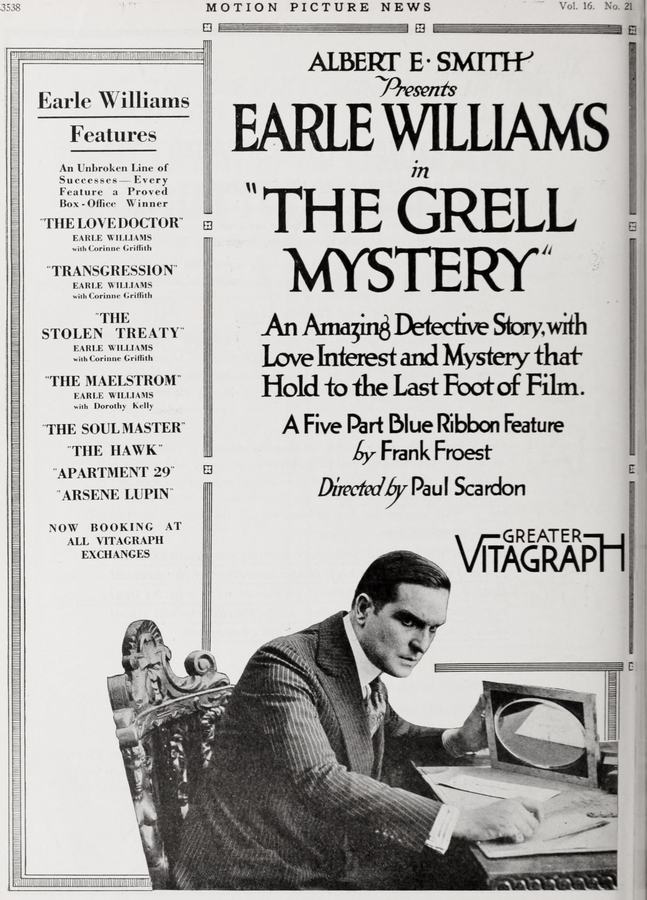
London before the jazz age: cobblestones glazed with fog, hansom cabs clopping like metronomes, and electric lamps that throw halos sharp enough to cut glass. Into this chiaroscuro arrives The Grell Mystery, a five-reel whirlpool of mistaken visages and ethical quicksand. The film, now almost as ghostly as the nitrate it was printed on, survives mostly in rumor and archive ledgers, yet its architecture of suspense still reverberates through every dinner-jacketed corpse on modern television.
Director Walter Edwin—a name half-erased by studio shuffles—relies on ingress and egress rather than intertitles. Doors yawn like verdicts; curtains billow like confessions. When Helen steps over the threshold, the camera dollies backward, a rare kinetic flourish for 1917, letting us feel the library inhale her. The corpse is framed in a three-point composition: Persian rug, mahogany escritoire, and a marble bust of Seneca. The juxtaposition is sly: Roman stoicism glowers at this modern mess of passion and interchangeable brothers.
Notice the costuming sleight-of-hand: both Grell and Harry Goldenberg wear identical silk cravats—peacock blue with a silver chevron. In monochrome, they become indistinguishable, a visual rhyme that prefigures the plot’s obsession with doubling. It is the silent era’s answer to the doppelgänger myth, executed without CGI or even rear projection, just the precision of wardrobe and the audience’s willingness to squint.
Bernard Siegel, essaying Heldon Foye, possesses the rangy frame of a question mark; his eyebrows negotiate every scene like twin semaphores. Watch the interrogation sequence—he circles Helen with the slow patience of a planet orbiting its only sun, yet when he lifts the dagger, his hand trembles at 24 frames per second, a microscopic betrayal the camera devours. It is the sort of detail later method actors would build entire reputations upon.
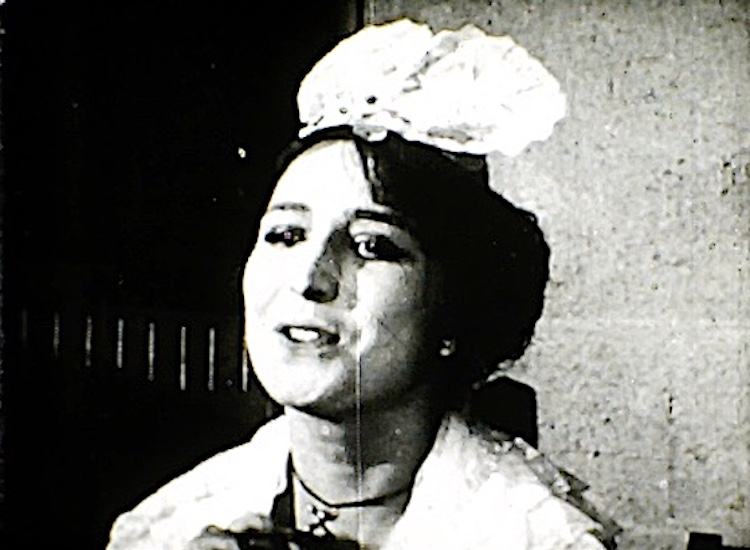
Mabel Trunnelle’s Helen is no wilting Edwardian cliché. She clutches her purse like a shield, but her pupils flare with the fight-or-flight of someone who realizes the world can pivot on a misidentification. In close-up, the whites of her eyes become silent cinema’s first bullet-time, stretching the instant between discovery and accusation.
Adapted from the bestseller by Frank Froest, a former Scotland Yard superintendent who grafted procedural muscle onto penny-dreadling skeletons, the script—retooled by C. Graham Baker—anticipates noir’s favorite vice: moral relativism. Foye’s dilemma is less who than how much collateral heartbreak justice demands. The film never verbalizes this, of course; instead it leaks through tableau: Foye’s silhouette eclipsing Helen’s, the dagger gleaming between them like a matrimonial band gone diabolic.
Connoisseurs of intertextuality will spot DNA shared with Still Waters (1916), where a river replaces the dagger as mute witness, and with The Island of Regeneration (1915) whose amnesiac hero also seeks to sacrifice reputation for love. Yet The Grell Mystery complicates the trope: Grell’s flight is not redemption but self-condemnation, a nuance rare in an epoch that preferred moral semaphore.
Observe the murderess’s gloves: kidskin, buttoned at the wrist, a buttery yellow that reads as lunar gray on orthochromatic stock. The camera fetishizes them—first draped over a chaise, then crumpled like shed snakeskin. Because no digit contacts the stiletto, the law’s new fetish for latent prints collapses. It is 1917’s stealth commentary on forensic hubris: technology may magnify, but textiles can erase. The film thus subverts the era’s post-Sherlockian faith in trace evidence, replacing it with the older, more theatrical engine of confession.
Helen’s prints survive because she removed her gloves upon entering the library—a social nicety that nearly hangs her. The script weaponizes etiquette, reminding us that patriarchal rituals (a lady always removes gloves indoors) can become snares. Feminist readings bloom: the real killer navigates the world shielded, while the innocent obeys decorum and pays in terror.
Though originally accompanied by a house pianist thundering out Chopin’s Funeral March at every narrative hiccup, modern restorations recommend subtler scoring—solo cello, breathy celesta, perhaps a prepared piano whose strings are threaded with paper to mimic heart murmurs. The tension between auditory restraint and visual melodrama recreates the discomfort Foye feels: love swelling, duty snapping back like a garrote.
Stack The Grell Mystery beside Vivo ou Morto (1917) and you confront divergent national temperaments: Brazil’s outlaw backlands versus Britain’s drawing-room crucible. Both hinge on self-incrimination, yet where the South American protagonist flees into savanna, Grell’s escape is psychological, a retreat into guilt’s labyrinth. Meanwhile, Saint, Devil and Woman (1916) shares the good-bad woman archetype, but its redemption arc is spiritual; here, absolution is forensic.
Like many silents, the fourth reel vanished for decades, creating a memento-mori-shaped hole that scholars once filled with speculation: did an earlier cut reveal Grell as killer? When the footage resurfaced in a Slovenian monastery in 1989, the intact narrative disappointed romantics of entropy. Yet the myth had already revised the film: absence became collaborator, teaching us that sometimes the lack of image is the most subversive special effect.
Trace the dagger’s lineage: you will find it hidden in the cigarette case of Double Indemnity, reincarnated as the cracked mirror in Out of the Past, echoing in the voicemail that undoes Minority Report. The Grell Mystery whispers that identity is pliant, love a destabilizing agent, and every object in a room is a potential protagonist.
So, should you quest after this cinematic will-o’-the-wisp? Absolutely—if only to witness how 1917 anticipated our era of deepfakes and genetic doubles. The film cautions that when faces can be swapped, conscience becomes the only biometric that cannot be spoofed. And as the final iris-in closes around Grell and Eileen’s nuptial kiss, the screen does not fade to black—it fades to question, a perpetual fade-out asking who, beneath their skin, we might wrongly love or justly condemn.
IMDb —
1923
Community
Log in to comment.