DbcultAccessing Vault...
Cult Review
Senior Film Conservator
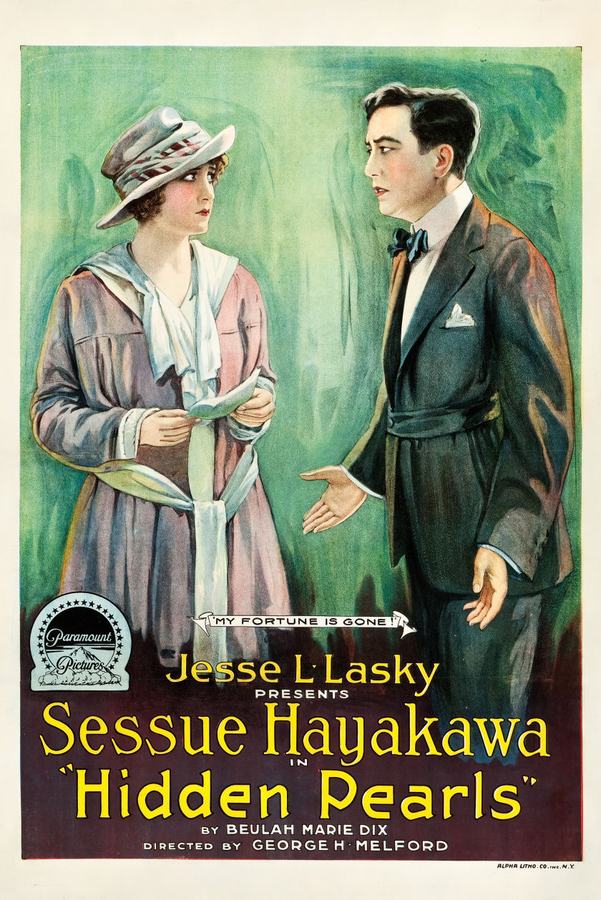
The cinematic landscape of 1918 was a crucible of burgeoning visual language and complex racial dynamics, and few figures occupied this space with as much magnetic gravitas as Sessue Hayakawa. In The Hidden Pearls, directed by James Cruze and penned by the prolific Beulah Marie Dix, we are treated to a narrative that functions simultaneously as an exotic adventure and a poignant critique of Western materialism. This film is a seminal artifact, not merely for its aesthetic merits, but for how it positions the Asian-American lead as a romantic and moral center—a rarity that remains striking over a century later.
The film opens with Tom in a state of cultural amnesia. Having been 'civilized' by the American educational system, he is a man adrift between two worlds, belonging fully to neither. His engagement to Enid Benton (played with a chillingly effective detachment by Florence Vidor) serves as the primary tether to his Western aspirations. Enid is the personification of Gilded Age vanity; her love is a commodity, contingent entirely upon Tom’s financial standing. This dynamic mirrors the thematic concerns found in The Royal Pauper, where social status and intrinsic worth are at constant loggerheads.
When the family fortune vanishes, the facade of Tom’s American life crumbles. The immediate rejection by Enid isn't just a personal betrayal; it’s a systemic one. It highlights the precariousness of the 'integrated' minority within a society that only values them for their utility or their capital. This catalyst propels Tom toward the Pacific, transitioning the film from a drawing-room drama into a lush, ethnographic odyssey. The shift in visual palette, even within the limitations of silent-era tinting, is palpable as the rigid geometry of Honolulu gives way to the organic, flowing lines of the island paradise.
Hayakawa’s performance is nothing short of revolutionary for the period. While his contemporaries often leaned into the histrionics of the era, Hayakawa employed a technique he called mutesage—the art of internalizing emotion. His face is a canvas of subtle shifts; the way his eyes darken when realizing Enid’s shallow nature, or the softening of his features upon meeting Tahona (Margaret Loomis), provides a psychological depth that elevates the film above mere melodrama. His portrayal of Tom’s internal struggle—the 'hidden pearls' of his own character—is the film’s true treasure.
In many ways, Tom’s journey of self-discovery through a return to 'primitive' roots echoes the narrative arcs seen in The Savage, yet Hayakawa imbues the role with a dignity that avoids the pitfalls of the 'noble savage' trope. He is a king returning to his people, not a curiosity being discovered by the West. This distinction is vital to understanding why The Hidden Pearls resonates as a proto-decolonial text.
James Cruze, who would later achieve immortality with The Covered Wagon, demonstrates an early mastery of location shooting here. The island sequences are imbued with a sense of place that feels remarkably authentic for 1918. The camera lingers on the flora and the crashing surf, creating a sensory experience that contrasts with the claustrophobic interiors of the opening act. The sequence where Tahona reveals the hidden lagoon is a highlight of silent cinematography, utilizing light and shadow to create an atmosphere of sacred mystery.
The supporting cast provides a sturdy framework for Hayakawa’s brilliance. Theodore Roberts and Noah Beery bring a seasoned gravitas to their roles, while the presence of James Cruze himself in a minor role adds a layer of historical curiosity. The screenplay by Beulah Marie Dix is surprisingly nuanced, avoiding the heavy-handed moralizing that plagued many films of the time, such as A Question of Right. Instead, Dix focuses on the internal evolution of the protagonist, making his eventual decision to return to the island feel earned rather than forced.
The central conflict of the film’s third act involves Tom’s theft of the pearls. This act represents his final attempt to reconcile with the Western world—to buy back his place in Enid’s heart. It is a moment of profound moral lapse, a 'transgression' of the highest order, reminiscent of the ethical dilemmas explored in Transgression. However, the film’s brilliance lies in what happens next. Upon his return to Honolulu, the pearls do not bring him the satisfaction he anticipated. Instead, they act as a mirror, reflecting the ugliness of the society he once craved.
The scene where Tom realizes Enid’s 'cold manner' is a masterstroke of silent storytelling. The physical distance between them in the frame, the stark lighting, and Hayakawa’s look of sudden, crushing clarity tell the audience everything they need to know. The pearls are no longer a fortune; they are a burden of guilt. His decision to return to the island is not an escape, but an act of restitution. He is not running away from his problems; he is running toward his soul.
To fully appreciate The Hidden Pearls, one must consider the era’s pervasive xenophobia. Only a few years prior, films like The Yellow Menace played on the deepest fears of the American public. In this climate, Hayakawa was a walking contradiction: a Japanese man who was a romantic lead, a fashion icon, and one of the highest-paid stars in Hollywood. The Hidden Pearls subverts the 'Yellow Peril' narrative by making the white antagonist (Enid) the source of moral decay, while the 'exotic' islanders are the keepers of tradition and honor.
The film also touches upon the themes of displacement and the search for home, which were common in immigrant narratives of the time, such as Darkest Russia or Life's Whirlpool. Yet, by setting the story in Hawaii—a territory then under American control—it adds a layer of colonial complexity. Tom’s return to his mother’s island is a reclamation of sovereignty, both personal and political.
While some of the pacing may feel deliberate to modern audiences, the film’s structure is remarkably tight. The editing by the uncredited cutters of the era manages to maintain tension during the escape sequence, while allowing the romantic moments to breathe. The use of intertitles is sparse but effective, allowing the visual performances to carry the emotional weight. This economy of language is something that contemporary filmmakers could still learn from.
The costuming also deserves a mention. The transition from Tom’s impeccably tailored Western suits to his island regalia is a visual shorthand for his transformation. It’s a shedding of a false skin. This attention to detail is what separates a standard studio production from a work of lasting artistic value, much like the stylistic choices seen in Vingarne.
The Hidden Pearls is more than a relic; it is a vibrant, breathing piece of cinema that challenges the viewer to look beyond the surface. It asks difficult questions about what we value and where we truly belong. Through the lens of Sessue Hayakawa’s incomparable screen presence, we see a man who loses the world but finds his soul. It is a story of redemption that feels as vital today as it did in 1918.
For those interested in the evolution of the silent film, or for those who simply wish to see a master at the height of his powers, The Hidden Pearls is essential viewing. It stands as a testament to the power of film to bridge cultures and to tell universal stories of the human heart. It is a cinematic pearl that has, thankfully, been rediscovered for a new generation of cinephiles to admire.
IMDb 6.3
1929
Community
Log in to comment.