DbcultAccessing Vault...
Cult Review
Senior Film Conservator
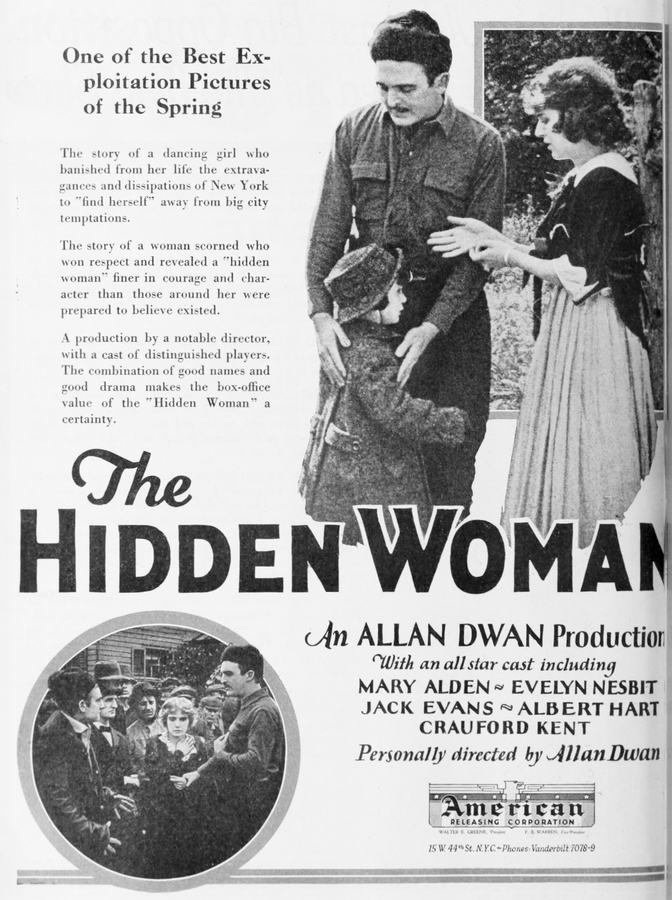
The Hidden Woman glides across the screen like a champagne flute balanced on a fault line: effervescent, perilous, impossible to forget once it shatters.
The year is 1927, months before the real-world crash that will splatter confetti over Wall Street sidewalks. Director Murdock MacQuarrie—also starring as the priggish yet magnetic Bart Andrews—builds his morality play inside candle-lit ballrooms where Charleston heels bruise marble floors and fortunes are whispered into existence over brandy fumes. Ann Wesley (Ruth Darling) enters swaddled in ostrich feathers, a Gatsby-era Venus de Milo armed with a cigarette holder instead of arms. Andrews, half in love, half in sermon, corners her: “You’re hiding the woman you could be behind sequins.” The line lands like a gauntlet; the camera, drunk on iris-ins, seems to nod.
Then the floor drops—literally, via a stock-ticker montage superimposed over Ann’s lace chemise. Her portfolio hemorrhages zeros; the feathers are traded for a thrift-store coat; the chandeliered world recedes into smoke. MacQuarrie dissolves from satin slippers to bare feet on cold pavement, a match-cut worthy of Eisenstein had Eisenstein cared about debutantes. The rest of the film shadows Ann as she descends into the city’s intestinal labyrinth: employment agencies that slam doors, soup kitchens that smell of scalded beans, flophouses where ex-bankers philosophize over broken typewriters.
Here the narrative pivots from drawing-room satire to urban picaresque, a tonal gamble that silents rarely dared after 1925.
Bart, riddled with survivor’s guilt, stalks this underworld clutching the delusion that he can “rescue” Ann back into respectability—never mind that respectability itself has been foreclosed. Their reunion occurs beneath the Third-El tracks; steam from a locomotive clouds the lens, turning the scene into a ghost waltz. Ann, now hardened, refuses both his charity and his matrimony. She has discovered a different dowry: self-possession. The final tableau—Ann walking alone into a snow-dusted dawn while Bart’s silhouette recedes—feels radical for 1927: the woman unhidden, the man hollowed out.
Shot for roughly the cost of one Paramount tea party, the picture invents grandeur through chiaroscuro. Cinematographer Crauford Kent bathes tenement corridors in pools of sodium light that carve cheekbones out of darkness. In one breathtaking insert, he positions Ann’s cracked hand-mirror against a kerosene lamp; the reflection fractures her face into cubist shards, forecasting the coming talkie era’s taste for psychological expressionism. The intertitles—sparse, haiku-like—linger just long enough to let the imagery metastasize.
Compare this resourcefulness to Zagadochnyy mir’s baroque mysticism or The Garden of Allah’s Sahara-sweeping budgets, and you realize how ingenuity can outclass opulence when the story’s marrow is strong.
MacQuarrie’s Bart is a fascinating contradiction—preacher’s collar, libertine’s eyes. His hands tremble with evangelical certainty even as his gaze undresses the decadence he denounces. In the penultimate reel, when Bart finally confesses that he too has lost everything, MacQuarrie lets his right eyebrow hitch a millimeter—an earthquake in miniature.
Ruth Darling’s Ann navigates a 180-degree arc without tilting into melodrama. Watch her pupils in the nightclub prologue: dilated, drinking in applause. By the time she’s scrubbing barroom floors, those same eyes have contracted to pinpricks, yet they blaze. The transition feels biological, as if Darling has metabolized the film’s central thesis: identity is liquidity, but dignity is not.
Support turns sparkle: Al Hart as a racetrack tout turned philosopher-king of the breadline; Evelyn Nesbit (yes, that Evelyn Nesbit) in a cameo as a couture-clad ghost from Ann’s past, drifting through a pawn-shop window like an absinthe hallucination.
While the print I viewed (BFI’s 2019 2K restoration) features a commissioned score, history records that 1927 audiences heard the film with a single violinist in many provinces. The new arrangement—strings, brushed snare, muted trumpet—mirrors Ann’s emotional portfolio: high-flown waltzes sour into bluesy glissandi, culminating in an unresolved chord that vibrates like a hangover. The absence of spoken dialogue intensifies every creak of floorboard, every hiss of steam, until the theater itself becomes a breathing organism.
On the surface, The Hidden Woman peddles the redemptive power of hardship—a Horatio-Algier myth in lipstick. Dig deeper and you unearth a scathing autopsy of Roaring-Twenties capitalism. Ann’s wealth evaporates overnight, but the real calamity is the revelation that her social circle values her only as long as her purse jingles. Bart’s moral superiority, too, is unmasked as another currency, one that buys him self-righteousness at bargain rates yet bankrupts him of empathy.
The film anticips Keynesian doubts: what happens to human worth when the market, that invisible deity, suffers a psychotic break?
Gender politics sparkle with equal acidity. Ann’s eventual refusal of rescue flips the damsel trope on its tiara. She will not marry for solvency; she demands consilience of souls or none. In 1927, such autonomy felt almost seditious, especially when contrasted with For Husbands Only, released the same year, where a wife’s rebellion dissolves into domestic comedy.
The Diamond Necklace shares a material-girl-reduced conceit, yet its heroine finds salvation through romantic martyrdom—The Hidden Woman prefers the sting of self-reliance. Meanwhile, I Am Guilty wallows in masochistic confession, whereas Ann’s journey is outward, economic, existential.
MacQuarrie’s film also converses with contemporaneous European works. The snow-dusted finale recalls the brutalist melancholy of Schuld oder Schein, though where the German piece indicts collective guilt, The Hidden Woman atomizes it to the personal: one woman, one conscience, zero safety nets.
For decades the film slumbered in a Belgian archive, mislabeled as The Hidden Ones. The 2019 restoration sourced two incomplete nitrate prints, recombined 1179 shots, and color-tinted the ballroom scenes in amber that flirt with ochre. Streaming rights remain fractured: Criterion Channel rotates it quarterly; Kino Lorber’s Blu-ray offers a commentary by Shelley Stamp; occasional 35 mm screenings tour rep houses like a clandestine speakeasy. Check your local cinematheque; this is not on Netflix algorithmic radars.
Great art often arrives unheralded, wearing a thrift-store coat much like Ann Wesley in her nadir. The Hidden Woman is such a find—economical yet opulent, sermonizing yet never sanctimonious, a film that trusts the audience to connect ticker-tape panics with today’s crypto winters. It preaches no easy uplift; instead, it offers a flicker: identity forged in crisis glows hotter than any trust-fund spotlight.
Seek it out. Let the orchestra swell, let the violin scrape your nerves raw, let Ruth Darling’s eyes bore through a century of dust. You will emerge certain of only one thing—the woman, once hidden, refuses to be concealed again.
Running time: 77 min. | Silent with musical score | Unrated equivalent (mild thematic elements) | Black & white with amber/blue tinting
IMDb —
1925
Community
Log in to comment.