DbcultAccessing Vault...
Cult Review
Senior Film Conservator
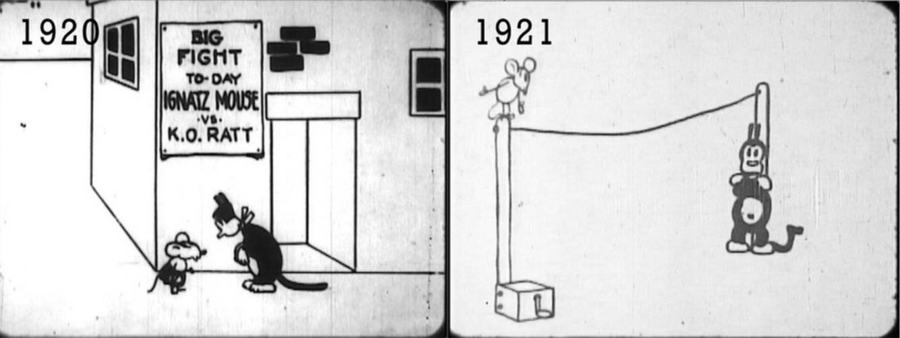
To witness The Hinges on the Bar Room Door is to observe the primordial soup of American slapstick as it begins to crawl onto the dry land of narrative structure. George Herriman, the mastermind who would later gift the world the sublime absurdity of Krazy Kat, brings a jagged, nervous energy to this production that distinguishes it from the more pedestrian comedies of its era. While films like Jumbles and Jokers relied on broader, perhaps more conventional situational ironies, this Stallings-fronted vehicle operates on a frequency of pure movement. The bar room door is not merely an object; it is a metaphysical boundary, a rhythmic metronome that dictates the pace of the entire cinematic experience.
The film’s brilliance lies in its restriction. By centering the action around a single architectural focal point, Herriman and Stallings create a claustrophobic yet expansive arena for physical comedy. Unlike the sprawling domestic disasters found in Cooks and Crooks, the stakes here are distilled into the very act of passage. The hinges themselves become characters, their invisible groans—implied by the frantic visual pacing—serving as the soundtrack to a frontier society in a state of perpetual collision. It is a study in the geometry of the gag, where the angle of a swing or the timing of a recoil carries the weight of a Shakespearean monologue.
Vernon Stallings delivers a performance that is remarkably lean. In an era where many actors were still struggling to shed the exaggerated gesticulations of the vaudeville stage—a problem evident in some sequences of Stop That Shimmy—Stallings displays a proto-modernist restraint. His movements are sharp, economical, and perfectly synchronized with the mechanical whims of the set. He navigates the swinging doors with the precision of a clockmaker, turning a simple entrance into a choreographed ballet of near-misses and direct impacts.
This physicality is essential because the script provides no safety net. There is a raw, unvarnished quality to the humor that feels closer to the gritty realism of Fighting Mad than to the polished whimsy of later silent classics. Stallings occupies the frame with a sense of desperate urgency, as if he is aware that the very world around him—the wood, the glass, the dust—is conspiring to eject him from the narrative. This tension between the man and the machine (or in this case, the man and the hinge) creates a visceral viewing experience that transcends the limitations of its primitive technology.
One cannot discuss this film without analyzing the DNA of George Herriman. His writing here anticipates the shifting horizons and surrealist logic of Coconino County. The way the bar room functions—as a space where logic is suspended and physical laws are dictated by the needs of the joke—echoes the thematic depth found in Il film rivelatore, albeit through a much more populist lens. Herriman treats the saloon as a microcosm of the human condition: we are all swinging through doors we don't fully understand, hoping for a drink and fearing a collision.
The visual language of the film, though constrained by the static cameras of the 1910s, manages to evoke a sense of depth through layered action. While contemporary works like Fantômas: In the Shadow of the Guillotine were utilizing shadows and mystery to build suspense, Herriman uses the stark, flat lighting of the comedy set to emphasize the absurdity of the physical form. There is nowhere to hide in this bar room; the hinges expose everyone. This exposure creates a democratic form of comedy where the high-born and the low-life are equally susceptible to the door's indifferent swing.
When placed alongside The Evil Thereof, the lighthearted nihilism of The Hinges on the Bar Room Door becomes even more apparent. Where other films of the period sought to moralize or provide a cautionary tale about the vices of the tavern, Herriman and Stallings find only a playground of physics. There is a refreshing lack of sentimentality here. Even The Thirtieth Piece of Silver, with its heavy-handed allegorical weight, feels distant from the pure, unadulterated joy of a well-timed face-plant in a dusty saloon.
Furthermore, the film touches upon the burgeoning American obsession with efficiency. The swinging door is a labor-saving device that, in the hands of these creators, becomes a labor-inducing nightmare. It reflects the same anxieties found in Will It Come to This, where the future is viewed with a mixture of awe and trepidation. The hinges are the gears of a social machine that is moving too fast for the characters to control. It is a theme that resonates through the ages, from the silent era to the digital present.
Technically, the film is a marvel of timing. The editing—primitive as it may seem to modern eyes—must have been a Herculean task of matching action across cuts. To maintain the illusion of a continuous, rhythmic banging of the doors requires a level of directorial foresight that was rare in the mid-1910s. We see echoes of this precision in Rip & Stitch: Tailors, but here the stakes feel higher because the environment is more volatile. The bar room is a place of potential violence, and by subverting that violence into comedy, the film achieves a sophisticated level of social commentary.
The use of space is equally impressive. The camera remains a silent observer, much like the voyeuristic lens in Oh, You Kid, but it captures a much more frantic energy. The frame is often crowded, yet the focus never wavers from the central conflict between man and hinge. This clarity of vision is what allows the film to remain watchable over a century later. It doesn't rely on topical humor that would have faded; it relies on the universal language of gravity and momentum.
As we look back at the trajectory of silent film, The Hinges on the Bar Room Door stands as a pivotal moment where the "gag" began to evolve into "cinema." It shares a certain DNA with Straight Is the Way in its exploration of the path one takes through life, though Herriman’s path is significantly more circular and prone to hitting one in the face. The film’s influence can be seen in the works of Buster Keaton and even the early sound comedies where sound effects would eventually replace the visual "thwack" of the door.
The film also serves as a fascinating companion piece to With the Moonshine on the Wabash, providing a more urban, or at least more settled, counterpoint to the rural moonshining tropes. It is a celebration of the public house as the center of the universe, a place where all life—and all comedy—eventually converges. Even when compared to the dramatic intensity of Rose Bernd, there is a different kind of truth to be found in Stallings’ struggle with the saloon door—a truth about the inherent clumsiness of being human.
In the final analysis, this short film is a masterclass in minimalist storytelling. It proves that you don't need a sprawling cast or an epic budget to capture the essence of a character or a culture. All you need is a man, a thirsty disposition, and a pair of hinges that refuse to stay still. It is a vibrant, flickering testament to the power of the early moving image and a reminder that sometimes, the most profound insights into our nature come from the simplest of movements. The hinges may be rusty, and the film stock may be grainy, but the laughter it evokes is as sharp and clear as the day it was first screened.
IMDb —
1931
Community
Log in to comment.