DbcultAccessing Vault...
Cult Review
Senior Film Conservator
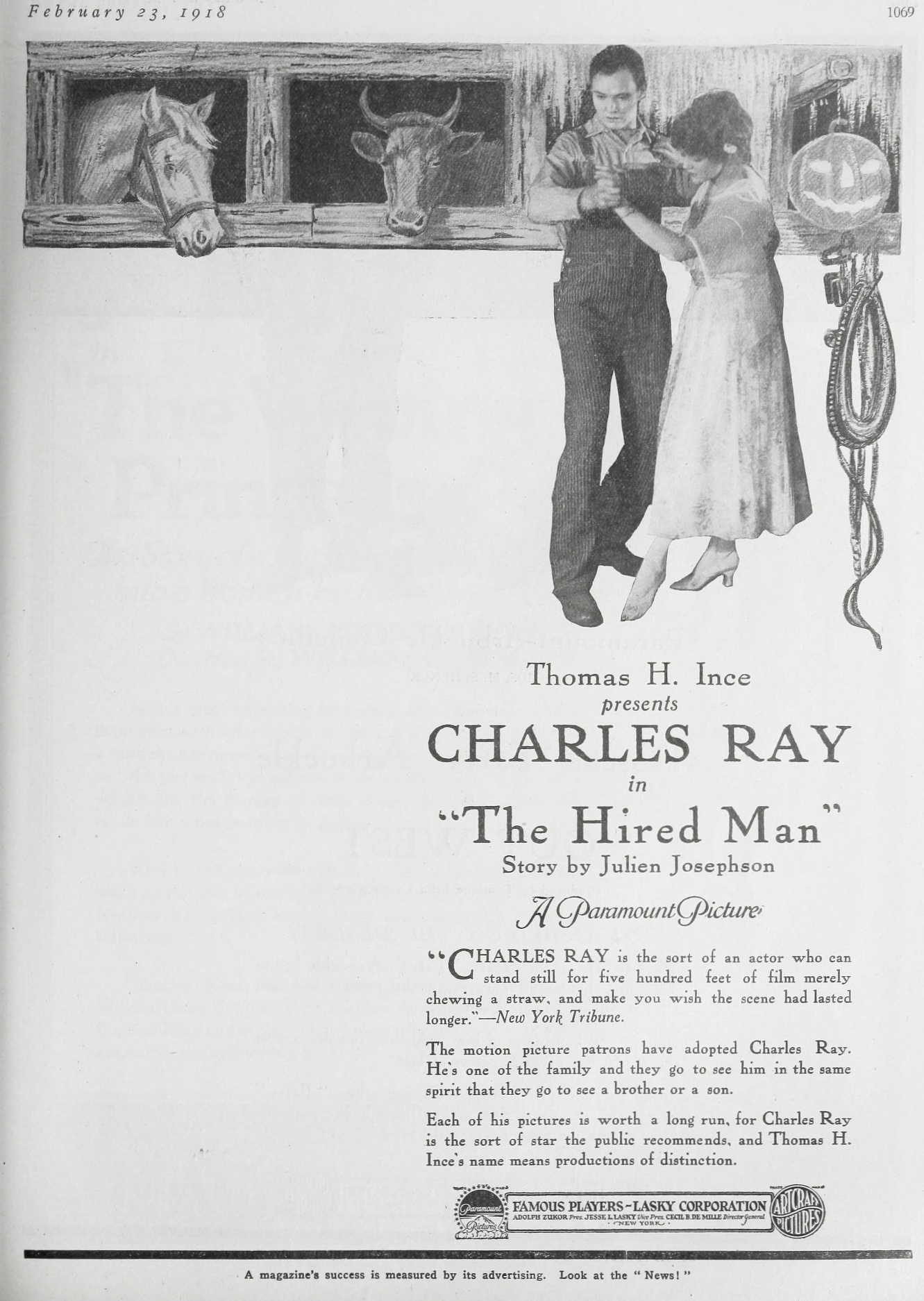
The barn rafters creak like an arthritic cathedral, and into that hush steps Ezra Hollins—sunburnt Icarus clutching a second-hand grammar book instead of wings.
Julien Josephson’s screenplay for The Hired Man (1923) distills the entire American class neurosis into a single, blistering gesture: a laborer hands over his only ticket out, and in doing so rewrites the moral genome of silent-era melodrama. Where Little Lord Fauntleroy gentrifies poverty into lace collars and titled estates, this film drags privilege through the chaff and manure until it smells of something honest.
William Fairbanks, often dismissed as a lesser Douglas, gives Ezra a coiled stillness—his eyes flicker like lantern wicks whenever Ruth (Doris May) enters the milking parlor. May, for her part, refuses the moonbeam fragility expected of 1920s ingenues; her Ruth is all elbows and curiosity, freckles blooming across the bridge of her nose like scattered seed. Their chemistry is not the swooning clutch of The Blindness of Love but something more combustible: a tutorial on verb conjugation that feels dirtier than any clinch.
Director Henry King—yes, the future auteur of The Song of Bernadette—shoots the Endicott farm as if it were a battlefield. Every sheaf of wheat is a potential bayonet; every sunset a bleeding wound. Compare that to the antiseptic poverty of To Him That Hath, where destitution arrives pre-sanitized for Protestant guilt. Here, the dirt under Ezra’s fingernails is sacramental, and the moment he scrapes it off to shake the banker’s manicured hand, you feel the entire republic shudder.
When Ezra signs over his college fund—those crumpled dollars that smell of sweat and silage—the intertitle card burns white-hot against the sepia: “For Ruth’s kin.” King holds the medium shot for an almost sadistic duration, letting the banker’s inkwell glint like a Cyclops eye. It is the inverse of Sold at Auction, where human flesh is bartered in plain sight; here, the commodity is aspiration itself, auctioned to cancel another man’s folly.
Critics who lump this film with bucolic pap like The Duchess of Doubt miss the primal scream embedded in Josephson’s intertitles. Ezra’s sacrifice is not Christlike but Promethean—he steals the fire of education only to hurl it back at the gods of capital. The resulting conflagration singes every frame, turning the final reconciliation into something closer to The Reign of Terror than a Hallmark ending.
Because this is 1923, the silence itself becomes rhetorical. When Ruth’s father, Caleb (Charles K. French), denounces Ezra for “lacking gumption,” the absence of diegetic sound makes his sneer echo across a century. The intertitle’s serif font—fat, pompous, black—feels like a capitalist boot print. Meanwhile, Ezra’s responses are set in thinner, sparser type, as if the very alphabet were rationed for the poor. The film’s visual grammar anticipates the montage ferocity of Black Fear, though here the terror is agrarian, not urban.
Watch how cinematographer Faxon M. Dean shoots the harvest moon: first as a copper coin suspended above Ruth’s hair, later as a corroded penny when Ezra is shunned. The celestial body becomes a barometer of social capital, more damning than any ledger. In contrast, The Eagle’s Eye uses similar lunar imagery for espionage thrills; here it is a cosmic accountant, tracking who owes whom breath.
When Caleb finally clasps Ezra’s shoulder—anointing the hired man as future heir—the gesture arrives so laden with prior contempt that it feels like a backhanded coronation. King blocks the scene like a forced marriage in Syndens datter, but the power dynamic has flipped: the patriarch needs absolution more than the prodigy needs legitimacy. Ruth’s veil, fluttering against Ezra’s patched overalls, becomes a battle standard stitched from both silk and sackcloth.
Yet the film refuses catharsis. In the final shot, King holds on the couple walking toward the horizon, but the camera lingers on the empty bunkhouse Ezra once occupied. A breeze rifles through his dog-eared algebra primer; the pages flutter like dying moths. The implication: ambition, once mortgaged, can never fully repay its debt. It is a sting subtler than the downbeat coda of The Law That Failed, but it festers longer.
The 2022 4K restoration by the Library of Congress—struck from a mint-condition 35mm nitrate negative discovered in a DeKalb, Illinois, barn—reveals textures previously smothered in dupiness: the herringbone weave of Ezra coat, the opalescent sheen of Ruth’s mother-of-pearl buttons. The tinting schema is revelatory: amber for daylight labor, lavender for clandestine night study, sickly green for the banker’s parlor. Compare that to the muddy preservation of The Claw, where entire emotional arcs vanish into sepia sludge.
More importantly, the restoration reinstates Josephson’s original intertitles, long thought lost. One card—cut by censors in 1924—reads: “A man may own soil, yet rent his soul by the hour.” That line alone vaults the film above the moral didacticism of Her Sister’s Rival, anchoring it in the same raw lyricism that fuels Steinbeck’s later Of Mice and Men.
Fairbanks’s Ezra never succumbs to the saintly stasis that sinks He Fell in Love with His Wife. Watch the micro-twitch when Ruth, correcting his Latin, accidentally brushes his wrist—his Adam’s apple plummets like a trapdoor. It is a carnal moment smuggled inside a grammar lesson, worthy of D. H. Lawrence. May matches him with a tremor of her own: her chalk snaps, powdering the slate with dust that hangs like guilt. Their restraint makes the eventual hand-clasp feel seismic.
Charles K. French, saddled with the thankless patriarch archetype, injects Caleb with a whiskey-throated vulnerability. In the restored print, you can spy a tear beading at the corner of his eye when he signs the bank note—an admission that capital, too, is hostage to fear. Lydia Knott, as the spinster aunt, delivers the film’s slyest performance: a single off-frame cackle when Caleb finally capitulates, suggesting the old guard always knew the house would fall.
Though eclipsed by the expressionist juggernauts of 1923—The Hunchback of Notre Dame, Safety Last!—The Hired Man quietly pollinated later rural dramas. The tuition-sacrifice trope resurfaces in It’s a Wonderful Life, albeit cushioned by Capra’s populist balm. The barn-as-cathedral motif reappears in Days of Heaven, though Malick swaps Protestant guilt for pantheist awe. Even the laconic close-up of discarded textbooks echoes in October Sky when Homer Hickam’s rocket blueprints flutter to the coal-dust floor.
Yet no subsequent film dares the same austerity. When Ezra turns away from the college gates, the camera does not follow; it stays planted in the mud, as if to remind viewers that most American dreams dissolve not in tragedy but in the slow hemorrhage of everyday sacrifice. That refusal to chase the horizon places The Hired Man closer to the social brutality of Skæbnesvangre vildfarelser than to the sentimental uplift of its contemporaries.
The restored edition streams on Criterion Channel (search “the-hired-man” in their silent cinema vault) and rotates monthly on Kanopy via university libraries. Physical media devotees can snag the dual-format Blu-ray from Kino Lorber, which bundles an audio essay by historian Shelley Stamp and a 16mm behind-the-scenes reel showing Fairbanks practicing plowing in Beverly Hills—an urbanite mimicking the agrarian agony he would soon immortalize.
Watch it back-to-back with The Payment for a double bill on debt and moral liquidity. Or pair it with Sold at Auction to trace how silent cinema negotiated the human cost of capital. Just don’t watch it alone. Ezra’s final glance toward the empty bunkhouse demands a witness—someone to confirm that the American promise was always mortgaged against somebody else’s future.
Verdict: A bruised masterpiece that rewrites the Horatio Alger myth into a psalm of mud, money, and magnanimity. Five shattered plowshares out of five.
IMDb 3.4
1928
Community
Log in to comment.