DbcultAccessing Vault...
Cult Review
Senior Film Conservator
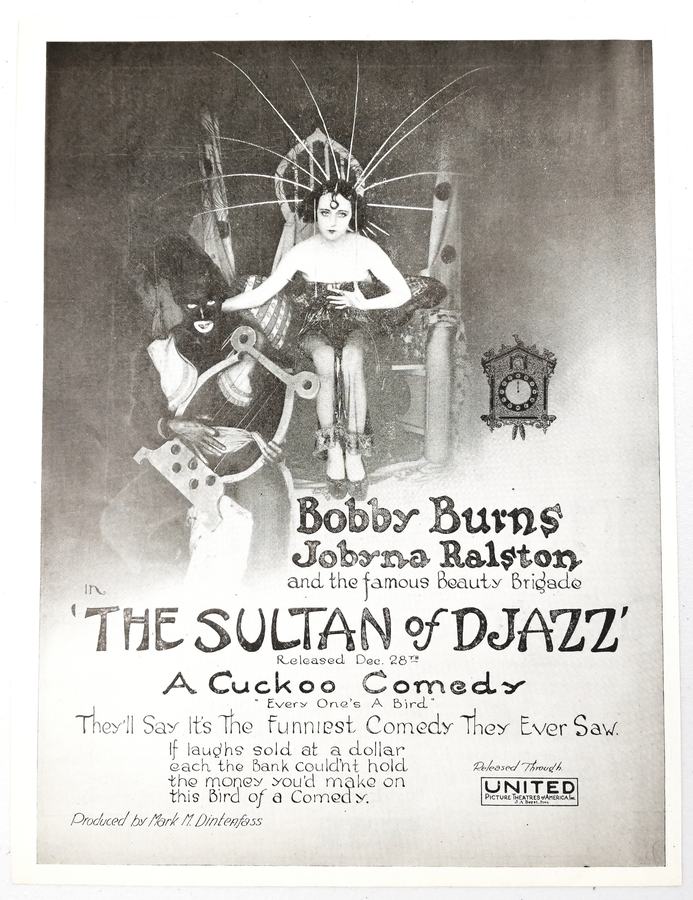
The year 1923 represented a peculiar inflection point in the American consciousness. The scars of the Great War were being cauterized by the white-hot intensity of the Jazz Age, a period defined by its frantic rejection of Victorian sobriety. It is within this effervescent cultural milieu that The Sultan of Djazz emerges, not merely as a slapstick diversion, but as a celluloid artifact reflecting the erratic pulse of its time. To watch this film today is to engage with a ghost of the proscenium, a flickering sequence of frames that captures the exact moment when the world decided to stop walking and start dancing.
In the absence of spoken dialogue, the narrative weight of The Sultan of Djazz rests upon the expressive physicality of its leads. Bobby Burns, a performer often overshadowed by the pantheon of Lloyd or Keaton, exhibits here a remarkable gymnastic wit. His movements are not merely gestures; they are a form of punctuation. When he navigates the crowded ballroom scenes, his body language suggests a man constantly trying to outrun his own shadow. This kinetic desperation is reminiscent of the protagonist's journey in Mästertjuven, where the thrill of the chase becomes the primary engine of character development. However, where that film leans into the shadows of criminality, The Sultan of Djazz basks in the neon glow of the cabaret.
The title itself, with its idiosyncratic spelling of 'Djazz,' hints at the exoticism that the 1920s projected onto the musical genre. It was a time when the 'Orient' and the 'Urban' were often conflated in the popular imagination to represent a break from the mundane. The film plays with these tropes, casting its lead in a role that requires him to perform an identity that is both royal and rhythmic. This exploration of the 'other' through a lens of social performance can be intellectually linked to the mythological grandeur found in Mohini Bhasmasur, though the latter treats its themes with a theological weight that the Sultan’s light-hearted romp avoids.
Jobyna Ralston is the true revelation of the piece. While many actresses of the era were confined to the role of the 'ingenue' or the 'vamp,' Ralston occupies a middle ground of intelligent mischief. Her eyes, captured in tight close-ups that defy the technical limitations of 1923, convey a cynical awareness of the farce unfolding around her. She is not merely an object of desire; she is the architect of her own social navigation. In many ways, her character shares the resilient DNA of the protagonist in The Waif, yet Ralston’s character has traded the rags of poverty for the sequins of the upper class, proving that the struggle for survival merely changes its wardrobe as one ascends the social ladder.
Her chemistry with Burns is a masterclass in rhythmic timing. In the scenes where they are forced to maintain a facade of dignity while the world around them descends into chaos, they demonstrate a synchronicity that mirrors the very jazz music the film celebrates. This is not the heavy-handed drama of La madona de las rosas; this is a light, airy souffle of a performance that requires immense skill to prevent from collapsing. Ralston’s ability to remain grounded while Burns spins into comedic orbit is what allows the film to maintain its emotional resonance.
Technically, the film is a fascinating specimen of early cinematography. The lighting in the nightclub sequences utilizes a high-contrast palette that predates the noir sensibilities of the 1940s. The sea of black tuxedos and white silk dresses creates a visual rhythm that is as syncopated as the soundtrack would have been in a live theater. The director’s use of the frame—often packing it with extras to create a sense of claustrophobic opulence—serves to heighten the tension of the Sultan’s deception. We feel the walls of high society closing in on our imposter hero.
This visual density invites comparison to Gems of Foscarina, which similarly utilized ornate set designs to reflect the internal states of its characters. In The Sultan of Djazz, the sets are characters in themselves—the overstuffed armchairs, the shimmering chandeliers, and the endless corridors all serve to highlight the protagonist's status as an interloper. He is a man out of place, a theme that resonates deeply with the narrative arc of The Outsider, albeit delivered through the medium of laughter rather than pathos.
At its core, The Sultan of Djazz is a biting satire of the American obsession with titles and lineage. The ease with which the protagonist is accepted into the inner sanctums of the elite—simply by adopting the moniker of a 'Sultan'—speaks volumes about the superficiality of the era’s social gatekeeping. This thematic thread is a commonality shared with Nearly a Lady, where the transformation of self is depicted as a performative art form. The film suggests that in the Jazz Age, identity is not something you are born with, but something you put on like a record.
The absurdity of the situation reaches its zenith during the grand banquet scene. Here, the film transitions from situational comedy into something approaching the surreal. As the 'Sultan' is asked to weigh in on matters of state and philosophy, his improvised answers are met with profound nods of agreement from the aristocrats. It is a scathing indictment of intellectual vanity, echoing the deceptions found in The Liar. The comedy stems from the audience's awareness of the truth, creating a delicious irony that sustains the film through its middle act.
The final act of the film is a whirlwind of motion. As the Sultan’s true identity is threatened by the arrival of an actual dignitary, the film shifts into high gear. The ensuing chase through the ballroom, the kitchen, and eventually out onto the city streets is a triumph of editing. The cuts become shorter, the action more frenetic, mimicking the rising tempo of a jazz solo. It is a moment of pure cinema, where movement and light tell a story that words would only encumber. This sense of breathless adventure is a stark contrast to the more somber, expansive journey depicted in Thru the Roosevelt Country with Colonel Roosevelt, highlighting the diverse ways in which silent film captured the American spirit—one through the majesty of the landscape, the other through the madness of the city.
When the dust settles and the Sultan is unmasked, the film offers a surprisingly poignant resolution. Rather than a harsh punishment, there is a sense of shared realization. The elite have been entertained, and the imposter has tasted a life beyond his station. In this regard, the film touches upon the complex morality of The Parson of Panamint, where the boundaries of right and wrong are blurred by the needs of the community. In The Sultan of Djazz, the community’s need was for a distraction, and the Sultan provided it in spades.
To dismiss The Sultan of Djazz as a mere relic of a dead genre is to ignore its foundational contribution to the grammar of modern comedy. It established a blueprint for the 'fish out of water' narrative that continues to dominate screens today. More importantly, it captures a specific frequency of human joy—the kind of joy that can only be found in the middle of a dance floor, surrounded by strangers, while the world outside threatens to change forever. It lacks the religious fervor of Comrade John or the political weight of The Golden God, but it possesses something perhaps more valuable: an unadulterated sense of play.
In the end, we are all Sultans of our own Djazz, improvising our way through a world that rarely provides us with the sheet music. This film is a celebration of that improvisation. It is a reminder that even when the masquerade ends and the lights come up, the rhythm remains. Whether you are a fan of the silent era or a newcomer to the charms of Jobyna Ralston, The Sultan of Djazz is a mandatory viewing experience—a syncopated masterpiece that proves, even after a century, that the beat goes on.
IMDb —
1913
Community
Log in to comment.