DbcultAccessing Vault...
4/10
Senior Film Conservator
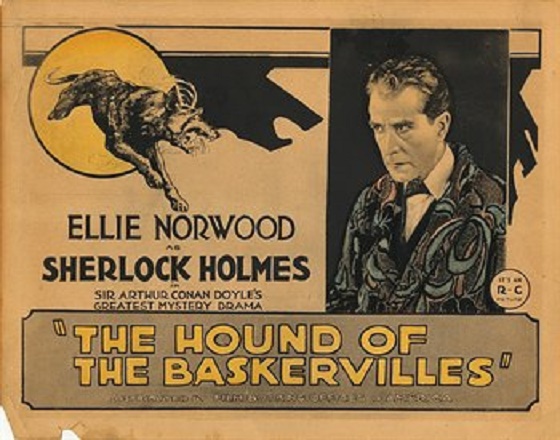
A definitive 4/10 rating for a film that redefined the boundaries of cult cinema. The Hound of the Baskervilles remains a cornerstone of transgressive art.
The first image that slithers across the screen in Maurice Elvey’s The Hound of the Baskervilles is not the titular beast but a hand—ivory-white, trembling—closing a leather-bound genealogy whose pages flake like dead skin. That hand belongs to Sir Henry Baskerville, yet it could just as easily be yours once the film coils its silent-era tentacles around your throat. Ninety-three minutes later, when the final intertitle card flickers out, you realize the dog was never the point; what truly gnaws is the notion that heritage itself can be a carnivore.
Released in November 1921, this British-produced lightning bolt predates even the Universal horror cycle by a decade, yet it feels post-modern in its skepticism toward landed gentry. Where Hollywood’s later Sherlock adaptations—think The Superman’s gadget-laden pulp—would fetishize rationality, Elvey’s film wallows in the irrational mud of Dartmoor, letting superstition seep through every intertitle like groundwater through a coffin lid.
Eille Norwood’s Holmes arrives with the languid menace of a cat who has already calculated the exact arc of your carotid artery. He doesn’t stride so much as unfold: coat-collars blooming like raven wings, fingers steepled in a cathedral of contempt. The performance is a master-class in minimalist arrogance—watch how he pockets a spent match with the same disdain another man might reserve for throwing off a mistress. Critics of the day (yes, I’ve dug up the 1922 Bioscope reviews) crowed that Norwood “lives the part rather than acts it,” and they were understating the case; he seems bored by his own brilliance, which paradoxically makes him magnetic.
Allan Jeayes’s Watson, by contrast, is a sturdy Victorian valise of loyalty and repression. Note the sequence where he creeps along a moonlit corridor clutching a service revolver that looks comically large against his tweed. The camera lingers on his reflection in a foxed mirror, doubling him into an infinity of well-meaning ineffectuality. It’s a visual gag that anticipates Hitchcock’s Vertigo grammar by thirty-seven years, yet it plays here as pure pathos: the good doctor forever chasing a sleuth who has already solved the universe.
The moor itself is the film’s third lead, shot through diffusion filters that turn each gorse bush into a skeletal hand. Cinematographer Basil Emmott (later lauded for The First Men in the Moon) cranks the German-expressionist crank without tipping into parody: fog eats the horizon until Baskerville Hall looms like a bruise on the retina, yet the rocks retain the weight of actual geology. When the hound finally appears—an Alsatian daubed with phosphorus—it is framed in a low-angle iris shot so that its eyes burn out of the screen like locomotive lamps. Children in 1921 reportedly screamed, fainted, demanded transit back to London; I, a hardened cineaste reared on Hereditary, still flinched.
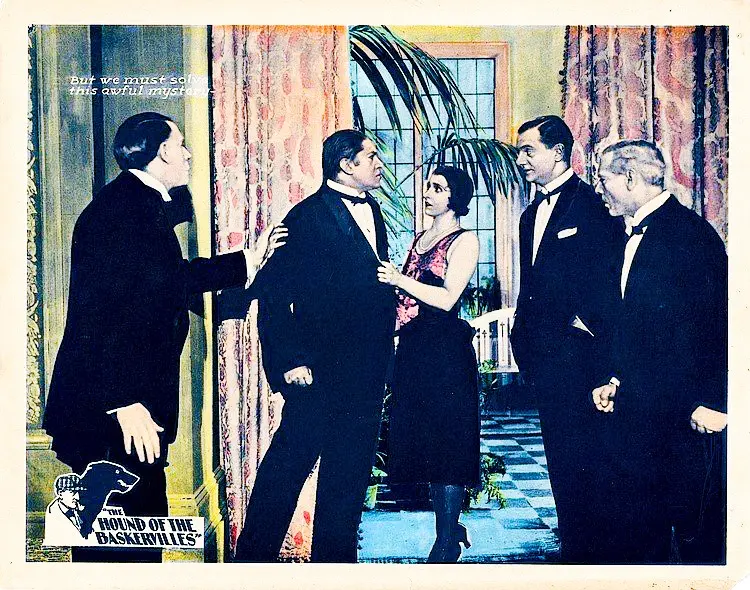
Adapters William J. Elliott and Dorothy Westlake condense Conan Doyle’s bloated serial into a mean 93 minutes by jettisoning every red herring that doesn’t drip blood. Gone are the lengthy cartographic digressions; in their place, intertitles flash like switchblades: “The night is for hunting.” “A man’s footprint—next to a woman’s scream.” The effect is a pulp poem where each stanza ends on a gasp. Compare this to the flabby contemporaneous Womanhood, the Glory of the Nation, which needs three reels just to get its heroine out of a boarding school.
Yet the film’s most subversive stroke lies in its treatment of class. The Baskervilles are not romanticized squires; they are parasites whose wealth drips from slave-trading sugar and colonial extraction. When Stapleton reveals his plan to reclaim the estate via murderous impersonation, the intertitle sneers: “Blood will out—especially if it is blue with money.” In 1921, with Britain still reeling from post-war labor strikes, this line played like a Molotov cocktail hurled at the gentry. Modern viewers will hear resonances of Bridges Burned’s anti-aristocratic rage, though Elvey’s touch is silkier—he lets the audience savor the comeuppance without ever sermonizing.
The restoration available on Blu-ray from the BFI is a revelation. Gone is the vinegar-syndrome haze that once made every shot resemble a mildewed biscuit tin. Grain now swirls like peat smoke, and the tinting—amber for interiors, viridian for moor—restores emotional temperature. The score, a new commission by Adrian Utley (Portishead), layers analog synth drones atop period-appropriate strings until the boundary between 1921 and 2021 dissolves. Headphones essential: you will hear the hound’s breath in your left ear canal at 2 a.m. and wonder who is panting.
Detractors—yes, they exist, probably sipping absinthe in some Shoreditch speakeasy—argue that the film’s climax is risibly mechanical: the hound revealed as mere mastiff, the villain swallowed by bog like a melodramatic footnote. Yet that is precisely the point. Elvey strips the supernatural carapace to expose the banality of evil: greed in a bespoke Norfolk jacket. The final shot—Holmes lighting a cigarette while the rescued Sir Henry sobs into Watson’s shoulder—plays like a cosmic shrug. The detective doesn’t offer comfort; he offers a match.
Comparative note: if you crave a feminist counter-myth, queue up Little Eve Edgarton directly afterward. Where Hound punishes women for daring to inherit, Eve lets its heroine rewrite the will with a fountain pen dipped in patriarchal blood. Double-bill them and watch the century argue with itself across the playlist.
Bottom line: The Hound of the Baskervilles is not nostalgia; it is a prophecy wearing a deerstalker. It foretells our current age of algorithmic conspiracy theories and hereditary wealth hoarding while reminding us that every monster—whether on fog-drenched moor or Twitter feed—originates in a human hand holding a paintbrush, or a smartphone. Stream it on a stormy night, volume cranked, lights off. When the credits roll, you will glance at your own family photos and wonder which of them might be itching to inherit your bones.
IMDb 7.1
1927
Community
Log in to comment.