DbcultAccessing Vault...
6.9/10
Senior Film Conservator
A definitive 6.9/10 rating for a film that redefined the boundaries of cult cinema. The Killer remains a cornerstone of transgressive art.
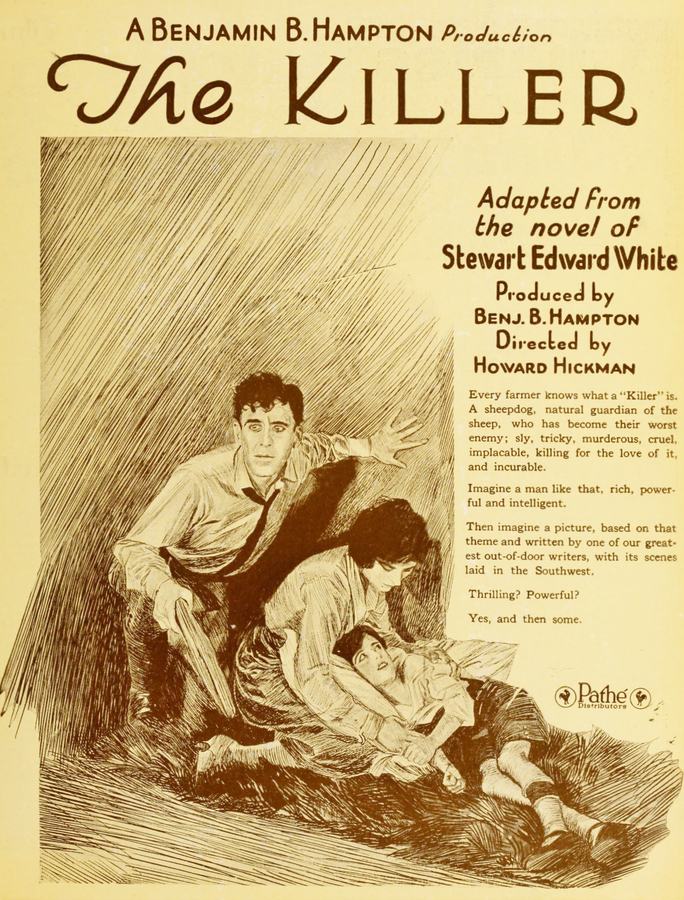
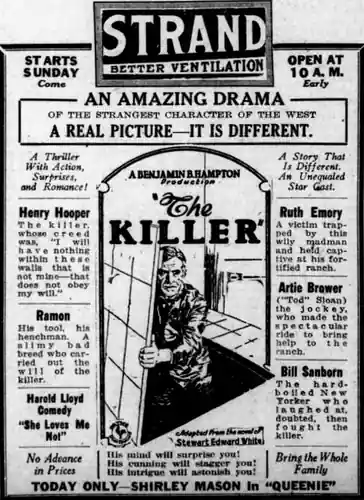
The first thing that strikes you about The Killer is how aggressively it refuses the postcard myth of the frontier. Richard Schayer and Stewart Edward White’s screenplay treats the border not as a dotted political line but as a psychic fracture—an open wound where trust putrefies faster than mesquite carcasses. Cinematographer Edward Earle (uncredited yet indispensable) lets the camera loiter on barbed wire until it looks like a string of black teeth, then tilts up to reveal Henry Hooper lounging beneath a ramada, hat brim devouring his face. Even before the intertitles intrude, we know this man has already orchestrated doom; his silhouette alone is a confession.
Silent-era westerns usually swagger; this one slithers. The plot’s inciting incident—the murder of Emory—occurs off-camera, relayed only through a blood-smeared letter that Hooper promptly steals. That act of textual larceny turns the screenplay itself into a character: parchment becomes body, ink becomes blood. When Emory arrives, lugging little Ruth and Bobby, the audience already carries a clandestine awareness that the children’s father is a ghost on furlough. Their naïveté is unbearable precisely because the film withholds the usual orchestral foreshadowing; instead, crickets creak and windmill blades groan like slow torture.
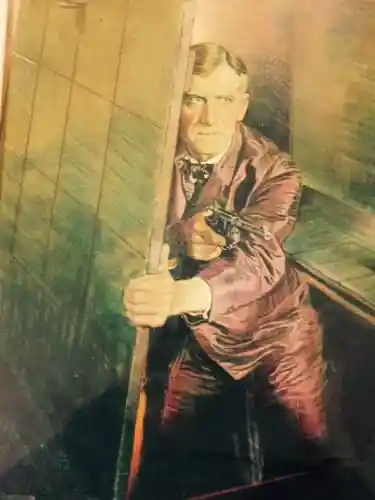
Will Walling plays Hooper with the flabby amiability of a small-town banker, which makes his venality reptilian. Notice how he ruffles Bobby’s hair: fingers splayed a fraction too wide, as though measuring the skull for a future grave. Every gesture is calibrated to remind us that true predators rarely advertise; they resemble uncle, benefactor, guardian—until the click of a hammer behind the ribcage.
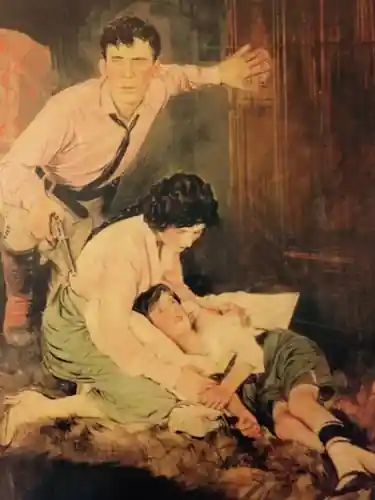
Ruth and Bobby are more than endangered innocents; they are the film’s moral ballast. Their wide eyes refract the adult perfidy around them into grotesque carnival shapes. In one chilling tableau, Ruth clutches a porcelain doll whose head has crazed into spiderweb cracks—an image that feels prophetic of her own fractured tomorrow. Yet the film denies them the saccharine salvation common to melodramas. Their rescue is clumsy, harried, nearly fatal: Sanborn throws them across a saddle like feed sacks while rifle rounds chew the adobe behind them. Survival here is not baptismal; it is merely the right to keep breathing.

Zack Williams’s Sanborn arrives halfway through, sun-hardened, speaking so sparingly the intertitles almost stutter. His laconic aura recalls The Recruit’s taciturn drifter, yet Williams adds a veneer of Protestant guilt: you sense he has already failed someone, somewhere, and refuses to compound the sin. The instant he spooks at Hooper’s too-hearty laughter, the film pivots from domestic noir to pursuit poem. The rescue sequence—shot day-for-night with magnesium flares—feels like a negative-image nativity: two kids astride a stranger’s horse, fleeing toward an unknown heaven while a false shepherd bleeds out in the dust.
Frank Campeau’s nameless vaquero deserves a dissertation. Hollywood circa 1921 could have rendered him a sneering caricature; instead, Campeau plays him as bored artisan. When he offs Emory, he might as well be branding cattle—workmanlike, slightly annoyed at the heat. Later, the same hand that squeezed the trigger turns against Hooper, not out of ethical epiphany but because wages dry up. This circular betrayal compresses U.S.-Mexico relations into a microcosm: exploitation begets retribution, gringo gold rusts, and the border remains littered with bodies whose passports no longer matter.
Though celluloid decay has bleached many frames, enough survives to testify to a startling palette. Earth tones dominate—sienna, umber, desert rose—yet the costume designer sneaked in flashes of blood-orange on Ruth’s sash, a premonition sewn into cotton. Interiors are chiaroscuro caverns: kerosene lamps throw amber halos that shrink whenever Hooper’s shadow eclipses them. The eye learns to dread those eclipses more than any gun barrel.
No score survives, and that absence is apocalyptic. Each gunshot arrives as a visual shudder—no cymbal crash to cushion the visceral. When Ruth sobs, you hear only the projector’s mechanical purr, which paradoxically amplifies emotion; the viewer’s brain fills the vacuum with personal memories of loss. In that sense, The Killer anticipated the Dogme 95 avant la lettre: it strips artifice until cinema becomes a mirror hurled at the audience’s feet.
Against Under Southern Skies’s operatic nobility or The Amazing Adventure’s picaresque fizz, The Killer feels like a bruise that never yellows. Its closest spiritual sibling might be Souls Triumphant, another morality tale where redemption is partial and the cosmos indifferent. Yet while that film leans on expressionistic sets, The Killer anchors its metaphysics to grit under fingernails, sweat staining denim—an approach that foreshadows later neo-westerns like Blood Meridian more than anything from the Fordian stable.
Claire Adams receives fifth billing as “The Woman,” yet she appears solely in a photograph Hooper fondles while plotting. Her erasure is strategic: by rendering femininity as a static image, the film critiques the frontier’s transactional view of women—prizes to be hoarded or discarded. The living female presence defaults to 10-year-old Ruth, whose gendered vulnerability is acute yet never sexualised, a line modern cinema still struggles to walk.
Watch how the camera ogles the barbed fence: it bisects ancestral Yaqui trails, railroad spurs, and cattle paths, each layer a palimpsest of conquest. Hooper’s crime is personal, yet the setting implicates Manifest Destiny itself. Every dollar he hopes to squeeze from stolen land titles feels like an echo of 19th-century filibustering. When the henchman’s bullet topples him, history’s unpaid invoice comes due.
Jack Conway as Emory exudes the affable cluelessness of a man who believes contracts matter; his shock when Hooper rips up the partnership scroll is infantile, heartbreaking. Milton Ross’s sheriff is a study in bureaucratic impotence, arriving after the carnage to survey hoof prints as though auditing receipts. Child actors Frankie Lee and Tod Sloan avoid the era’s trademark mugging; their terror is feral, all nostrils and knuckles.
Intertitles total fewer than sixty, many single-line. One reads: “A man may smile and smile—and be a rascal.” That’s it. No exposition dump, no hand-holding. The austerity forces viewers to decode facial twitches, shadow lengths, the precise moment a handshake becomes a handcuff. It’s storytelling closer to haiku than epic, yet the emotional payload dwarfs many a three-hour talkie.
Like roughly 75% of silent-era features, the complete 35mm negative succumbed to nitrate oblivion. What circulates today is a 42-minute assemblage rescued from a Dawson City dump, water-warped and flea-bitten. Yet those scars enhance the film’s thesis: memory is partial, justice is fragmented, and history itself can be murdered in a back room with a fountain pen.
Replace land deeds with encrypted USB drives, swap the vaquero for a cartel sicario, and the narrative could premiere at Cannes tomorrow. The border still kills; children still get auctioned among wolves wearing ranger badges or three-piece suits. That timeless elasticity is the mark of art that matters—its specifics decay, but the skeleton keeps dancing.
Absolutely—provided you’re willing to let silence crawl under your skin. Don’t binge it between TikToks; wait for a moonless night, pour mezcal into a chipped glass, and let the flickers infect you. When the last frame flares out—Sanborn and the kids galloping toward an ambiguous dawn—you may find yourself staring at your own reflection in the black screen, wondering which side of the border your soul occupies.
Rating: 8.7/10 – A lacerating relic that proves silent doesn’t mean voiceless, and the past isn’t even past; it’s just waiting for the projector bulb to reignite.
IMDb 5.7
1930
Community
Log in to comment.