DbcultAccessing Vault...
5.7/10
Senior Film Conservator
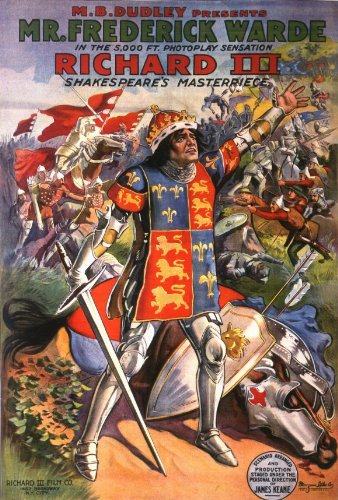
A definitive 5.7/10 rating for a film that redefined the boundaries of cult cinema. The Life and Death of King Richard III remains a cornerstone of transgressive art.
Stepping back into the nascent days of cinematic artistry, James Keane’s 1912 rendition of The Life and Death of King Richard III emerges not merely as an archaeological curiosity, but as a surprisingly potent distillation of Shakespearean tragedy, filtered through the nascent grammar of silent film. This early epic, predating many of the more widely celebrated adaptations, offers a fascinating glimpse into how filmmakers grappled with bringing the Bard’s intricate narratives and profound character studies to a medium still finding its voice. It’s a testament to the enduring power of the story and the raw theatricality of its lead performance that it manages to resonate over a century later, even without the benefit of spoken verse.
At its core, the film chronicles the relentless, self-serving ascent of Richard, Duke of Gloucester, a man whose physical deformities are matched only by the grotesque contortions of his moral compass. The narrative, penned by James Keane himself, drawing heavily from William Shakespeare’s monumental play, charts Richard’s Machiavellian machinations to seize the English throne. The post-Wars of the Roses era, ostensibly a period of peace, becomes instead a fertile ground for Richard’s boundless ambition, a canvas upon which he paints a masterpiece of manipulation and murder. Robert Gemp, in the titular role, delivers a performance that, while rooted in the exaggerated gestures of early stage acting, manages to convey a chilling sense of calculated malevolence that transcends the limitations of the medium.
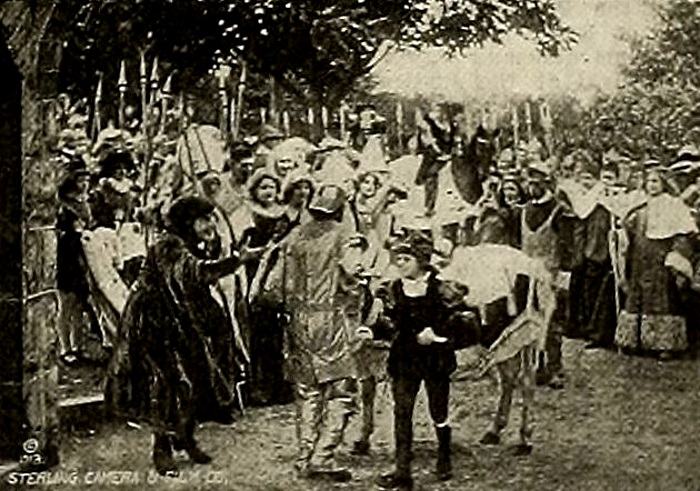
Gemp’s portrayal of Richard is the linchpin of this entire production. Without the soliloquies that define Shakespeare’s character, Gemp is forced to convey Richard’s inner turmoil, his sardonic wit, and his terrifying resolve through purely physical means. His hunched posture, the malevolent gleam in his eyes, and his sweeping, often theatrical gestures become the language of his ambition. It is a performance that demands close attention, as every subtle shift in his expression, every pointed finger, every feigned sigh of piety, must communicate volumes. He embodies the 'bottled spider' with a visceral intensity that is rare for the era. The famous seduction of Lady Anne, a scene pivotal to establishing Richard’s diabolical charm, is handled with a bravado that, while perhaps melodramatic by modern standards, effectively communicates Anne's inexplicable capitulation to her husband's murderer. Gemp’s Richard doesn't merely act; he performs for the camera, understanding, perhaps instinctively, the unique demands of this burgeoning art form.
The supporting cast, including Frederick Warde, Albert Gardner, and James Keane himself, provide solid, if less electrifying, counterpoints to Gemp’s central force. Warde, a renowned stage actor, brings a certain gravitas to his role, reflecting the theatrical pedigree of many early film performers. Their interactions, often punctuated by intertitles, serve to advance the plot with a directness that prioritizes narrative clarity over psychological depth, a common characteristic of films from this period. One might draw parallels to the grand theatricality seen in other early historical dramas, such as Cleopatra (1912), where the spectacle and star power often overshadowed nuanced character work. Yet, within these constraints, Keane’s direction manages to maintain a compelling pace, ensuring the audience remains invested in Richard’s relentless pursuit of power.
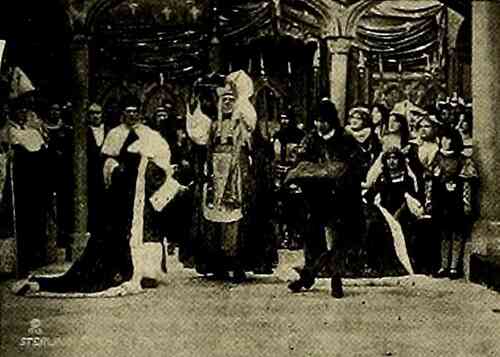
The technical aspects of The Life and Death of King Richard III are, understandably, primitive by contemporary standards, yet they are remarkably ambitious for 1912. The staging often resembles filmed theatre, with static cameras capturing full-body performances against painted backdrops or rudimentary sets. However, there are moments of surprising visual ingenuity. The battle sequences, particularly the climactic confrontation at Bosworth Field, attempt to convey scale and chaos through clever use of extras and rudimentary editing. While lacking the kinetic dynamism of later war films, they represent a significant effort to move beyond mere documentation and embrace cinematic storytelling. The use of natural light and early artificial lighting techniques adds to the film's atmospheric quality, creating stark contrasts that enhance the drama.
The film’s reliance on intertitles to convey dialogue, exposition, and even Richard’s famous soliloquies is a crucial element. These textual insertions, while breaking the flow of purely visual storytelling, were the primary means by which silent films communicated complex narratives. In an adaptation of Shakespeare, the challenge was immense: how to distill the poetic grandeur and intricate wordplay into concise, impactful captions. Keane and his team largely succeed in capturing the essence of Shakespeare’s plot, even if the linguistic artistry is necessarily sacrificed. This approach can be seen in other complex literary adaptations of the era, such as Oliver Twist (1912), where the narrative backbone had to be strong enough to carry the weight of the original text through visual cues and concise intertitles.
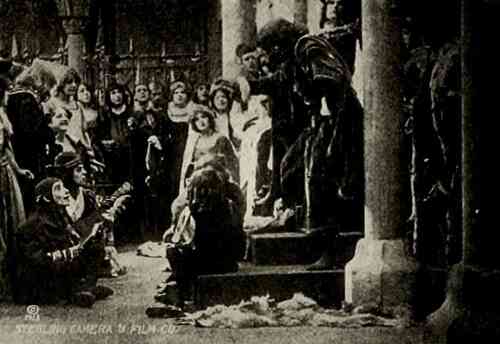
Beyond its historical significance as an early Shakespearean film, The Life and Death of King Richard III offers a compelling exploration of timeless themes. Richard’s insatiable hunger for power, regardless of the human cost, remains a potent cautionary tale. His journey is a descent into moral depravity, where loyalty, family, and even basic human decency are sacrificed on the altar of ambition. The film visually articulates this descent, showing Richard’s increasing isolation as he eliminates allies and enemies alike. The haunting presence of the ghosts of his victims before the Battle of Bosworth Field, though perhaps simplistic in its execution, effectively conveys the psychological torment that ultimately precedes his downfall.
The moral universe of the film is stark: unchecked evil inevitably leads to destruction. This is a common thread in many historical dramas and morality plays of the early 20th century, from the religious epic Life and Passion of Christ (1911) to the more overtly nationalistic The Independence of Romania (1912), where clear lines between good and evil, heroism and villainy, were often drawn. Richard’s ultimate defeat is presented not as a random act of fate, but as the inevitable consequence of his own monstrous deeds, a karmic reckoning that underscores the film's moral framework. The final battle, while staged with the limitations of its era, still manages to convey the sense of a grand, decisive confrontation, a fitting end to a reign built on blood and deceit.
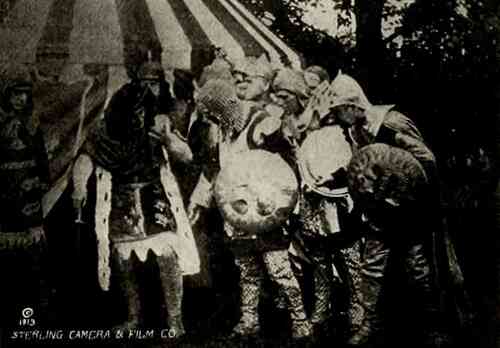
The very existence of this film, alongside other early Shakespearean efforts like Hamlet, Prince of Denmark (1913), speaks volumes about the early film industry's desire to legitimize itself by adapting high culture. Shakespeare, with his ready-made narratives and enduring popularity, was a natural fit. However, the translation from poetic drama to silent moving images presented unique challenges. How do you convey the richness of language, the internal monologues, the philosophical debates, without dialogue? Keane’s film tackles this by emphasizing visual storytelling, broad character strokes, and the dramatic impact of physical action. It’s a fascinating precursor to the myriad Shakespearean adaptations that would follow throughout cinematic history.
Comparing it to contemporary action-oriented films like The Corbett-Fitzsimmons Fight (1897) or Jeffries-Sharkey Contest (1899), Richard III demonstrates a leap in narrative ambition. While those films captured real-life spectacle, Keane’s production constructs a fictional world, albeit one drawn from history and literature, with a complex plot and character arc. This push towards narrative complexity was crucial for cinema’s evolution. It wasn't just about showing; it was about telling. The film, in its own way, contributes to the foundational understanding of what cinema could achieve, moving beyond simple actualités or comedic shorts towards grand dramatic narratives.
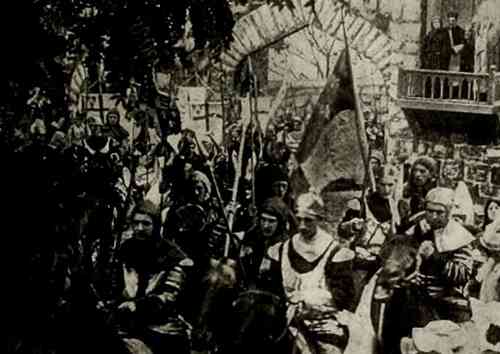
The historical significance of The Life and Death of King Richard III cannot be overstated. It is not just a film; it is a document of a pivotal moment in cinematic history, showcasing the pioneering efforts of filmmakers to translate complex literary works to the screen. It represents a bridge between the theatrical tradition and the emerging art of cinema, a bridge built with ambition, ingenuity, and a deep respect for the source material. While viewers accustomed to modern film aesthetics might find its pacing deliberate and its acting style declamatory, it demands to be seen through the lens of its time, appreciated for its bold vision and its contribution to the language of film.
In conclusion, James Keane’s The Life and Death of King Richard III stands as a monumental achievement for its era. It’s a testament to the power of a compelling story and a captivating central performance that it manages to hold an audience’s attention even without the spoken word. Robert Gemp’s Richard is a villain for the ages, a silent force of nature whose malevolence is palpable through the screen. The film, despite its technical limitations, offers a rich textual experience, inviting viewers to engage with Shakespeare’s narrative in a uniquely visual way. It reminds us that the fundamental elements of powerful storytelling – compelling characters, dramatic conflict, and universal themes – transcend technological advancements. For enthusiasts of early cinema, Shakespearean adaptations, or simply the evolution of dramatic storytelling, this film is an essential viewing, a historical artifact that continues to speak volumes about ambition, power, and the enduring human capacity for both good and evil.
It’s a fascinating journey back to a time when cinema was still finding its feet, yet already reaching for the stars, daring to tackle the grand narratives that have shaped our cultural consciousness for centuries. The echoes of this early endeavor reverberate through every subsequent Shakespearean film, a silent, yet resonant, prologue to a rich cinematic legacy.
IMDb —
1924
Community
Log in to comment.