DbcultAccessing Vault...
Cult Review
Senior Film Conservator
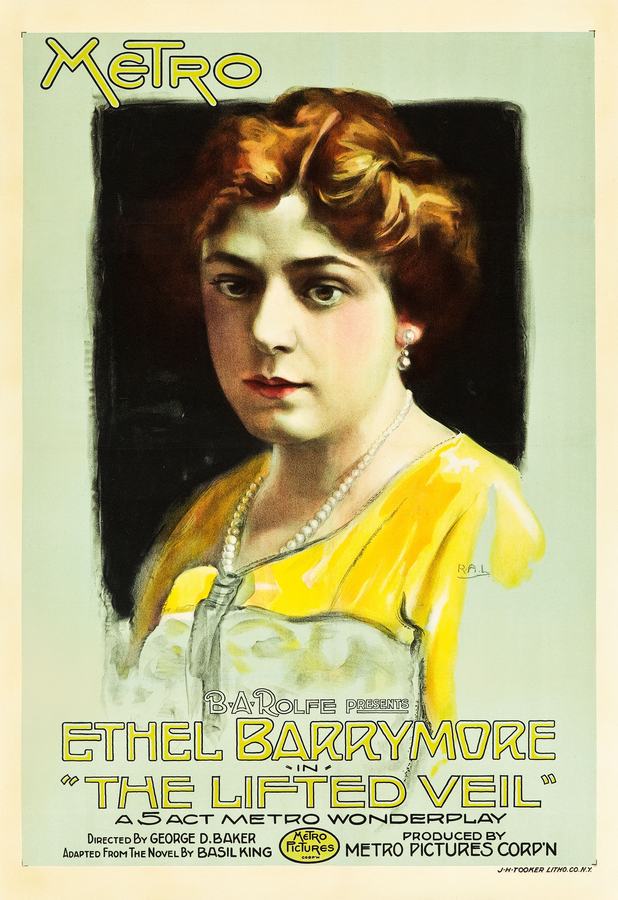
The camera opens on a close-up so tight that Ethel Barrymore’s left iris fills the frame, a stormy iris haloed by nitrate flicker. In that aqueous shimmer, The Lifted Veil announces its intent: to dissect contrition at twenty-four frames per second, to make every spectator a co-conspirator in Clorinda’s trespass. What follows is no ordinary morality play but a chiaroscuro poem where silhouettes glide through Gilded Age parlors that reek of tuberose and turpentine, where even the wallpaper seems to perspire secrets.
Director George W. Lederer, armed with Basil King’s source novella and Albert S. Le Vino’s scenario, opts for a visual grammar closer to European urban gothic than to the sun-splashed farms of contemporaries like The Miner’s Daughter. Observe the adultery sequence: two silhouettes reflected in a mahogany table so polished it behaves like black mercury, the betrayed friend’s shadow entering stage right—an accidental Magritte before Magritte. The film’s palette, hand-tinted in mint and bruise-mauve for the Italian print, survives only in fragments, yet those fragments throb with a symbolism that makes later melodramas such as En hjemløs Fugl feel positively Lutheran by comparison.
Barrymore, already a Broadway queen at thirty-eight, understood that silent acting is not declamation minus sound but dance plus geology—every gesture striated with subtext. Watch her hands during the confessional scene: they flutter like shot birds, then clamp shut as though manacled by her own pulse. She ages Clorinda a decade over the reel change simply by lowering the timbre of her shoulders. Comparisons with her stage roles—especially Captain Jinks of the Horse Marines—reveal an actress who could scale vulnerability from regal to feral without ever tumbling into the bathos that swamps so many Fine Feathers knock-offs.
Robert Ellis, matinee-idol handsome yet armed with the hollow eyes of someone who has read Schopenhauer between takes, incarnates a masculinity leagues removed from the chest-thumping swains populating Don Juan knock-offs. His Malcolm courts through omission: he listens more than he speaks, a radical strategy in 1917. The film’s midpoint long take—ninety seconds of Ellis simply absorbing Barrymore’s tear-streaked semaphore—feels modern even by 1970s standards. When love turns to revulsion upon hearing Clorinda’s past, Ellis does not gnash; instead, his face drains until the cheekbones look galvanized, a far more chilling excommunication than any intertitle could supply.
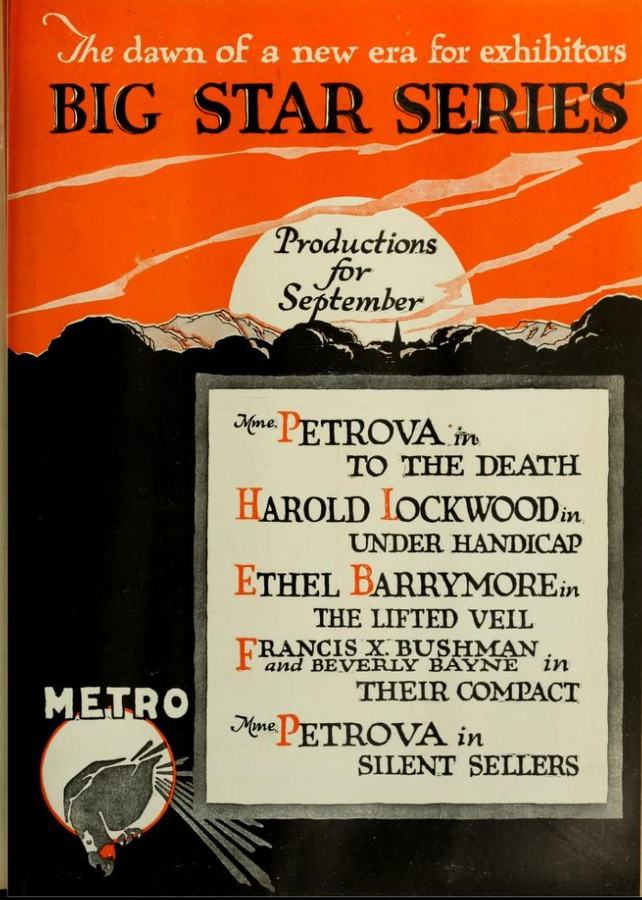
Charles K. French essays the clergyman with a baritone gravity that makes every cassock pleat seem doctrinaire. Yet the screenplay refuses to caricature him. In an era when preachers in cinema were either canting hypocrites or plaster saints, Bainbridge is something knottier: a genuinely decent man whose proposal springs from both pastoral concern and unspoken desire. Note the blocking inside the candle-lit study: French stands half in shadow, half in amber, a visual intimation that even the anointed dwell in penumbra. His final benediction—delivered through a doorway that frames the betrothed couple departing for France—carries no triumph, only a wistful half-smile that complicates every easy moral ledger.
The Atlantic Ocean here is no mere chasm of waves but a liquid purgatory, crossed twice, each voyage scrubbing Clorinda’s identity like a palimpsest. First trip: eastward, guilt is cargo. Second trip: westward, hope is ballast. The symmetry is almost Oulipian, yet never announces itself as such. Lederer punctuates both crossings with identical shots of smokestacks belching coal plumes that momentarily eclipse the screen—black flags of the industrial age reminding viewers that penitence cannot escape history’s soot.
Though the original score is lost, cue sheets preserved in the Library of Congress suggest Wagner, specifically the Tannhäuser Pilgrims’ Chorus, underscored Clorinda’s return to American shores. One can almost hear those tremulous chords buttressing Barrymore’s tentative descent down the gangway, the music grafting onto her face a penitential shimmer that no organ-grinder polka could supply. Contemporary exhibitors, however, frequently swapped highbrow cues for ragtime fizz, proof that reception is a promiscuous beast.
Modern readings might fault the ending as patriarchal recuperation: woman errs, woman repents, woman wed-locks herself to a secular savior. Yet the film slyly undercuts that template. Clorinda’s choice of Malcolm over the minister is not absolution but strategic self-definition; she prefers a partner stained by mutual humanness over a custodian of moral ledgers. In 1917, such an election edges toward the radical, especially when compared with the punitive finales inflicted upon adulteresses in Stormfågeln or Golfo.
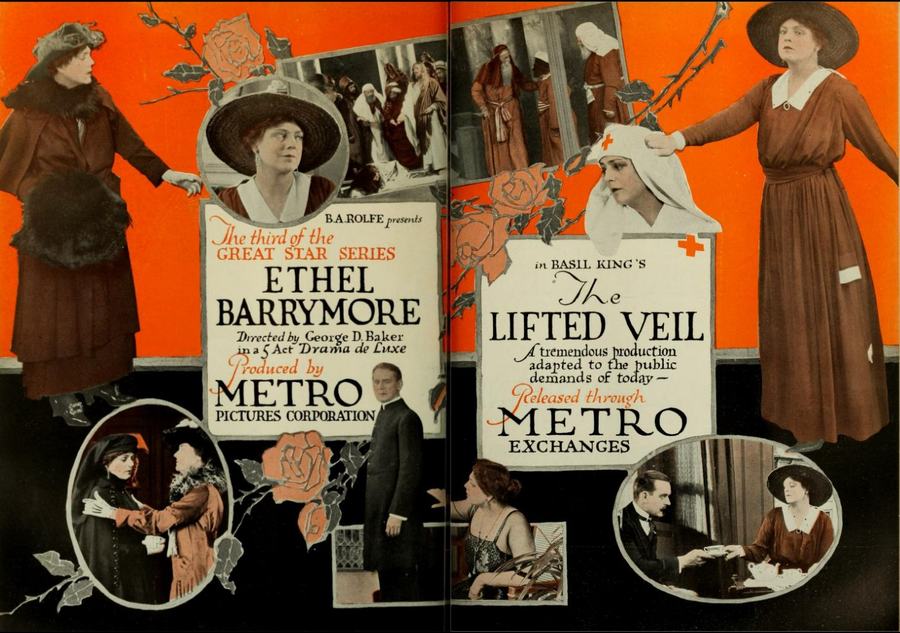
Cinematographer William F. Wagner—no relation to the composer—experiments with what archivists now call “ghosting.” By double-exposing the negative at differential focal planes, he overlays Clorinda’s face atop a tableau of stained-glass saints, so that her cheek becomes the Virgin’s veil. The trick anticipates the spiritual superimpositions in Joseph in the Land of Egypt, yet predates them by two years. Critics of the era dismissed it as “gimmickry,” but contemporary scholars hail the effect as proto-expressionist, a harbinger of Weimar cinema’s later psychic montage.
Variety’s 1917 capsule labeled the picture “morbid,” complaining that “audiences seek laughter, not flagellation.” Meanwhile, the New York Globe praised Barrymore for “elevating photoplays to the dignity of drama.” Today, the split persists: cine-club attendees extol its ethical ambiguities; TikTok micro-critics mock its lack of action set-pieces. Yet both camps concede that watching The Lifted Veil feels like eavesdropping on the Edwardian unconscious, a place where desire and doctrine conduct their guerrilla warfare.
Only a 35 mm partial positive—reels 3 and 5—survives at UCLA’s Film & Television Archive, water-stung but projectable. A 2K scan surfaced on the arthouse torrent circuit last winter, prompting a micro-furor over ethical restorations. The cinematographer’s granddaughter has lobbied for a proper Blu-ray with commissioned score, though licensing the Barrymore estate has proven Sisyphean. Until then, most cinephiles piece the narrative together via contemporary novelization and surviving stills, a jigsaw that paradoxically amplifies the film’s mystique.
I first encountered The Lifted Veil as a smudged VHS dupe in a graduate seminar on transitional femininity. The image wavered like heat haze, the organ track hissed like a faulty radiator, yet Barrymore’s agony tunneled through the decay and nested inside my skull for decades. Each rewatch—now courtesy of a digitized fragment—reveals fresh nuances: a blink that doubles as a veto, a grip on a ship’s rail that telegraphs both seasickness and guilt. Great art mutates alongside its spectator; this 107-year-old ribbon of celluloid continues to lift successive veils on my own presumptions about sin, mercy, and the terrifying freedom of choosing one’s warden.
If you excavate only one pre-1920 morality tale from the archives, let it be this tremulous, thorn-sweet epic—an artifact that proves silence can speak in tongues far more polyglot than sound.
IMDb 6.8
1923
Community
Log in to comment.