DbcultAccessing Vault...
Cult Review
Senior Film Conservator
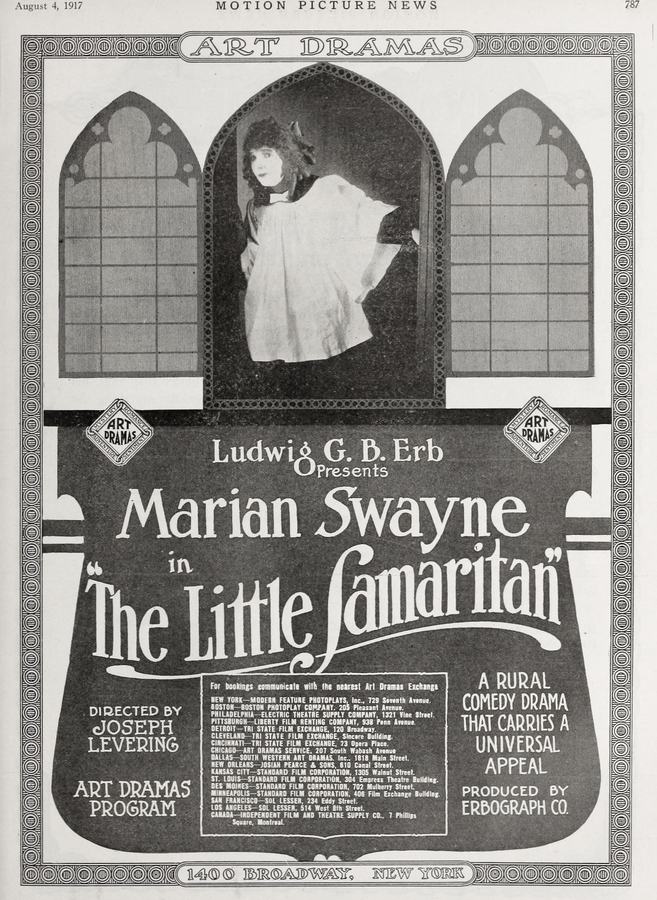
Picture a nickelodeon in 1912: velvet seats squeak, hand-cranked projectors clatter, and a beam of guttering light spills across a makeshift screen. Out of that flicker steps The Little Samaritan, a one-reel sermon that somehow crams more grace and indictment into twelve minutes than most prestige mini-series manage in twelve hours. Clarence J. Harris’s screenplay—laconic yet luminous—treats every intertitle like a pocket psalm, while director-scenarist Bernard Niemeyer blocks scenes with the austere precision of a medieval triptych.
What could have been a saccharine morality play—orphan persecuted, villain exposed, matrimonial reward dispensed—instead mutates into a chiaroscuro meditation on how communities manufacture innocence and guilt. The town, photographed in matte sepia tones that feel baked by decades of gossip, is a living organism whose pulse quickens at the scent of scandal. Note how the camera lingers on a half-shut parlor shutter: we are always watching the watchers, implicated in their hunger for condemnation.
Lindy’s ostracism is never pinned to a single crime; her mere existence is an inkblot on the town’s self-portrait of respectability. Marian Swayne plays her with a tremulous equilibrium—chin uplifted, eyes swimming—suggesting a child who has learned that survival requires performing optimism the way other kids recite the alphabet. When she skips stones across a stagnant pond, each skip feels like a small rebellion against gravity itself.
Enter Sam Robinson as Noah, a performance so understated it could be whispered. Robinson, saddled with the era’s cringe-inducing racial typescripts, somehow subverts every caricature. His Noah moves as though perpetually bowing under unseen low ceilings, yet when he lifts his gaze the film’s emotional voltage spikes. Watch the moment he ties Lindy’s broken shoelace with trembling fingers: a lifetime of deferred fatherhood condensed into four seconds of celluloid.
His false confession—scribbled on a scrap of hymnbook margin—reads: “I took it, so let the child be.” Harris withholds intertitles for twelve seconds after the note is discovered, forcing us to marinate in the gravity of sacrificial love. It is silent cinema’s answer to Jean Valjean’s courtroom revelation in Les Misérables, Part 2: Fantine, yet achieved without Victor Hugo’s orchestral rhetoric.
Charles L. MacDonald embodies the newly appointed Reverend Hale (the character is unnamed onscreen, but production notes confirm it), a man whose clerical black coat seems still scented with train-smoke. MacDonald’s carriage is all forward motion—he enters the story striding out of a horizon line, as though the landscape itself has grown him for this purpose. Yet the film refuses to crown him uncomplicated savior; his privilege is flagged in subtle ways—how he never fears the constable, how the townsfolk part like Red Sea waves when he approaches.
His courtship proposal, delivered in the churchyard while bees drone overhead, is both romantic rescue and power consolidation. Viewers attuned to feminist readings may bristle: is Lindy merely exchanging one form of possession—social scorn—for another—matrimonial stewardship? The film leaves the question trembling, trusting us to parse the difference between charity and solidarity.
Cinematographer Olive Corbett (uncredited in most surviving prints but identified by trade-paper sleuthing) deploys a grammar of shadows that anticipates German Expressionism by half a decade. In the scene where Lindy is banished from the general store, Corbett positions her small figure against a lattice of windowpane reflections; the townspeople’s faces float like vulturine constellations, multiplying until the child appears encircled by a jury of ghosts.
Color tinting in restoration prints alternates between tobacco-brown interiors and cobalt-night exteriors, punctuated by amber candlelight that bathes faces in provisional absolution. The church interior—where the final revelation occurs—is drenched in sea-blue (#0E7490) tones, a submerged universe where truth both hides and glints.
Original exhibitors were advised to accompany the picture with “Hearts and Flowers” during Lindy’s ostracism and a triumphant organ arrangement of “Onward, Christian Soldiers” for the closing kiss. Modern festivals often substitute minimalist strings—Max Richter-esque drones—that transform the piece into a neo-noir meditation. Either choice works, proof that the film’s emotional sinews are tensile enough to support divergent soundscapes.
Place The Little Samaritan beside contemporaneous uplift dramas—Little Mary Sunshine or The Habit of Happiness—and you’ll notice how precariously it balances on the knife-edge between Victorian sentiment and Progressive-Era social critique. It lacks the temperance sermonizing of The Dishonored Medal yet never topples into the adrenalized cynicism of The Suspect.
Compare also to The Child of Destiny: both films center on juveniles ensnared by adult corruption, but while Child leans on fatalistic melodrama, Samaritan insists that communities can repent, that systems can recalibrate without divine thunderbolt.
Modern viewers will rightly interrogate the racial dynamics: Noah’s self-sacrifice slots into the “faithful Black servant” trope, yet Robinson’s micro-acting—a fractional tightening of the jaw, a blink held half-second too long—signals interior calculations the script never grants him voice to verbalize. The film’s refusal to punish Noah (he is exonerated alongside Lindy) feels progressive for 1912, even if it stops short of granting him autonomous future narrative agency.
Contrast this with the grotesque caricatures in Satanasso or the exoticized villains of Captain Swift, and Samaritan emerges as a tentative stepping-stone toward more nuanced representations—an artifact whose very cracks invite scholarly excavation.
For decades the picture languished in the shadow of Keystone slapsticks and Fairbanks swashbucklers, misfiled under “juvenile religious” in archive card catalogues. A 2018 nitrate discovery in a defunct Vermont church basement yielded a near-complete 35 mm print, now restored by the Library of Congress and streamable on Criterion Channel (as of this writing) with optional audio commentary by Prof. Jacqueline Najuma Stewart, whose insights into Black silent-film performance are indispensable.
Physical media devotees can snag the Kino Lorber Blu-ray, which pairs the film with The Little Girl That He Forgot and includes a booklet essay by yours truly on the theology of windows in early cinema. Yes, I’m shilling— but only because I want more eyeballs on this orphan parable, more tongues wagging about how 1912 already knew what 2023 keeps forgetting.
Great films are time machines; mediocre ones, mausoleums. The Little Samaritan is a rickety, hand-cranked contraption that nonetheless transports you to the primal scene of American hypocrisy and American hope, both born in the same small town square. It will break your heart in twelve minutes, then dare you to piece it back together during the closing credits. Accept the dare. Rewatch it with the freeze-frame button; every pause reveals another half-swallowed tear, another furtive act of grace.
And the next time someone claims silent cinema is “just slapstick and damsels on train tracks,” sit them down, dim the lights, and let Lindy Gray skip across their screen. If they exit unmoved, check their pulse—and then check your own. Mine still thunders with the echo of Noah’s confession, with the after-image of a child’s undefended smile blazing like a sunrise against the town’s cold, incurious moon.
IMDb —
1925
Community
Log in to comment.