DbcultAccessing Vault...
Cult Review
Senior Film Conservator
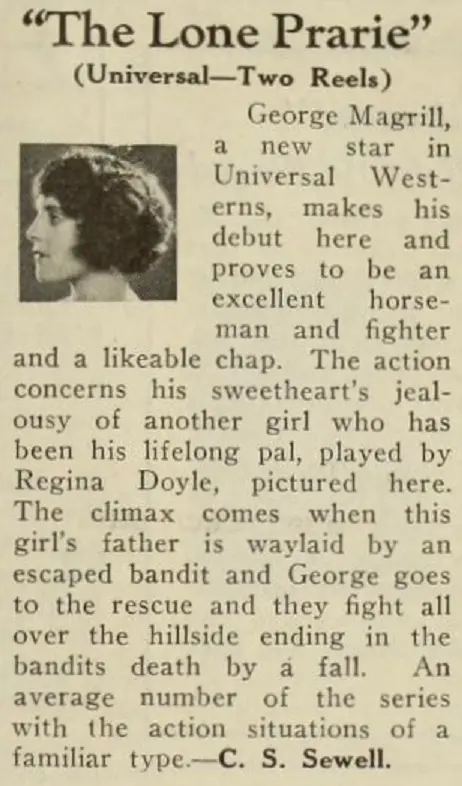
Is "The Lone Prairie" worth watching today? Short answer: yes, but with significant caveats that demand a particular kind of viewer. This film, a quiet entry into the early Western genre, is an intriguing, if somewhat dusty, relic best suited for ardent film historians and those with a deep appreciation for early cinematic explorations of human emotion, rather than casual viewers seeking high-octane action or polished modern storytelling.
For those willing to engage with its historical context and accept its stylistic limitations, "The Lone Prairie" offers a fascinating glimpse into the nascent stages of narrative cinema. It’s not for everyone, certainly not for those accustomed to contemporary pacing or explicit dialogue, but it holds a subtle charm for the patient observer.
As a critic, I approach every film, regardless of its vintage, with an open mind, seeking its unique voice. "The Lone Prairie" is no exception, and while it doesn't aim for the grandeur of later Westerns, it offers something quietly compelling in its thematic focus.
At its core, "The Lone Prairie" is a surprisingly intimate study of human frailty set against a vast, indifferent landscape. The central conflict, born from a sweetheart's jealousy over her cowboy's female best friend, Regina Doyle, is a universal one, yet its portrayal in an early Western context is what truly makes it stand out.
Most Westerns of this period were preoccupied with good-versus-evil narratives, frontier justice, or grand adventures. "The Lone Prairie," however, dares to explore the internal landscape of its characters. It's a bold move for its time, suggesting an early inclination towards psychological realism within a genre often defined by external action.
The film grapples with the subtle nuances of platonic versus romantic love, and the devastating impact of suspicion. It’s not just about a love triangle; it’s about the erosion of trust and the irrationality of emotion. This is a film that, despite its silent film constraints, tries to articulate the unspoken anxieties of the human heart. It works. But it’s flawed.
One could argue that the jealousy, while primitive in its depiction, serves as a critique of societal expectations placed upon women in the West – forced to compete for male attention, often with little agency of their own. The sweetheart's reaction, while perhaps overblown, might be seen as a desperate act of self-preservation in a world offering few alternatives.
The film's most compelling aspect is its quiet rebellion against typical Western tropes. Instead of bullets and bravado, it offers furtive glances and simmering resentment as its primary dramatic fuel. This unconventional approach is its greatest strength, even if its execution can feel rudimentary to a modern eye.
In a silent film, the burden of conveying complex emotions falls squarely on the actors' physicality and facial expressions. Jack Dawn, as the cowboy, navigates the delicate balance of loyalty to his friend and affection for his sweetheart. His performance, while perhaps broad by today’s standards, effectively communicates his character's internal conflict.
There's a scene, for instance, where Dawn's character shares a laugh with Regina Doyle (played by Regina Doyle herself, in a surprisingly naturalistic turn for the era), perhaps over a shared memory or a practical joke. The camera lingers, catching a fleeting, almost imperceptible shift in his sweetheart's expression – a tightening of the jaw, a flicker of the eyes – that speaks volumes without a single intertitle. This is where the film finds its quiet power.
Regina Doyle, as the 'best friend,' embodies an innocence that is crucial to the plot's tension. Her gestures are open, her smiles genuine, making the sweetheart's jealousy seem all the more unfounded and tragic. George Magrill, Jack Knapp, and Alma Rayford, in their supporting roles, contribute to the tapestry of the community, often serving as silent witnesses or instigators of gossip, their reactions adding context to the central drama. Their collective presence helps ground the emotional turmoil in a believable, if sparse, social environment.
However, the performances, while commendable for their era, often lack the psychological depth we expect from modern cinema. Characters' motivations are often telegraphed rather than explored, a common pitfall of early narrative film where clarity often trumped nuance. This isn’t a fault of the actors themselves, but rather a reflection of the evolving cinematic language.
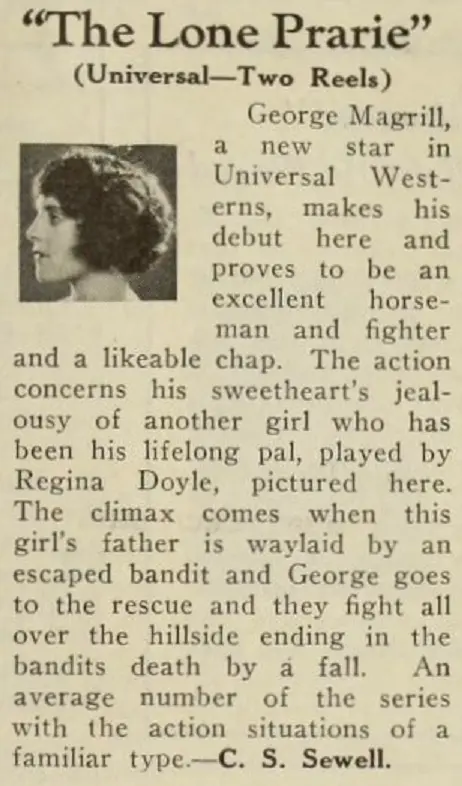
Given the minimal information available, it's clear that the director (presumably George Morgan, also a writer) would have relied heavily on visual storytelling to convey mood and narrative progression. The cinematography of "The Lone Prairie" likely uses the vast Western landscape not merely as a backdrop, but as an active participant in the emotional drama.
Imagine wide shots of the endless prairie, perhaps symbolizing the cowboy's emotional isolation or the vastness of the misunderstanding between the characters. Conversely, tight close-ups on faces would have been essential to capture the subtle shifts of jealousy, confusion, or burgeoning anger. A particularly effective choice might have been to frame the sweetheart isolated against a sprawling vista during a moment of intense suspicion, visually emphasizing her internal turmoil against the indifferent grandeur of nature.
The direction, while perhaps not groundbreaking in its technical innovation, would have been focused on clarity and emotional impact through visual cues. The use of natural light, the framing of figures against the horizon, and the deliberate pacing of visual information would have been critical in guiding the audience through the story without spoken words. It’s a testament to early filmmakers' ingenuity that they could craft coherent, emotionally resonant narratives with such limited tools.
One unconventional observation: the lack of elaborate sets or special effects forces a focus on the raw human element and the natural world, making the film feel almost documentary-like in its portrayal of frontier life, despite its melodramatic core. This stark simplicity, unintentional or not, lends an unexpected authenticity.
The pacing of "The Lone Prairie," like many silent films, might feel deliberately slow to contemporary viewers. This slower rhythm, however, was often necessary to allow audiences to absorb visual information, read intertitles, and process the emotional beats without the aid of spoken dialogue or complex sound design.
The film likely builds its tension through a gradual accumulation of misinterpreted glances, hushed conversations (implied through gestures), and mounting suspicion. A scene might start with an idyllic depiction of life on the prairie, slowly transitioning into a more somber or tense tone as the jealousy begins to fester. The shift in tone would be conveyed through changes in shot composition, the actors' expressions, and perhaps even the musical score (if one were originally composed or performed live).
The overall tone is likely one of understated drama, punctuated by moments of heightened emotion. It’s not a frenetic ride; it’s a slow burn. This deliberate pace allows for a deeper, albeit silent, contemplation of the emotional landscape. For those accustomed to the rapid-fire editing of modern blockbusters, this film will feel like a different species entirely. It demands patience. It requires active viewing, an engagement with the subtle visual language on display.
To truly appreciate "The Lone Prairie," one must place it within the burgeoning landscape of early 20th-century cinema. It predates the epic Westerns of John Ford and the complex psychological dramas that would define later eras. Instead, it sits alongside films like The Yosemite Trail or The Girl from Nowhere, which were also exploring the possibilities of narrative film on the frontier.
This film represents an early attempt to move beyond simple action sequences and incorporate more nuanced character dynamics into the Western genre. While it might not have the grand scope of All-Star Production of Patriotic Episodes for the Second Liberty Loan, it offers a different kind of historical value – one of intimate human conflict. It foreshadows a desire to tell stories that resonated on a personal level, even within the often larger-than-life canvas of the West.
It's a foundational piece, a stepping stone. It reminds us that even in cinema’s infancy, filmmakers were striving to tell emotionally resonant stories, not just visual spectacles. This film, for all its simplicity, reflects an ambition to explore the interior lives of its characters, a trait that would only grow more sophisticated with time and technological advancement.
Yes, for a very specific audience. If you are a student of film history, particularly interested in the evolution of the Western or silent cinema, "The Lone Prairie" offers valuable insight. It demonstrates early attempts at character-driven conflict. It showcases the acting styles of its era. It provides a window into how basic human emotions were conveyed without dialogue. For general audiences, its slow pace and dated conventions might be a barrier. It requires patience and a willingness to engage with a different cinematic language.
Ultimately, "The Lone Prairie" is not a film for everyone, nor does it pretend to be. It’s a quiet, almost academic exercise in early cinematic storytelling that attempts to inject a dose of human psychological drama into the nascent Western genre. While it undeniably suffers from the limitations inherent to its era – the broad acting, the deliberate pacing, the often simplistic resolutions – its ambition to explore jealousy and trust in a frontier setting is commendable.
As a critic, I believe its value lies not in its entertainment factor for a general audience, but in its historical significance and its subtle, almost proto-feminist leanings regarding female competition. It's a testament to the fact that even in cinema’s infancy, filmmakers were striving for more than just spectacle. It’s a film that asks for patience and rewards those who are willing to look beyond the surface, to understand its place in a much larger cinematic conversation. If you’re one of those discerning viewers, give it a shot. You might find a quiet, resonant echo of human nature across the vast, lone prairie.
IMDb 6.6
1914
Community
Log in to comment.