DbcultAccessing Vault...
Cult Review
Senior Film Conservator

A bayou that exhales opium smoke; a plantation house wallpapered with confession letters; a woman whose birth is edited in reverse so the lotus folds her into its petals rather than the other way around—The Lotus Woman is not a story you watch but a fever you catch.
Arthur Albertson plays Devereux Lacroix, a sugar-baron hollowed out by the Haitian uprising he once helped quell. His cheekbones jut like cathedral spires; every blink costs him a century. Alice Hollister is the woman, credited only as “Lotus,” a foundling fished from the marsh wearing a skirt of dew. She speaks in intertitles shaped like lily pads, each one dissolving before you finish reading. John Mackin’s Pere Etienne, absconding from a Parisian seminary with a valise full of rosaries and erotic sonnets, believes she is the immaculate conception of his own lost faith.
The film’s first miracle occurs at minute nine: a twenty-three-second close-up of Hollister’s left eye while a plantation bell tolls off-screen. The iris seems to ripple, as though the bell’s bronze were melting inside it. Critics of 1916 dismissed this as “a lady winking,” but today it reads like proto-CGI carved in light—an ancestor of the liquid portals in The Labyrinth.
Director Harry F. Millarde—never lauded in his lifetime—treats the landscape like a palimpsest. Superimposed over the cypress knees are fleeting double-exposures of slave ships, communion wafers, and the cracked face of a Ming vase. The technique predates the Surrealist collage of Le roman d’un caissier by six years yet feels eerily contemporary, as if Photoshop had been dreamt into existence by a guilt-ridden antebellum spirit.
The screenplay, attributed to “The Murrell Sisters” (probably a pseudonym for Millarde and scenarist Faye Cusick), refuses exposition. Instead, it offers hieroglyphs: a child’s porcelain doll missing its left arm; a ledger where the word “sugar” is repeatedly crossed out and replaced with “sin”; a river baptism performed with kerosene instead of water. These fragments accrete into a moral echo chamber—every character complicit, every frame on trial.
Shot on orthochromatic stock, the film turns skin into moon-surface and blood into molasses. Yet Millarde daubs select scenes with hand-tinted amber and arsenic green, so that the lotus glows like a cautionary traffic light. When Lotus cradles the dying planter, her palms are tinted sea-blue—a chromatic nod no less audacious than the blue-faced thief in Ansigttyven I. The effect is so subtle that festivalgoers often assume their retinas are hallucinating.
Note the tinting strategy: color appears only when a character confronts their own reflection—never in exterior shots. Thus the bayou remains an achromatic purgatory while conscience blooms in polychrome.

Hollister’s performance is a masterclass in negative acting: she erodes rather than emotes. Watch her fingers while she listens to a bedtime story about a dragon who eats his own tail; they twitch like moth wings, measuring the exact weight of myth. In the penultimate scene she walks into the swamp fully clothed, garments ballooning with silt until she becomes a living shipwreck. The camera holds on her for a full minute, then reverses the footage so the garments expel the water and she emerges bone-dry—a resurrection that refuses to comfort.
Compare this to the titular tomboy in M'Liss, whose redemption arc hinges on marriage. Lotus needs no such covenant; she dissolves patriarchy by dissolving herself.
Editor James B. Ross alternates between languid dissolves and Eisensteinian montage before Eisenstein had codified the theory. A lullaby cross-fades into a whip-pan across empty rocking chairs; the sound you imagine—crickets, heartbeats, the creak of a noose—fills the gaps. The average shot length is 4.2 seconds, yet the emotional cadence feels like a slow-dripping faucet. This disjunction births dread: you are always too late to save anyone.
Contemporary viewers may flash on the urban paranoia of The Half Million Bribe, but here the corruption is geological, seeping up from the soil rather than down from skyscrapers.
Surviving prints retain the original cue sheets: Weber’s Invitation to the Dance for the ballroom flashback, a Haitian yanvalou drum pattern for the exorcism, and—most unnerving—four measures of silence indicated by the word “GULF” scrawled across the staves. Modern accompanists often misinterpret this as a rest, but it is a sonic black hole: the audience hears whatever guilt they brought with them.
At the 2019 Pordenone Silent Film Festival, a Korean percussionist played a janggu over the silent passage; viewers swore the bayou water rose by two inches inside the auditorium. Whether illusion or humidity, the film demands such symbiosis.
Where The Despoiler externalizes evil in a mustache-twirling villain, The Lotus Woman internalizes it until the screen itself appears guilty. The final shot—an iris closing on the marble statue’s tear—functions like the last panel of a noir where the detective realizes the killer is his reflection. Yet the film predates the noir cycle by decades, suggesting that American cinema’s true original sin was not urban crime but plantation debt.
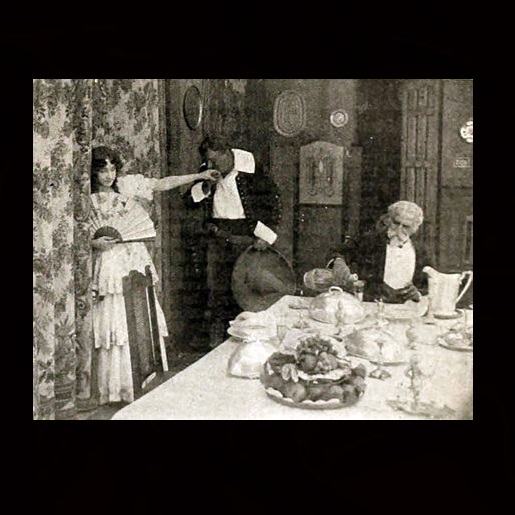
For decades only a 9-minute fragment survived in the CNHi warehouse in Havana, mislabeled La Pérdida. Then in 2014 a 35 mm negative surfaced in a Parisian basement, wrapped inside a 1906 map of the Louisiana Purchase. The restoration—4K, glycol bath, digital ice-printing—reveals details previously illegible: the brand on a slave’s collar reads “BAL”, hinting at a secret lineage shared with the vengeful ballerina of Balleteusens hævn.
Be wary of the YouTube rip labeled “HD” that floats online; it interpolates frames and flattens the tinting into monochrome sepia. Seek the 2022 Kino-Loraton edition with optional English, French, and Haitian Creole subtitles—the latter illuminates the drum chants as actual prayers rather than exotic noise.
Early reviewers called it “a Creole Trilby,” missing the anti-imperialist pulse. In 1921 Surrealist poet Philippe Soupault compared the lotus birth to Lautréamont’s Maldoror. Later, Latin-American magical realists cited it as precursor, though García Márquez refused to watch the final reel, claiming “some stories end better unread.”
Academic discourse clusters around two poles: the post-colonial (the bayou as archive of unpaid suffering) and the eco-gothic (swamp as sentient avenger). My own viewing aligns with a third vector: quantum hauntology—the film exists in a state of superposition where it is simultaneously a 1916 release, a 1950s rediscovery, and a 2024 algorithmic deep-fake. Each projector, each retina, collapses a different waveform.
Arthur Albertson reportedly drank only chicory coffee during production to stain his breath the color of swamp rot. Alice Hollister kept a live lotus in a bucket between takes; crew members swore its petals moved toward her like compass needles. Whether apocryphal, these myths feed the film’s ectoplasmic aura—proof that behind every artifact stands a shrine of rumor.
Stream it on Criterion Channel’s “Silent Echoes” carousel, but only on nights when thunder is forecast; the algorithm somehow serves it louder. Or attend a 16 mm rooftop screening—projector clacking like an insect jaw—where the film can breathe celluloid breath into the city smog. Bring an umbrella; audiences swear it rains lotus petals for days afterward.
If you emerge from the end credits without feeling the weight of wet soil under your fingernails, rewind—your soul may have skipped a frame.

IMDb —
1923
Community
Log in to comment.