DbcultAccessing Vault...
Cult Review
Senior Film Conservator
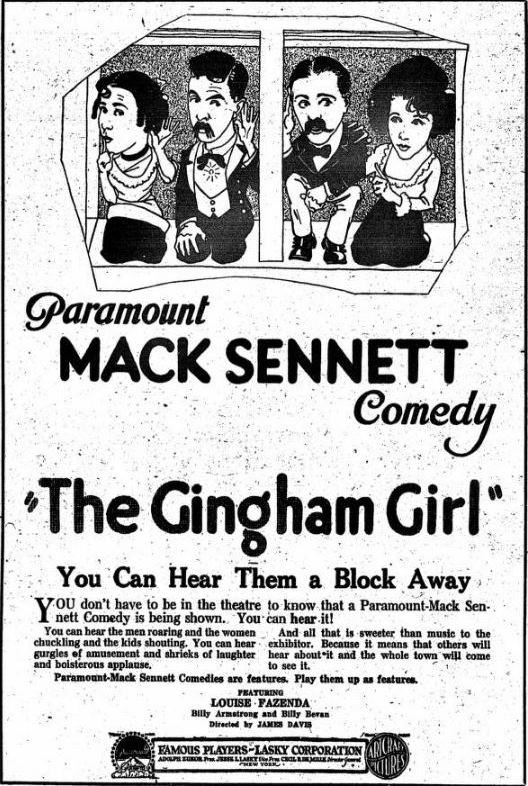
The first time we see Louise Fazenda’s country orphan she is stepping off the train as though she’s been stitched into the frame by a sewing machine: calico dress, sunbonnet, and a duck tucked under one arm like a living reticule. The platform is a mosaic of shadows and steam; the city looms beyond the iron ribs of the station, all spikes of glass and the distant clang of a streetcar. Director David Kirkland lets the shot linger for three extra beats—an eternity in 1923 pacing—so the audience can feel the grit of urban soot land on her apple-cheeked disbelief.
From that instant, The Gingham Girl reveals itself less as bucolic fish-out-of-water fluff and more as a cynical moral cartoon inked in lace and barnyard feathers. The plot’s hinge—an inheritance that transmutes familial hatred into perfumed love—would be a mere gimmick if the film didn’t stage it with such poker-faced ruthlessness. Aunt Maggie’s first glare at her niece could freeze gin; her second, post-telegram, melts into a treacle so molten it almost drips off the screen. The tonal pirouette is both hilarious and quietly horrifying, like watching a mask liquefy and reform in real time.
Kirkland’s visual grammar borrows from caricature. The aunt’s parlor is a mausoleum of overstuffed settees, antlered chandeliers, and aspidistras big as umbrellas; every prop seems to inhale when the girl enters, exhale when money is mentioned. The niece’s bedroom, by contrast, is a whitewashed attic that could double as a dove cote—her duck perches on the bedpost like a gargoyle of uncorrupted nature. Cross-cutting between these spaces feels like flipping between a Hogarth print and a pastoral lithograph, the edit itself editorializing on venality versus innocence.
Louise Fazenda, usually typecast as a flustered comedienne, here weaponizes her rubber-faced elasticity. Her wide eyes register incomprehension, then dawning realization, then a bashful gratitude that is entirely performative—she knows the audience knows she’s faking, and that complicity is the joke. Watch the moment she learns of the fortune: the smile starts in her pupils before it reaches her mouth, a financial sunrise that feels almost geological.
Billy Bevan’s city swell—a potential suitor who pivots from wolfish to obsequious once the bank balance surfaces—delivers a masterclass in silent-era sleaze. His moustache alone deserves co-star billing: it twitches like a dowsing rod sniffing out net worth. When he bows to the gingham-clad heiress, the angle is so steep it parodies chivalry, his top-hat brim nearly grazing the parquet. The film lets the physical gag run long enough to curdle into social critique.
And then there is Teddy the Dog, a border-collie mix who trots beside the girl like a four-legged moral barometer. In one sublime throwaway, Teddy sniffs Aunt Maggie’s handbag, bares his teeth, and exits frame left—an animal rejection of hypocrisy more eloquent than any title card. Silent cinema loved its fauna, but here the dog is no stunt spectacle; he’s the chorus the Greeks forgot.
Because dialogue is relegated to intertitles, the film’s ideological payload must travel via mise-en-scène and performance. Money becomes a character whose entrance is heralded by a telegram framed in extreme close-up: the stark black border of the card bleeds into the edges of the screen, swallowing the frame for a split second. It’s as though capital itself has punched a hole in reality. From that rupture onward, every interaction is barter. Affection is weighed by the ounce, courtesy measured by the yard.
Scholars often cite The Woman in the Case or Eyes of Youth when charting early feminist economics on screen, yet The Gingham Girl offers a more acidic, if less grandiose, commentary. Inheritance here is not emancipation but entrapment; the girl gains liquidity yet loses the only currency that had been freely given—the duck’s unfeathered loyalty. In the final reel, the pet escapes the townhouse and waddles back toward the rural train tracks, the girl in futile pursuit. The last shot freezes on her torn hem snagged in a wrought-iron gate: fortune behind, freedom ahead, neither wholly attainable.
Place this 63-minute satire beside the gargantuan pomp of Quo Vadis? or the spiritual hush of The Secret Garden and you gauge the full spectrum of early ’20s storytelling ambition. Where Evangeline mythologizes longing and The Hope sanctifies sacrifice, The Gingham Girl wields brevity like a stiletto, puncturing sentimental balloons. Its cynicism feels closer to A Temperamental Wife or the Hungarian obscurity Halálítélet, films that likewise suspect human motives yet refuse to sermonize.
Kirkland’s previous comedy shorts for Mack Sennett trained him in accelerated escalation: a pie must hit a face within the same breath that it’s baked. Transplanting that timing into a feature-length morality play yields tonal whiplash—sometimes the emotional pivot arrives so fast it skids. Yet that very volatility mirrors the era’s economic rollercoaster, the instant fortunes minted then erased by post-war boom-bust cycles. The film’s own budgetary constraints—sets recycled from a 1921 melodrama, stock footage of trains spliced in—underscore the theme of shabby make-do gentility masking desperation.
Cinematographer Jules Cronjager, best known for his noir tenebrism in later Fox programmers, here experiments with high-key lighting that borders on overexposure. The niece’s introductory close-up is so flooded with backlight that her silhouette bleaches into ivory, haloing her as a creature too pristine for pigment. Conversely, Aunt Maggie’s first medium-shot is underlit from below, the fireplace’s low flames carving gargoyles into her cheekbones. These choices aren’t subtle, but silent cinema rarely traffics in whispers; it shouts archetypes across orchestral pits and nickelodeon balconies.
Note also the recurrent motif of gates: iron grillwork, wooden slats, even the lattice of a birdcage. Each time the camera frames characters through these barriers, the implication is that lucre itself is a pen, commodifying even the viewer’s gaze. When the girl finally flees the mansion, Kirkland cranes upward, revealing the estate’s gate receding below her like a jaw closing too late. The geometry of enclosure has become the film’s final punchline.
Contemporary reviewers, clucking from their mahogany press boxes, dismissed the film as “a diverting trifle.” Yet the subtext is savage: a woman’s worth fluctuates in direct proportion to her liquidity, and the only male protection offered arrives with an invoice attached. Even the duck, nominally sexless, is coded feminine—soft, white, nurturing—yet its refusal to stay commodified (it won’t be dinner, it won’t be pet, it simply leaves) suggests a rebellion against transactional domesticity.
Fazenda’s performance complicates feminist readings. She never metamorphoses into the New Woman; instead she weaponizes the mask of innocence, learning to bat her lashes like semaphore flags signaling net present value. The closing intertitle reads: “She had the gold—but had she the heart to spend it?” The question is left dangling like a loose thread, inviting audiences to interrogate their own complicity in the gaze that converts girl into gold standard.
In 1923 most exhibitors paired the picture with a house organist improvising pastoral trills for rural scenes, then shifting to minor-key tremolo when the telegram arrives. Contemporary restorations screened at Pordenone and Bologna have commissioned new scores—one by the Mont Alto Motion Picture Orchestra reimagines the narrative as a chamber comic-opera, its duck motif rendered via bassoon bleats. The effect is Brechtian: laughter sticks in the throat, exposing sentiment as commodity.
For home viewing, I recommend queuing up Copland’s Appalachian Spring but fading it out the instant the inheritance letter appears, replacing it with the shrill atonality of early Schoenberg. The dissonance won’t match period practice, but it will honor the film’s mission: to make comfort impossible.
Sadly, no complete 35 mm print survives; the Library of Congress holds a 46-minute reconstruction culled from two incomplete negatives. Yet even in truncated form, the film vibrates with a satirical electricity that prefigures Sturges and McCarey. Cinephiles who revere The Ghost of Rosy Taylor for its bittersweet fusion of pathos and parody will find similar alchemy here, distilled to moonshine potency.
If you stumble across a rare 16 mm print in an estate sale, buy it, digitize it, upload it. The duck demands witness. And so, quietly, do we all—because the gingham may fade, the fortune may dwindle, but the marketplace of affection remains open 24/7, hawking love at compounded interest.
IMDb —
1917
Community
Log in to comment.