DbcultAccessing Vault...
Cult Review
Senior Film Conservator
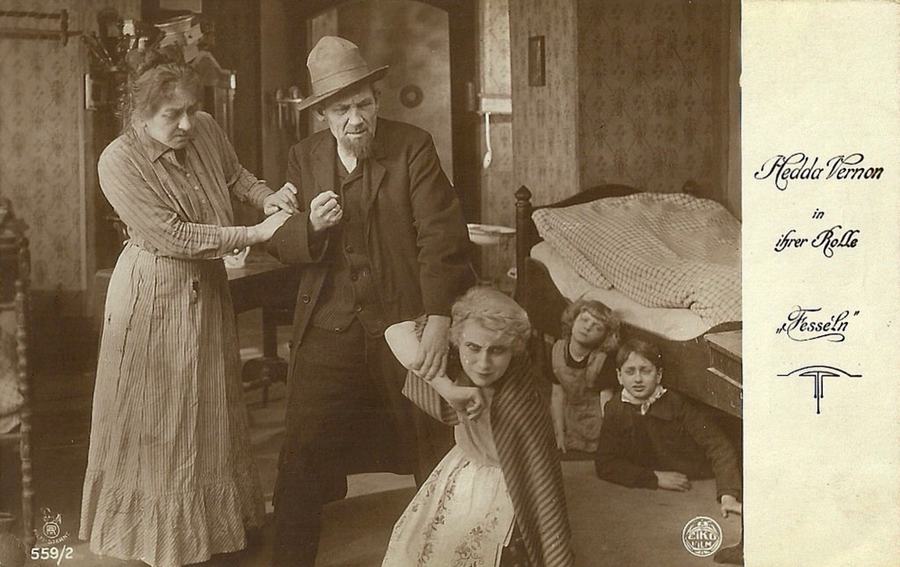
Fesseln, or *Chains*, is a 1930 German expressionist film that clings to the soul like barbed wire. Directed by Richard Wilde (yes, the writer-director shares the surname with lead actor Erich Wilde, a deliberate narrative echo of familial and artistic entanglements), this film is a masterstroke of visual and thematic dissonance. It’s the kind of work that demands you lean forward in your seat, fingers gripping the armrests as if you, too, are bound to the screen by invisible threads.
Set in a decaying aristocratic estate, the film follows Anton (Erich Wilde), a man whose life is a mosaic of contradictions. By day, he’s a stoic patriarch, his face a mask of duty; by night, he’s a man haunted by visions of his deceased wife, her ghost materializing in the flickering chandeliers. Hedda Vernon’s character, the enigmatic Countess von Reichenbach, is less a person than a living metaphor for temptation—her every gesture a slow-motion unraveling of Anton’s sanity. Vallentin’s role as the silver-tongued lawyer, whose motives are as opaque as the fog rolling in through the manor’s broken windows, adds a layer of political subtext that whispers of Weimar-era anxieties.
The film’s opening sequence—a tracking shot through the manor’s overgrown gardens, where the camera lingers on a rusted chain link half-buried in ivy—is not mere decoration. It’s a leitmotif, a visual metaphor that Wilde and Brückner’s cinematography return to like a lullaby. The chains here are not of iron but of expectation, of a society that demands its members be both prisoners and jailers. When Anton’s son, played by the young Ewald Albes, accuses him of cowardice, the accusation carries the weight of generational curses, a theme Wilde would later echo in his semi-autobiographical The Rail Rider, though never with such visceral elegance.
What elevates Fesseln beyond its genre conventions is its treatment of silence. Dialogue is sparse, often reduced to cryptic monologues delivered through smoke-filled windows or half-remembered letters. The score, a haunting blend of cello and piano, swells only when the characters’ emotions threaten to erupt, then recedes into a brittle stillness that amplifies the tension. This restraint is deliberate; Wilde understood that the most profound chains are those we impose on ourselves, the silence between spoken words.
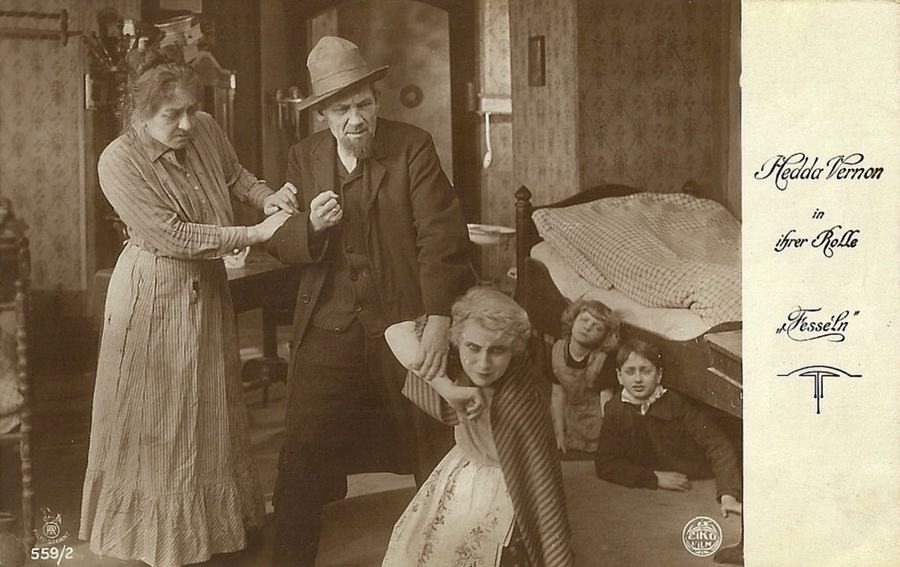
The film’s most audacious sequence occurs in Act II, where Anton confronts the Countess in a room transformed into a chiaroscuro nightmare. The walls pulse with shadows, and the light seems to emanate from her, a golden halo against the encroaching darkness. Their dialogue—a tango of veiled threats and forbidden desires—is rendered in close-ups so intimate you can see the sweat on their brows. This is where Wilde’s influence from Tsar Ivan Vasilevich Groznyy becomes evident, though Wilde tempers the political grandeur with a deeply personal tragedy.
Hedda Vernon’s performance is a revelation. She doesn’t act the Countess; she *is* the Countess, a woman whose beauty is both weapon and weakness. Her final scene, where she stands at the edge of a cliff (a recurring image in Wilde’s oeuvre, see also Brændte vinger) and watches the sea swallow the last light of day, is a tour de force. The camera holds on her face for 90 seconds of pure silence, the weight of her choices etched into every line. It’s a moment that outshines even the more technically accomplished sequences of Queen of the Sea, though Wilde’s film lacks the bombastic energy of that later work.
The film’s denouement is as bleak as it is inevitable. Anton, having shattered the chains of his past (symbolically and literally, in a final act of arson that mirrors the burning of a family heirloom in Der Wilderer), is left with nothing but the ashes of his self-deception. Yet there’s no catharsis here—only the cold realization that freedom, once attained, is as isolating as the chains it replaces. This ambiguity is Wilde’s greatest strength; he leaves the viewer to grapple with the moral implications, much like the post-war films of The Three of Us, though with a more intimate scope.
For modern audiences, Fesseln is a time capsule that feels startlingly present. The themes of inherited trauma and societal conformity resonate in an age where digital chains replace physical ones. Yet Wilde’s film is not a relic. It’s a living, breathing challenge to the viewer: to recognize the chains they wear and wonder, as Anton does in the film’s final shot, whether breaking them is truly liberation or just another kind of prison.
IMDb —
1929
Community
Log in to comment.