DbcultAccessing Vault...
6.7/10
Senior Film Conservator
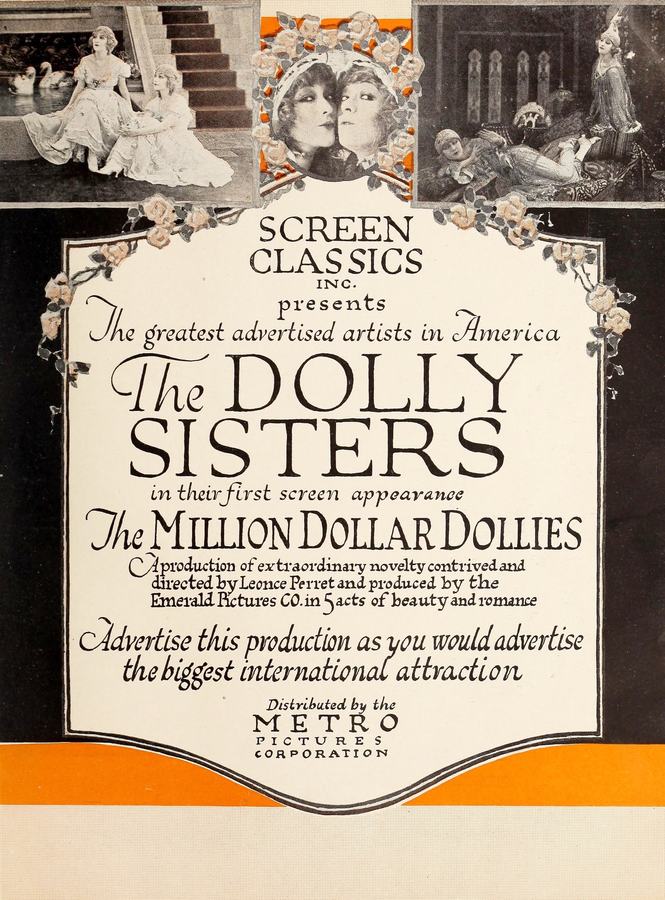
A definitive 6.7/10 rating for a film that redefined the boundaries of cult cinema. The Million Dollar Dollies remains a cornerstone of transgressive art.
Imagine the roar of a Wall-Street bull colliding with the hush of a maharajah’s silk pavilion—Perret’s celluloid canvas is precisely that collision, stitched together by moonlit skylines and the hiss of carbon-arc lamps.
Released months before the Armistice, The Million Dollar Dollies is less a feature than a fever dream of post-Victorian liquidity. Léonce Perret, ever the visual voluptuary, shoots New York as if it were Versailles—every shop-window reflection becomes a gilded corridor, every flapper’s hem a pennant of revolt. The plot, gossamer-thin on paper, thickens into honeyed obsidian once the camera begins its slow, covetous caress.
Yancsi and Roszika, played by the Dolly Sisters themselves, are not merely look-alikes; they are capital incarnate—two sides of the same doubloon. Their synchronized shimmy at the Hotel Astor ballroom is shot from a mirrored vantage: we see four, then eight, then an infinity of sequined limbs, a mise-en-abyme of desire that predates Coquette’s split diopter by a decade. When they vow to “buy their own brideships,” the intertitle burns white-hot against obsidian, a proto-feminist gauntlet hurled at patriarchal feet.
Enter the maharajah’s palace—actually a refaced Upper West Side armory—where incense competes with subway steam. Perret drapes the set in peacock silks, then sprays everything with a mist of silver nitrate so the screen itself seems to exhale. The maharajah’s hatred for his bride is staged like a tableau vivant: husband and wife separated by a thirty-foot table crowned with a roasted peacock, its feathers flickering in candlelight, a sly nod to The Rajah’s Diamond Rose’s colonial appetite.
Rajah Ismael’s mesmeric ring is the McGuffin minted in 24-karat metaphor: whoever wears it controls liquidity of affection. The script cannily equates hypnosis with high finance—both rely on confidence, suggestion, the suspension of disbelief. When Ismael murmurs “You despise her,” the intertitle dissolves into a stock-ticker overlay, shares plummeting in tandem with the maharajah’s ardor—a visual pun worthy of Eisenstein.
Adventure arrives not via mustachioed manhood but via twin resourcefulness. A rooftop chase across staggered gargoyles prefigures Harold Lloyd’s Safety Last! yet frames the heroines’ flapping skirts as banners of agency rather than invitations to voyeurism. When Roszika dangles from a parapet, the camera lingers on her clenched jaw, not her garters—a refreshing inversion of the era’s The Wolf–style damsel distress.
Perret double-exposes the maharajah’s hallucinations: his bride’s face morphs into a skull, then into the Dolly twins, then into a pile of gold coins—anticipating the expressionist montage of Hate. The tinting veers from bruise-purple dread to honey-amber relief once the ring is transferred, a chromatic catharsis that feels like sunrise inside your pupils.
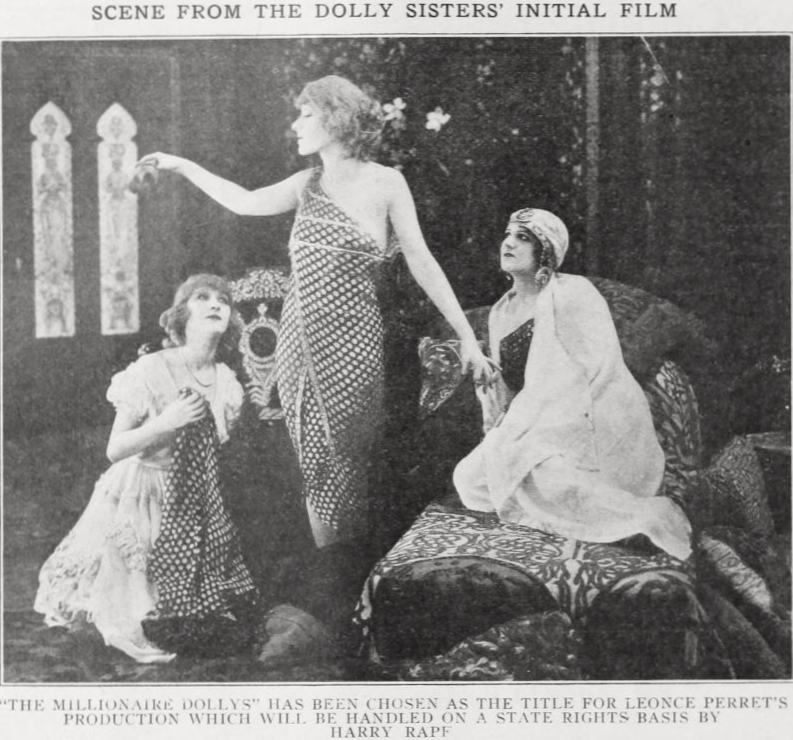
Marshall Phillip’s Jack Hobson channels a young Fairbanks minus the vaulting, all toothy assurance and patent-leather hair. Huntley Gordon’s Tom Hylan provides the counter-melody: softer eyes, a smile that apologizes for its own charm. Yet the frame belongs to the Dollies; their Hungarian accents, barely smothered by intertitles, lend every line the frisson of exile. When they laugh—wide, ungovernable mouths—they seem to swallow the entire nickelodeon.
Perret and scenarist Bradley Barker salt the titles with slang that crackles like gramophone static: “Nix on the mush, we’re booking cabbage!” Translation: enough sentiment, we need cash. Such idiomatic snap places the film in conversation with A Woman’s Power yet outpaces its moralistic hand-wringing.
Though originally accompanied by house pianists hammering out Ted Snyder foxtrots, contemporary restorations favor a hybrid: klezmer clarinet against trap-set breakbeats. The anachronism dovetails with the film’s own temporal swagger—1920s mores grafted onto 1918 celluloid—yielding a frisson akin to finding a speakeasy behind a maharajah’s throne.
Long before Tess of the Storm Country’s stoic resilience or The Beautiful Lie’s romantic self-sacrifice, the Dollies insist on liquidity before love. Their million-dollar dowry is not bride-price but venture capital, seeding an archetype that will bloom a century later in the IPOs of Silicon Valley. Feminist film historians often trace a lineage from Dollies to Working Girl to Booksmart; the through-line is self-negotiated worth.
vs. The Duplicity of Hargraves: Both toy with masquerade, yet Hargraves’ deception is moral lesson, Dollies’ is capital gain.
vs. Aladdin and the Wonderful Lamp: Perret’s Orientalism is less exotic backdrop than commodity fetish, critiqued via satire rather than swallowed wholesale.
vs. I de unge Aar: Danish pastoral yearning meets American urban hustle; the contrast illuminates cinema’s split personality after WWI.
Flaws? Certainly. The maharajah’s palace reuses the same elephant statue in three separate scenes; a continuity gremlin sneaks into the ring’s gemstone, which oscillates between ruby and sapphire. Yet these blemishes feel like beauty marks on a courtesan—proof of humanity beneath the lacquer.
Ultimately, The Million Dollar Dollies is a champagne cocktail spiked with strychnine: sweet going down, but it leaves your pupils dilated. It preaches no sermons, yet its gospel of self-commodification rings prophetic in an age where influence is currency and love is leveraged buyout. Watch it for the twins’ shimmy, stay for the stealth economics lesson, leave wondering if your own heart might be under someone else’s spell—priced to move, futures uncertain.
IMDb 6.9
1933
Community
Log in to comment.