DbcultAccessing Vault...
Cult Review
Senior Film Conservator
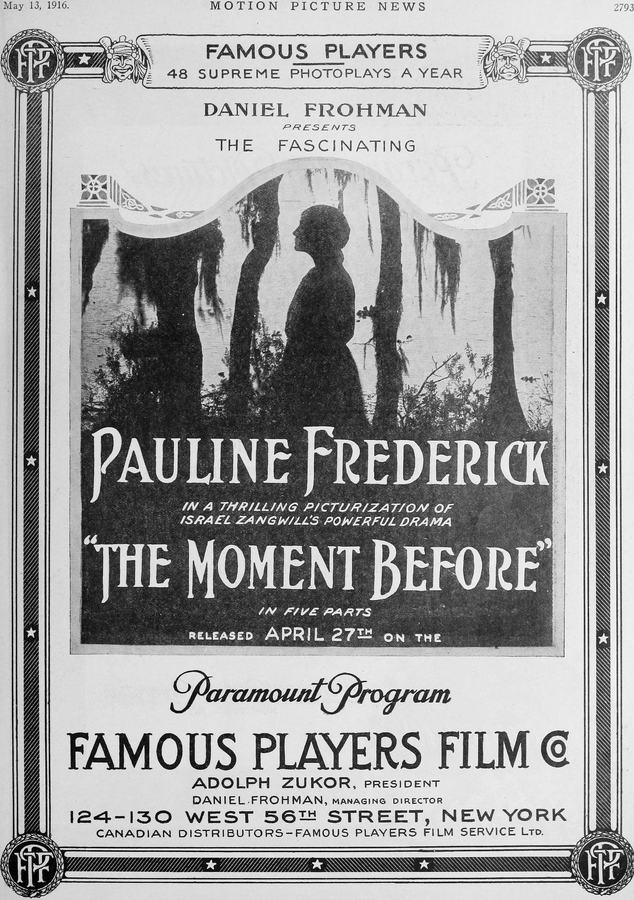
In the annals of silent cinema, where grand narratives often grappled with the profound complexities of human existence, Hugh Ford’s 1916 production, The Moment Before, stands as a mesmerizing, albeit often overlooked, psychological drama. It’s a film that eschews simplistic morality tales, instead diving headlong into the labyrinthine mind of a woman whose life, on the precipice of its end, flashes before her with startling clarity and unsparing detail. This isn't merely a chronological recounting; it's a visceral, emotional excavation, a final judgment passed by memory itself. The venerable Duchess of Maldon, a figure of unimpeachable societal standing and philanthropic renown, finds her carefully constructed edifice of respectability crumbling in the face of her own mortality, revealing the tempestuous, morally ambiguous journey that forged her.
The narrative’s true genesis lies not in the Duchess's twilight years but in the fiery spirit of Madge, a young gypsy woman whose life is anything but sedate. Her introduction to love and conflict is brutally swift: two men, locked in a primal struggle, vie for her. The victor, a domineering figure named John, claims her as his prize, forcing her into a union devoid of affection. This early trauma sets the stage for a life defined by resistance and an unyielding quest for agency. Madge’s subsequent desertion of John, a radical act for its time, isn't born of caprice but a desperate yearning for self-determination, a refusal to be merely chattel. Her subsequent romance with Harold, the youngest son of the Duke of Maldon, represents a tantalizing glimpse of genuine connection, a stark contrast to the coercion that marked her first entanglement. This forbidden liaison, however, is a mere prelude to further tragedy, reminding us that happiness, particularly for women who dare to defy convention, often comes with a steep price. The film brilliantly portrays the societal hypocrisy of the era, where a woman's past, no matter how circumstances shaped it, could forever brand her.
The ensuing conflict, rooted in Harold’s aristocratic brother’s condemnation of his affair with a “married woman,” culminates in a violent confrontation. Harold, believing he has committed fratricide, flees the country, abandoning Madge to navigate the fallout alone. This sequence is a masterful stroke of dramatic irony, as Harold's flight, driven by a mistaken belief, inadvertently leaves Madge vulnerable, mirroring the earlier abandonment she suffered. The emotional devastation for Madge is palpable, a cruel echo of her past. It’s a narrative device that not only propels the plot forward but also deepens our understanding of Madge’s resilience and her growing disillusionment with the promises of love and security. Comparisons could be drawn to films like The Climbers, which similarly explores the precariousness of social standing and the severe consequences of defying societal norms, particularly for women entangled in scandalous affairs. The stakes in The Moment Before feel even higher, given the raw, almost elemental struggles Madge faces.
Years later, the threads of fate, or perhaps sheer narrative convenience, bring Harold back into Madge’s life. He has discovered his brother survived, absolving him of his perceived crime. This reunion, however, is not a simple rekindling of romance. Madge, hardened by years of solitary struggle and the bitter taste of abandonment, is no longer the naïve gypsy girl. She is a woman forged in the fires of adversity, resolute in her determination not to let Harold slip away again. Her subsequent action – the calculated murder of John – is a stark, shocking demonstration of her evolved character. It's a moment that challenges the audience's moral compass, forcing us to grapple with the ethical ambiguities of her choices. Is it an act of liberation, a desperate bid for a legitimate future, or a descent into criminality? The film leaves this open to interpretation, a testament to its nuanced approach to character development.
Central to the film’s enduring power is Pauline Frederick’s extraordinary performance as Madge, a portrayal that transcends the often-melodramatic conventions of the silent era. Frederick imbues Madge with a raw intensity, a palpable journey from spirited youth to steely resolve. Her expressive eyes and subtle gestures convey a universe of unspoken emotion – the youthful defiance, the heartbreak of betrayal, and ultimately, the chilling determination of a woman who will stop at nothing to secure her destiny. She doesn't just play Madge; she inhabits her, making her moral compromises understandable, if not entirely forgivable. This nuanced performance elevates the character beyond a mere victim or villain, presenting her as a complex, deeply human figure navigating an unforgiving world. One might compare her compelling screen presence and emotional depth to other powerful female leads of the era, such as those found in films like Le crépuscule du coeur, where the internal struggles of the protagonist are similarly brought to vivid life through subtle acting.
The subsequent cover-up of John’s murder, alongside their past scandals, is executed with a chilling efficiency that speaks volumes about their collective will to survive and thrive. This isn’t a story of justice served in the conventional sense, but rather of a new form of justice, one forged by ambition and a desire for societal acceptance. Madge and Harold’s ascent into the upper echelons of English society, becoming the “model couple,” is the ultimate irony. Their public image is a meticulously crafted facade, a testament to their ability to manipulate appearances and bury their tumultuous past beneath a veneer of respectability. This transformation is not merely a plot point; it's a profound commentary on the performative nature of aristocracy and the lengths to which individuals will go to achieve and maintain status. The film, in its quiet subversion, reveals that the most distinguished lives can often be built upon the most unspeakable foundations.
The screenplay, penned by Israel Zangwill and Hugh Ford, is a marvel of intricate plotting, deftly weaving together themes of fate, free will, moral ambiguity, and societal hypocrisy. Zangwill, known for his literary prowess, brings a psychological depth to the narrative that elevates it beyond mere melodrama. The structure, beginning with the Duchess's deathbed revelation, is particularly effective, imbuing the entire flashback with a sense of fatalism and retrospective judgment. This framing device compels the audience to view Madge’s life through the lens of its ultimate outcome, constantly questioning how each choice led to her final, revered, yet haunted, status. Hugh Ford's direction, while perhaps less flashy than some of his contemporaries, is remarkably assured, allowing the story and performances to take center stage. He understands the power of the close-up, particularly in capturing Frederick's nuanced expressions, and orchestrates the dramatic sequences with a keen eye for tension and emotional impact. The visual storytelling, characteristic of the silent era, relies heavily on the actors' physicality and the careful composition of each frame to convey the complex emotional undercurrents of the narrative.
The film’s exploration of a hidden past and the lengths taken to conceal it resonates strongly with other period dramas that delve into secrets and their corrosive effects. One might draw parallels to The Mystery of Room 13, where the unraveling of a crime is intricately linked to the obscured histories of its characters. However, The Moment Before distinguishes itself by focusing not just on the revelation of the secret, but on the *construction* of the respectable life *around* the secret, a feat of social engineering as much as personal transformation. The film subtly critiques the rigid class structures of early 20th-century England, demonstrating how even the most scandalous origins could be whitewashed with enough cunning and determination, provided one achieved a certain level of wealth and influence. The narrative implies that respectability is often a performance, a carefully curated illusion maintained by societal complicity and selective memory.
In an era that often glorified overt heroism or tragic victimhood, The Moment Before dares to present a protagonist who is neither purely good nor irredeemably evil, but a complex tapestry of survival, ambition, and moral compromise. It's a film that asks profound questions about identity, the nature of memory, and the true cost of societal acceptance. What does it mean to be a “model couple” when your foundation is built on deception and violence? Does success absolve past transgressions, or merely bury them deeper? The film’s refusal to offer easy answers is precisely what makes it so compelling and enduringly relevant. It's a testament to the power of early cinema to explore sophisticated psychological landscapes, proving that silent films were far from simplistic entertainment. For those interested in the evolution of cinematic storytelling and the nuanced portrayal of complex female characters, The Moment Before is an essential watch, a fascinating glimpse into the moral ambiguities that lie beneath the polished surface of even the most esteemed lives. It reminds us that every grand public figure, every respected Duchess, carries within them a private history, a personal epic that may be far more tumultuous and morally fraught than the world ever knows. Its narrative echoes the life-spanning sagas of films like My Old Dutch, but with a darker, more introspective lens on the protagonist's journey and the choices that define her ultimate fate. This film is a powerful reminder that the human spirit, when pushed to its limits, is capable of both immense love and formidable, even dangerous, resolve.
IMDb —
1918
Community
Log in to comment.