DbcultAccessing Vault...
Cult Review
Senior Film Conservator
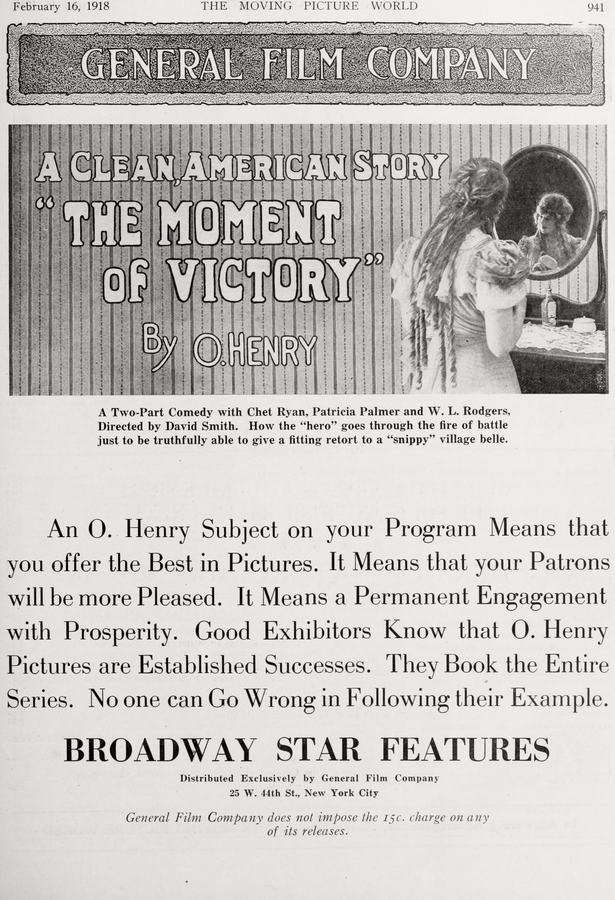
When I first encountered The Moment of Victory, I expected a straightforward war romance, a relic of early twentieth‑century melodrama. What unfolded was a layered meditation on unrequited affection, the fickle nature of public adulation, and the inevitable erosion of superficial beauty. The film, scripted by the legendary O. Henry in collaboration with George H. Plympton, weaves a narrative that feels both of its era and oddly prescient.
Set against the languid backdrop of San Augustine, a town that seems to exist in a perpetual amber glow, the story opens with Willie Robbins (Chet Ryan), a lanky, earnest young man whose heart beats in sync with the town’s slow rhythm. His object of desire, Myra Allison (Patricia Palmer), is introduced not merely as a love interest but as a cultural icon: the prettiest, most vivacious girl in the county, whose laughter can be heard echoing down the main street. Myra’s teasing is not cruel for cruelty’s sake; it is a performance, a social dance that reinforces her status. Willie, however, misreads the choreography, interpreting her mockery as a challenge.
The first act is a study in youthful vulnerability. Willie’s attempts to win Myra’s favor are clumsy, his gestures earnest yet misguided. He offers her a hand‑woven bracelet, recites a clumsy poem, and even tries to impress her with a borrowed violin. Each overture is met with a giggle, a dismissive wave, or a sarcastic remark that leaves him more exposed than before. The cinematography—though limited by the technology of 1919—captures these moments with a lingering close‑up that forces the audience to feel the sting of rejection.
Enter the Spanish‑American War, a historical catalyst that propels Willie from the margins of his own life into the epicenter of national conflict. The transition from domestic disappointment to battlefield valor is handled with a briskness that mirrors the era’s storytelling conventions, yet the emotional stakes feel genuine. Willie’s enlistment is not a calculated career move; it is an impulsive flight from the ache of unreciprocated love. The war sequences, shot with a stark, high‑contrast aesthetic, juxtapose the chaos of combat with Willie’s internal resolve. When he captures a Spanish general—a feat that earns him a captain’s rank—the film pauses to let the triumph sink in, employing a triumphant brass fanfare that reverberates through the theater.
Upon his return, San Augustine erupts in celebration. The mayor, a rotund figure in a top hat, leads a brass band down the main thoroughfare; schoolgirls in crisp white dresses wave ribbons; townsfolk line the streets, their faces illuminated by lanterns. This tableau is a visual ode to the hero’s welcome, a moment where Willie’s personal narrative is subsumed by collective adulation. The director uses a wide‑angle shot to capture the entire procession, allowing the audience to feel the weight of communal expectation.
Yet the film’s true emotional fulcrum lies not in the fanfare but in the quiet, almost mundane scene that follows. Willie walks to the modest white cottage of Joe Cranberry (Walter Rodgers), Myra’s husband. The camera lingers on the porch, where Myra now stands—her hair unkempt, her dress wrinkled, her eyes dulled by the fatigue of domestic routine. The transformation is stark, a visual metaphor for the impermanence of youthful allure. Willie’s approach is deliberate; his stride, once tentative, now exudes a quiet confidence. He offers a polite bow, a smile that hints at both triumph and melancholy.
The climax is less about a dramatic confrontation and more about an unspoken reversal of power. Myra, who once wielded beauty as a weapon, now finds herself on the receiving end of a gaze that once adored her from afar. The audience is invited to witness the subtle shift: the once‑mocked lover now holds the reins of emotional authority. The scene ends with a lingering shot of Willie’s face, half‑smiling, half‑pensive, as the camera pulls back to reveal the quiet street, the night sky, and the distant echo of the brass band that once celebrated his return.
The performances are noteworthy. Chet Ryan imbues Willie with a blend of earnestness and quiet steel; his eyes convey a depth that transcends the silent film medium. Patricia Palmer, as Myra, masterfully navigates the spectrum from vivacious flirtation to weary resignation, her facial expressions speaking volumes in the absence of dialogue. Walter Rodgers provides a solid, if understated, counterpoint as Joe Cranberry, embodying the everyman who inadvertently becomes the catalyst for Willie’s poetic justice.
Beyond the central narrative, the film subtly engages with broader themes that resonate with contemporary audiences. The notion of heroism is interrogated: is Willie a hero because of his battlefield exploits, or because he confronts his personal demons and reclaims agency? The film also critiques societal expectations of beauty, suggesting that external allure is fleeting, while inner resolve endures.
When placed alongside other silent‑era works, The Moment of Victory shares a kinship with Miss Petticoats in its exploration of youthful romance, yet diverges by embedding the love story within a war narrative, akin to the structure of The Return of Draw Egan. Its moral resolution echoes the bittersweet tone of Blue‑Eyed Mary, where characters confront the consequences of their choices in a world that offers no easy redemption.
The film’s visual palette—though constrained to black‑and‑white—employs light and shadow to great effect. The celebratory scenes are bathed in soft, diffused illumination, while the final porch encounter is rendered in stark chiaroscuro, emphasizing the emotional chiaroscuro within the characters. The director’s use of intertitles is sparing, allowing the actors’ gestures to carry the narrative weight.
From a technical standpoint, the editing is crisp, with transitions that maintain narrative momentum without feeling rushed. The war sequences, though brief, are choreographed with a sense of urgency that mirrors the protagonist’s internal drive. The sound design—limited to the musical accompaniment typical of the era—leverages a recurring leitmotif that underscores Willie’s journey from longing to triumph.
In terms of cultural impact, the film offers a window into early twentieth‑century American values: the glorification of military service, the idealization of small‑town virtue, and the gender dynamics that position women as both objects of desire and arbiters of social standing. Yet it also subverts these tropes by granting its male protagonist a moment of personal vindication that is not predicated on further violence but on emotional equilibrium.
For modern viewers, the film’s relevance lies in its timeless exploration of unreciprocated love and the quest for self‑validation. In an age where social media amplifies the performative aspects of attraction, Willie’s journey reminds us that true worth is not measured by external approval but by the courage to confront one’s own insecurities.
If you appreciate nuanced storytelling that balances romance, war, and moral introspection, The Moment of Victory deserves a place on your watchlist. Its narrative economy—delivering a complete arc within a concise runtime—demonstrates the power of silent cinema to convey complex emotions without uttering a single word.
In summary, the film excels on three fronts: a compelling character study, deft direction that maximizes the silent medium’s expressive potential, and thematic depth that transcends its historical context. Whether you are a scholar of early American cinema or a casual enthusiast seeking a story that lingers long after the credits roll, this work offers a richly textured experience that rewards attentive viewing.
For further exploration of similar narratives, consider delving into Detective Craig's Coup for its intricate plot twists, A London Flat Mystery for its atmospheric tension, or Hidden Valley for its pastoral charm. Each of these films, while distinct in genre, shares the underlying thread of characters confronting societal expectations and personal destiny—an enduring motif that continues to captivate audiences across generations.
IMDb —
1923
Community
Log in to comment.