DbcultAccessing Vault...
Cult Review
Senior Film Conservator
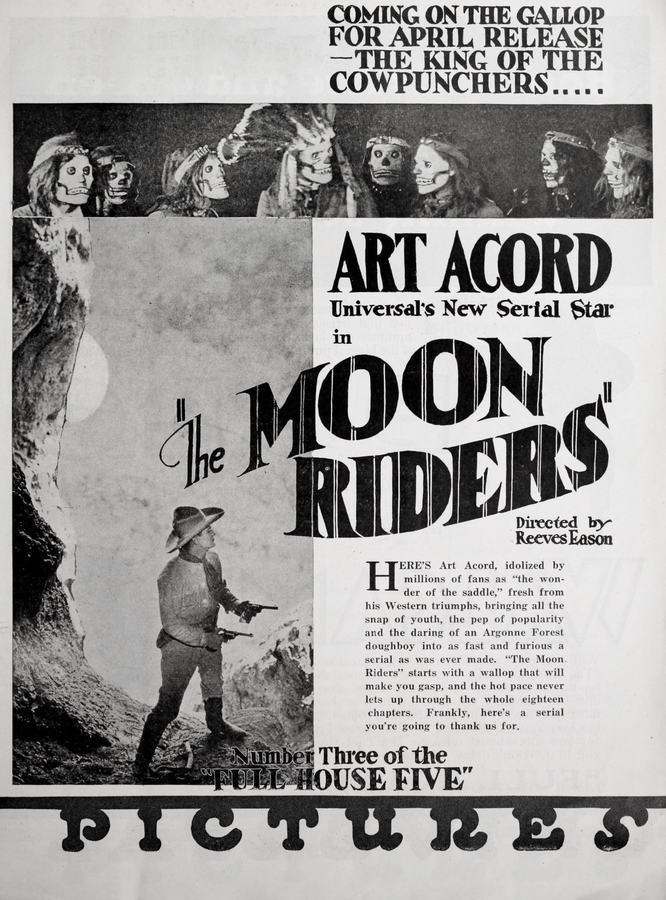
In the pantheon of early 20th-century American cinema, few genres captured the national zeitgeist quite like the Western serial. The Moon Riders (1920) emerges not merely as a relic of celluloid history, but as a kinetic, 18-chapter odyssey that defines the transitional anxieties of an era. Directed by Albert Russell and Theodore Wharton, this production stands as a testament to the raw, unvarnished physicality that preceded the sanitized artifice of later Hollywood Golden Age Westerns. While contemporary audiences might view the silent era through a lens of nostalgic simplicity, a closer inspection of this work reveals a complex tapestry of socio-political tension, specifically regarding the contentious legacy of the Spanish land grants.
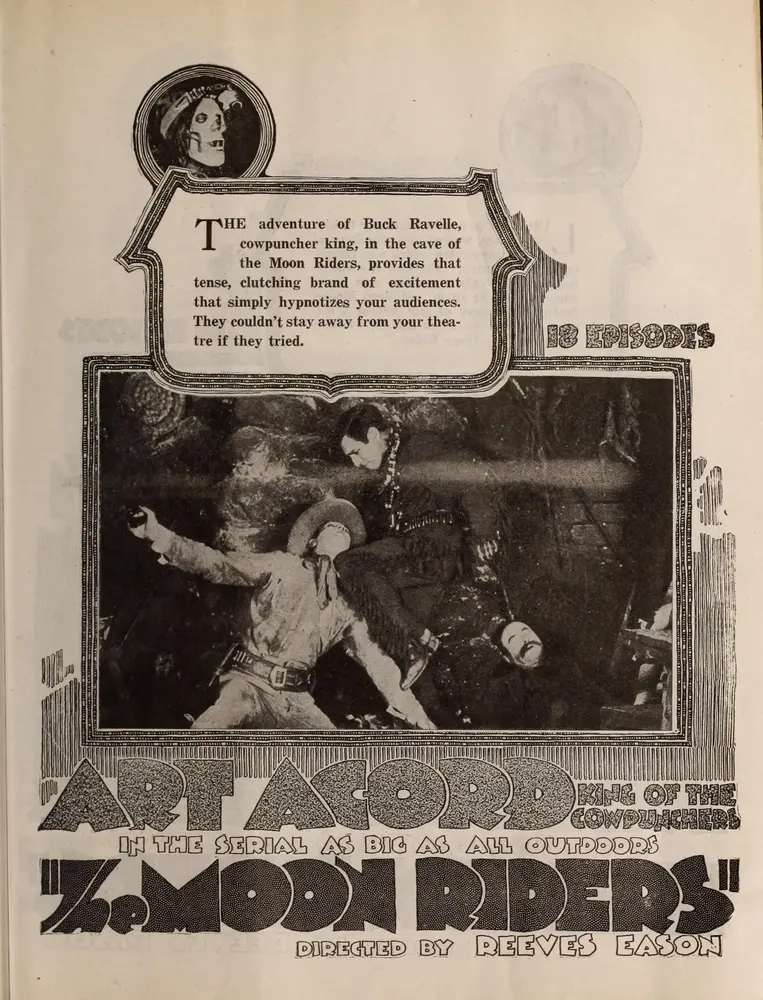
At the epicenter of this whirlwind is Art Acord. To understand Acord’s appeal in 1920, one must look past the screen and into the arena; a real-life rodeo champion, Acord brought an atavistic authenticity to the role of Buck Masterson that few of his contemporaries could emulate. Unlike the theatrical flourishes seen in The Intrigue, Acord’s performance is rooted in the language of the body. Every mount, every gallop, and every desperate struggle against the 'unscrupulous band' feels weighted with genuine peril. His presence provides a stark contrast to the more polished, perhaps less physically grounded protagonists found in Law of the Land.
Acord’s physicality is bolstered by a supporting cast that reads like a who’s who of silent-era character actors. Charles Newton and George Field provide the necessary gravitas and villainy, respectively, creating a moral binary that, while common for the time, is executed here with a particular venom. The inclusion of Tote Du Crow and the mesmerizing Beatrice Dominguez adds layers of ethnic complexity that reflect the heterogeneous reality of the frontier, even if filtered through the limitations of 1920s racial tropes.
The plot, penned by a collective of writers including George Hively and William Pigott, hinges on a fascinatingly dry legal concept: the obsolete Spanish land grant. In the hands of the film’s antagonists, these ancient documents are transformed into weapons of mass displacement. This isn't just a story about outlaws robbing banks; it's a story about the systemic theft of livelihoods. This thematic depth elevates The Moon Riders above the standard 'shoot-em-up' fare, placing it in conversation with more intellectually rigorous works like The Island of Intrigue, where the conflict is as much about information and legacy as it is about gunpowder.
The homesteaders, led by the steadfast Mildred Moore, represent the agrarian ideal—the Jeffersonian dream under siege. The tension between the 'obsolete' past (the grants) and the 'future' (the homesteaders' productivity) creates a narrative friction that sustains the film across its eighteen grueling chapters. It is a struggle for the soul of the land, mirrored in the dusty, wide-angle cinematography that captures the vastness of the Californian desert, a landscape that remains indifferent to the petty squabbles of men.
Technically, The Moon Riders is a masterclass in the 'cliffhanger' architecture. The pacing, overseen by editors and writers like Karl R. Coolidge, is relentless. Each episode must provide a self-contained arc while fueling the momentum for the next, a structural requirement that often led to repetitive plotting in lesser hands. However, here, the variety of the set pieces—ranging from high-speed horse chases to claustrophobic encounters in rocky ravines—prevents the fatigue that can sometimes plague long-form silent narratives. For a comparison in pacing, one might look at the urban tension in The Night Workers, though the scale of the Western landscape allows for a much more expansive visual breath.
"The film operates as a visual palimpsest, where the grit of the horse-opera is layered over a sophisticated critique of American property law and the ghosts of its colonial origins."
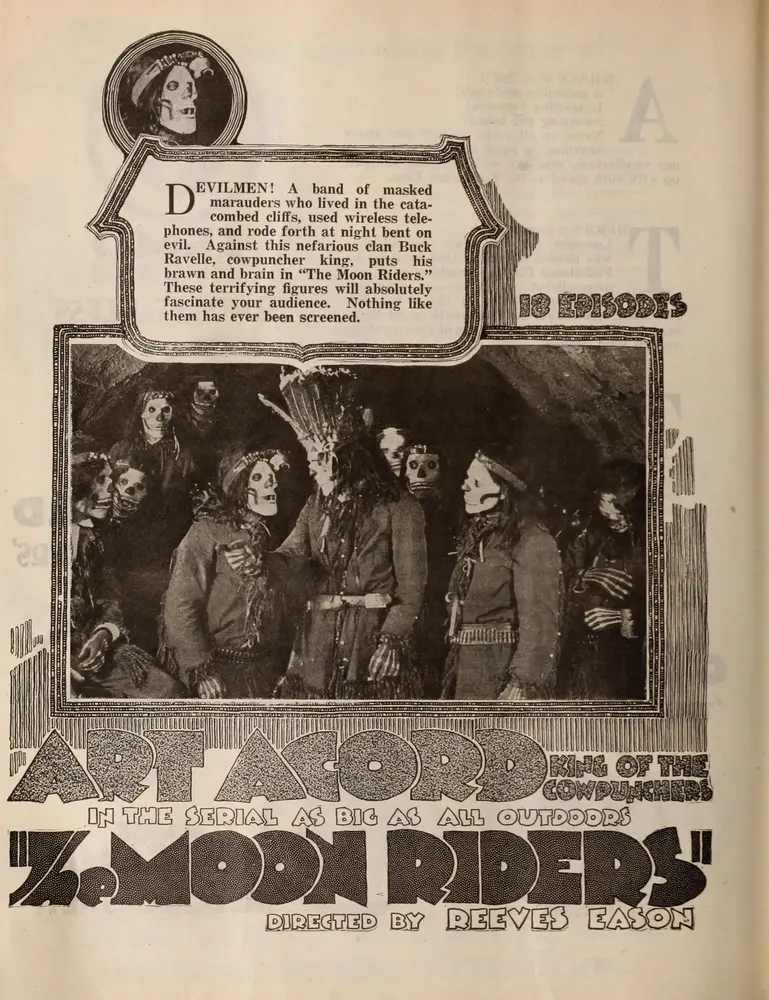
The lighting and composition, while restricted by the technology of 1920, utilize natural sunlight to create high-contrast imagery that highlights the ruggedness of the performers' faces. Albert MacQuarrie, another stalwart of the era, brings a certain rugged reliability to the frame, ensuring that even the smaller roles feel grounded in a specific time and place. The film avoids the surrealism of European contemporaries like A kuruzslo or the psychological depth of Die rollende Kugel, opting instead for a quintessentially American directness.
One cannot discuss The Moon Riders without addressing the stunts. In an age before CGI or sophisticated wirework, the feats performed by Acord and his peers were genuinely life-threatening. This 'cinema of attractions' aspect is what kept audiences returning week after week. The visceral thrill of seeing a man leap from a moving stagecoach onto a galloping horse is a universal cinematic language. While films like The Marionettes focused on the artifice of performance, The Moon Riders celebrates the reality of the human body in motion.
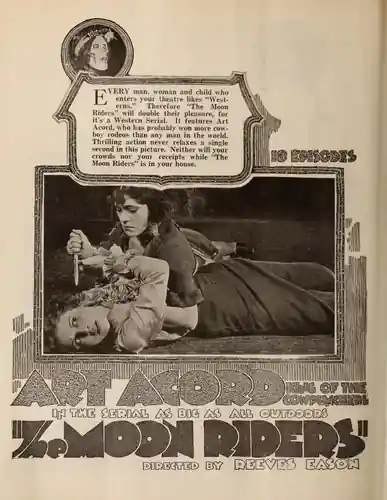
The choreography of the fights is remarkably modern in its brutality. There is a lack of the choreographed 'ballet' that would later define Western brawls. Instead, we see the stumbling, desperate grappling of men fighting for their lives. This realism extends to the treatment of the horses, which are as much characters in the film as the humans. The bond between Acord and his mount is palpable, a silent partnership that serves as the emotional core of the film’s most intense sequences.
The collaborative writing team, including Albert Russell and George Hively, tapped into a uniquely American anxiety: the loss of land. In 1920, the memory of the frontier was still fresh, and the legal battles over land titles were still a reality for many in the West. By framing the villains as users of 'obsolete' grants, the film positions itself on the side of progress and hard work over inherited privilege and bureaucratic manipulation. This theme resonates with the struggles seen in The Captive, though the stakes here are broader, encompassing an entire community rather than a single individual.
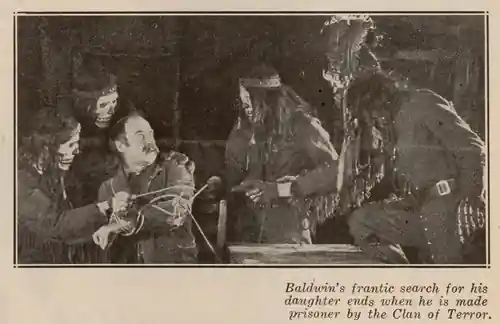
Furthermore, the film’s exploration of these themes places it within a broader cinematic movement that sought to define American identity through its relationship with the wilderness. Unlike the more gothic or theatrical explorations of human nature found in Vampire or Ludi i strasti, The Moon Riders is firmly rooted in the dirt. It is a film of textures—the grain of the wood, the dust of the trail, the sweat on the brow.
While many serials of the silent era have been lost to the ravages of nitrate decomposition, the legacy of The Moon Riders persists in the DNA of every Western that followed. It established a blueprint for the hero who is both a man of action and a man of principle. It highlighted the importance of landscape as a narrative character, and it proved that even the most complex legal disputes could be translated into thrilling visual drama. For those seeking to understand the roots of the American action hero, look no further than Art Acord’s Buck Masterson.
The film may lack the subtle nuances of The Girl of Today or the experimental flair of Shades of Shakespeare, but what it possesses is a raw, unadulterated energy that is infectious even a century later. It is a reminder that cinema, at its most fundamental level, is about movement, conflict, and the eternal struggle for a place to call home. In the end, The Moon Riders is not just a relic; it is a living, breathing piece of the American mythos, as stubborn and resilient as the homesteaders it portrays.
For more explorations into the early days of cinema and the evolution of the Western genre, consider checking out our analysis of The Right Element or the adventurous spirit of A Successful Adventure.
IMDb 5.2
1936
Community
Log in to comment.