DbcultAccessing Vault...
Cult Review
Senior Film Conservator
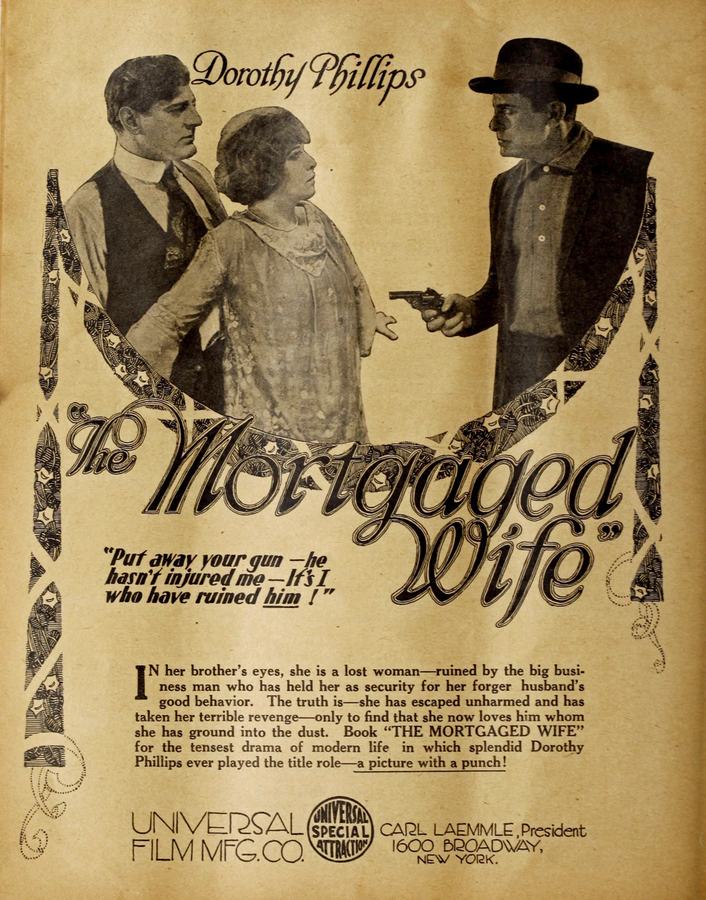
The silent era, often romanticized yet frequently underestimated, was a crucible for narrative innovation, and The Mortgaged Wife stands as a testament to its capacity for intricate melodrama and moral complexity. This 1918 production, starring the luminous Dorothy Phillips, delves into the fraught landscape of human desperation and unexpected virtue, painting a portrait of sacrifice that resonates far beyond its initial release. It’s a film that demands a contemporary re-evaluation, not merely as a historical artifact, but as a compelling study of character under duress, a thematic exploration that rivals many of its more celebrated contemporaries.
At its core, the narrative is a stark examination of a woman's agency, or lack thereof, in a patriarchal society. Gloria Carter, portrayed with poignant vulnerability and nascent strength by Phillips, finds herself ensnared in a predicament born of her husband Ralph's (Alan Roscoe) egregious moral failing. Ralph's embezzlement of a substantial sum, $50,000, from his employer, a bank, immediately thrusts Gloria into a desperate search for salvation. Her appeal to Jerome Harris (Edwin August), a wealthy bank official with a long-standing, unspoken affection for her, sets in motion a transaction that is both shocking and, for the time, perhaps disturbingly plausible: Gloria's very person offered as 'security' against her husband's charges. This premise alone elevates the film beyond simple crime drama, pushing it into the realm of social commentary, akin to the societal constraints and moral compromises explored in The House of Mirth, where a woman's value is often tragically tied to her social standing and perceived purity.
The film then pivots into an unexpected exploration of restraint and burgeoning respect. Once Gloria moves into Jerome's opulent residence, the audience, conditioned by the tropes of melodrama, might anticipate a descent into exploitation. Yet, The Mortgaged Wife subverts these expectations. Jerome, despite his initial transactional demand, demonstrates a surprising nobility, respecting Gloria's refusal of his advances and leaving her unmolested. This particular plot point is crucial; it transforms Jerome from a potential villain into a figure of complex moral ambiguity, a man capable of both ruthless negotiation and profound, if unconventional, honor. It's a nuanced portrayal that adds considerable depth to the unfolding drama, preventing it from devolving into a simplistic tale of victimhood.
The re-emergence of Ralph Carter into Gloria's life serves as a stark reminder of the catalyst for her predicament and highlights his utter lack of redemption. His anger and demands for money, coupled with his brazen association with chorus girls, underscore his parasitic nature and moral decay. This scene is pivotal, not only for showcasing Ralph's continued dissolution but also for solidifying Jerome's protective instincts towards Gloria. His decisive expulsion of Ralph from the house marks a turning point, signaling his commitment to Gloria's well-being, irrespective of the initial, morally dubious terms of their arrangement. The contrast between Ralph's self-serving depravity and Jerome's evolving, protective affection provides much of the film's emotional tension, echoing similar struggles for dignity and survival found in films like On the Level, where characters grapple with the consequences of their choices and the moral failings of others.
What truly elevates The Mortgaged Wife beyond a mere domestic drama is the introduction of a geopolitical undercurrent through the character of Meyer, Jerome's seemingly innocuous secretary. Meyer is revealed to be a German spy, his covert dealings meticulously orchestrated to bring about Jerome's financial ruin. This layer of espionage injects a thrilling element of wartime intrigue, a common thematic thread in cinema of the era, given the contemporary global conflicts. The film skillfully intertwines personal melodrama with broader political machinations, creating a tapestry of betrayal that extends from the intimate confines of a marriage to the grand stage of international espionage. This aspect lends the film an unexpected urgency and relevance, aligning it with the more suspenseful narratives of the period, perhaps even touching upon the clandestine world depicted in The Closed Road or the intricate plots of Manden med de ni Fingre III, albeit with a distinct American melodrama sensibility.
Gloria's response to Jerome's impending financial ruin is a testament to her evolving character arc. Her initial placement in his home was a matter of coerced self-sacrifice, yet witnessing his vulnerability and the injustice perpetrated against him by Meyer stirs a genuine pity and, crucially, a burgeoning affection. This shift from obligation to empathy is subtly yet powerfully conveyed by Phillips, whose expressive performance must have been central to communicating these complex internal states without dialogue. It's in these moments that the film truly shines, showcasing the transformative power of shared adversity and the unexpected blossoming of love amidst crisis. This emotional journey of a woman finding her own moral compass and agency, distinct from the men in her life, echoes the spirit of self-determination often seen in films like Her Decision, where protagonists navigate difficult choices to forge their own paths.
The climax is a masterclass in silent film dramaturgy: a confrontation between Gloria and Meyer, fueled by her discovery of his duplicity. The struggle that ensues is fraught with tension, a physical manifestation of the battle for truth and justice. The unexpected re-entry of Ralph into this volatile scene, culminating in his death, serves as a brutally effective narrative device, tying up loose ends and simultaneously deepening the emotional stakes. His demise, while tragic, feels almost inevitable, a consequence of his own moral bankruptcy rather than a random act of fate. Meyer's subsequent arrest brings a sense of closure to the espionage subplot, but the true resolution lies in Gloria's profound realization. In the aftermath of chaos and revelation, she finally acknowledges her deep, undeniable love for Jerome, a love forged not in initial attraction but in shared hardship, mutual respect, and his unwavering, if initially unconventional, protection. It's a powerful conclusion that transcends the transactional nature of their initial arrangement, transforming it into a genuine emotional bond.
Dorothy Phillips, as Gloria, delivers a performance that anchors the entire production. Her ability to convey a vast spectrum of emotions—desperation, dignity, fear, resolve, and ultimately, love—through facial expressions and body language, is a testament to the artistry of silent film acting. She makes Gloria's impossible choices comprehensible and her emotional journey believable. Alan Roscoe, as Ralph, skillfully embodies the character's weakness and moral degradation, providing a necessary foil to Jerome's more complex heroism. Edwin August imbues Jerome with a quiet strength and a surprising depth, navigating the character's initial questionable morality towards a more noble, heroic stance. The synergy among these performers, under the direction of Allen Holubar, must have been compelling, creating a visceral experience for audiences of the time. The script, co-written by Holubar and Frank Howard Clark, is remarkably tight, weaving together personal drama, crime, and international intrigue with commendable coherence.
Visually, one can imagine The Mortgaged Wife utilizing the expressive power of early cinema. Close-ups would have been crucial for Phillips' nuanced performance, drawing the audience into Gloria's internal world. The contrast between Ralph's squalid surroundings with chorus girls and Jerome's opulent home would have visually underscored the moral and social divide, a common technique in silent films to convey character and status without dialogue. The pacing, typical of the era, would likely have been deliberate, allowing the emotional beats to register fully, building tension towards the dramatic confrontations. The use of intertitles, while serving to advance the plot, would also have provided opportunities for poetic or impactful statements, enhancing the film's artistic merit. This careful construction of visual storytelling is what made many silent films enduring, much like the intricate visual narratives found in Zudora or the evocative religious imagery of Miraklet: Tavlor ur det katolska samfundslivet, albeit in a different genre.
The film's exploration of 'sinful love' and its consequences, particularly through Ralph's actions and Gloria's initial predicament, finds parallels in films like Sündige Liebe or Sins of Ambition, which often delved into the moral failings and societal judgments of the time. However, The Mortgaged Wife distinguishes itself by offering a path to genuine, redemptive love, not through conventional means but through a crucible of sacrifice and mutual respect. Gloria's journey from a pawn in a financial transaction to a woman who chooses love based on deeper understanding is a powerful statement, even by today's standards. It challenges simplistic notions of hero and villain, instead presenting characters who are flawed, evolving, and capable of surprising acts of grace.
In conclusion, The Mortgaged Wife is far more than a period piece; it is a gripping human drama that speaks to enduring themes of sacrifice, betrayal, and the complex nature of love. Its innovative intertwining of personal melodrama with wartime espionage adds layers of intrigue, making it a film that defies easy categorization. The compelling performances, particularly Dorothy Phillips' nuanced portrayal of Gloria, elevate the material, ensuring that the emotional beats land with considerable impact. For enthusiasts of silent cinema and those interested in the evolution of narrative film, this picture offers a rich, rewarding experience, demonstrating the sophisticated storytelling capabilities of early Hollywood. It serves as a powerful reminder that even in an era without spoken dialogue, films could explore the deepest recesses of the human heart and the most intricate webs of societal and political intrigue, leaving an indelible mark on cinematic history.
IMDb —
1935
Community
Log in to comment.