DbcultAccessing Vault...
Cult Review
Senior Film Conservator
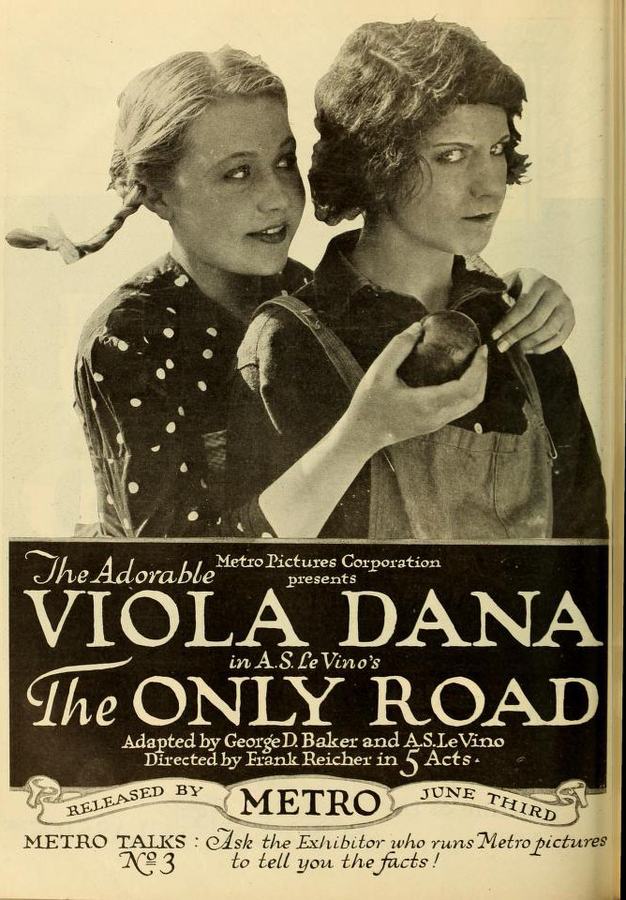
Moonlit nitrate flickers, and suddenly 1922 feels less like a calendar square than a wound—one that The Only Road keeps prising open. Watch how cinematographer George Barnes (borrowing chiaroscuro from his later work on The Secret Orchard) turns a Monterey back-lot into a mythic frontier: every zucchini leaf trembles like green currency, every mission shadow suggests both sanctuary and trap. The film arrives wearing the wardrobe of a routine melodrama, yet beneath its gingham hem pulses an anarchic heartbeat—an interrogation of blood, property, and the female body as negotiable parchment.
Forget sepia nostalgia; Barnes opts for sulfuric yellow to render high-noon hysteria, then dunks night interiors into sea-blue pools that anticipate Az éjszaka rabja’s cobalt prisons. Note the moment Nita—played by Viola Dana with feral kineticism—discovers her lineage: the camera dollies backward through an archway shaped like a birth canal, Clara Hawkins (Edythe Chapman) framed within a halo of over-exposed lamplight. No intertitle is needed; the iris contracts like a pupil digesting lightning. It is silent cinema’s answer to Proust’s madeleine—memory as physical collision.
The screenplay, credited to Albert S. Le Vino and George D. Baker, weaponizes the American caste flip: field becomes ballroom, daughter becomes heiress, predator becomes plaintiff. When Pedro (Casson Ferguson) struts into the Hawkins soirée clad in charro black, the mise-en-scène weaponizes negative space—he stands isolated beneath a chandelier crystalline as verdicts, while ranch workers peer through French windows, their faces constellating the glass. The sequence recalls the ballroom in Die Königstochter von Travankore, yet here the colonial gaze is reversed: the periphery stares down the center until gilt cracks.
Critics often chuckle at the sheriff forcing matrimony at gunpoint, dismissing it as hoary trope. Reexamine the staging: the lawman’s star catches a shaft of light, projecting a cruciform silhouette across Nita’s breast. Marriage morphs into penal contract, prefiguring Michel Foucault by half a century. Bob’s compliance reads less cowardice than survivalist cunning—he intuits that the ritual’s performative utterance (“I do”) can be unpronounced once safety is bartered. In that calculus lies the film’s stealth feminism: Bob does not save Nita from patriarchy but recruits her as co-conspirator against its circuitry.
Dana’s physical lexicon deserves its own dissertation. She hitches up her dungarees like Douglas Fairbanks buckling swash, yet her eyes—anxious, always calculating—betray the performance of masculinity as armor. In the convent escape she clambers down rain-soaked vines; the camera cranks at a slightly slower speed so her movements acquire helium buoyancy, a proto-Looney-Tunes defiance of gravity. Contrast that with The Heart of the Hills where Mary Pickford’s mountain girl femininity is saccharine prophecy; Dana fractures the template, letting shards cut audience skin.
Original exhibitors accompanied The Only Road with everything from La Traviata reductions to Wurlitzer improvisations. Yet the surviving cue sheets hint at subversive dissonance: during the abduction sequence, conductors were advised to segue from a tender waltz into a Schoenberg-esque atonal stab. Few venues risked modernism, but the prescription alone testifies to the film’s appetite for discord. View today with Meredith Monk’s vocal experimentations and watch the celluloid exhale like a long-caged animal tasting open air.
The trope of swapped babies snakes through world cinema: Zhuangzi shi qi uses Taoist circularity to interrogate parental fate, while A Falu rossza embeds the device inside Magyar fatalism. The Only Road distinguishes itself by yoking the motif to Manifest-Destiny capitalism: land as inheritance, woman as deed. The convent sequence reverberates through The Torture of Silence, yet where the latter wallows in Catholic guilt, Le Vino’s script converts the nunnery into transit lounge—liminal, negotiable, escapable.
Though set in a nominally post-Mexican-American-War landscape, the film crackles with colonial hauntology. Ramon Lupo’s law office bristles with Spanish land-grant maps; his quill scratches parchment that dispossesses californios and Indigenous alike. When he plots Nita’s forced assimilation into the Lupo dynasty, the narrative exposes settler logic: blood purity as hedge against annexation anxiety. The camera pans across his collection of crucifix-sheathed swords—conquistador nostalgia weaponized against a daughter of the very soil he commodifies.
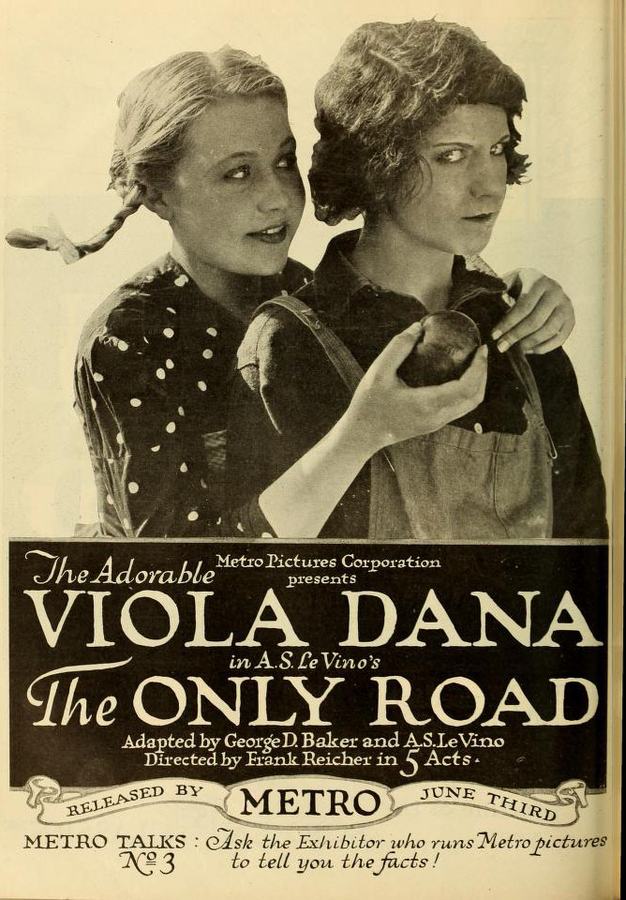
Nita’s trajectory sketches a palimpsest across Californian topography: market stall (public commerce), prison chamber (domestic enclosure), convent (spiritual sequestration), open range (liberation). Each locale reads as text upon her epidermis—dirt under nails, bruise on clavicle, wimple abrasion on temple. The film invites us to read landscape as tattoo, anticipating Andrea Arnold’s American Honey by nearly a century but with the added venom of birthright usurpation.
Bob Armstrong, essayed by Monte Blue with rangy diffidence, embodies the Eastern gaze that oscillates between rescue and possession. His linen suits wrinkle conspicuously against the ranch’s dusty ochres, signaling cosmopolitan impotence. Yet the film denies him savior catharsis; instead, Nita reverse-colonizes his futurity. In the closing two-shot their silhouettes merge against a sunset that bleeds from tangerine to arterial scarlet, suggesting partnership rather than patriarchal absorption—an egalitarian covenant rare in 1922.
Chicago’s Board of Censors excised approximately 435 feet—roughly five minutes—allegedly depicting "excessive brutality against female personage." The lost segment, pieced together from censorship notes, involved Pedro’s attempted branding of Nita’s shoulder with a cattle iron. Its absence mutes the class-sexual violence metaphor, yet even in truncated form the film radiates menace. Contemporary restorers have opted to leave the gap signaled by a flicker of leader and a subtitle: "Here the abyss speaks without us."
Viola Dana, née Virginia Flugrath of German-Irish stock, darkens her complexion with walnut stain to embody a character coded as mestiza. The performative slipperiness exposes Hollywood’s emerging pigmentocracy: brownface as passport into narratives of dispossession. Rather than cancel the film, we should archive the dissonance—let the stain remain like evidence under UV light, reminding us that identity in early cinema is cosplay layered atop capital.
The picture runs a brisk 58 minutes at 22 fps, yet its narrative density rivals Nearly Married’s labyrinthine screwball. Cross-cutting accelerates like a runaway stagecoach: Pedro’s machinations interlace with Bob’s investigative gallop, while Clara’s maternal dread hovers above like a banshee. The editors employ match-action bridges—whip-pan from slamming gate to Nita’s blinking eye—creating a proto-Kuleshov effect that manufactures tension without intertitles.
Variety’s 1922 capsule dismissed the film as "program fodder for hinterland houses," praising only Dana’s "pluck." Flash-forward a century: MoMA’s 2019 retrospective hailed it as "a palimpsest of gendered resistance." The whiplash typifies silent reclamation—each era projects its neuroses onto nitrate Rorschach. Modern queer readings celebrate Nita’s refusal to capitulate to matrimonial norms; post-colonial scholars excavate the land-theft subtext; feminist theorists lionize her escape from both convent and conjugal contract.
The 4K restoration by Elephant Gate employs AI-assisted dust removal, yet conscientiously retains cue-mark burns as scar tissue. Gradation curves were adjusted to accentuate the tangerine/cerulean palette without imposing modern teal-and-orange cliché. The ethics debate—whether to archive decay or sanitize—mirrors the film’s own obsession with lineage: how clean must the past be to enter contemporary parlour?
Streamers releasing the film into public domain invite viewers to craft bespoke scores. My preferred accompaniment: field recordings of Watsonville lettuce sheds layered with Moorish oud riffs, bridging California’s agricultural present with its colonial past. The resulting dissonance makes Pedro’s assault reverberate like news alerts on contemporary phones—violence as push notification.
The Only Road is no curiosity footnote; it is a foundational text exposing how American cinema forged its mythology out of stolen land and swapped infants. To watch it is to ingest a century-old x-ray of national pathology. The film does not merely entertain; it indicts, seduces, and finally liberates—leaving us stranded on a roadside where every milepost reads both destination and warning.
IMDb 5.6
1931
Community
Log in to comment.