DbcultAccessing Vault...
Cult Review
Senior Film Conservator
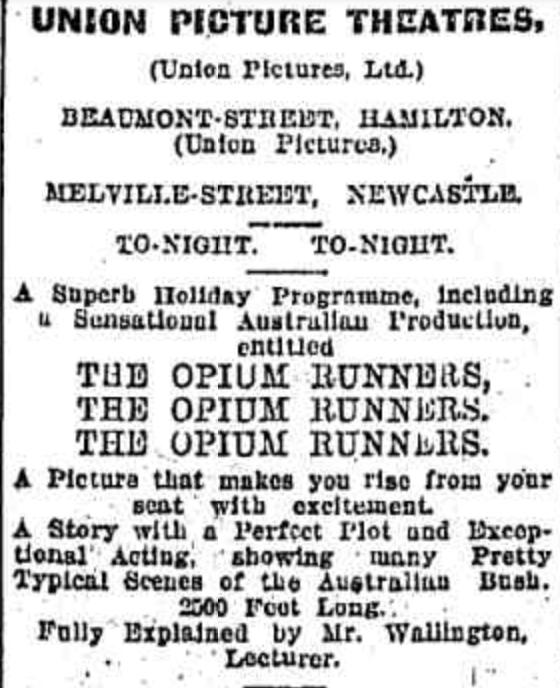
If celluloid could mainline, The Opium Runners would leave track marks across your retinas. Shot on unstable, highly-flammable nitrate that itself feels like a narcotic, the 1913 Anglo-Indian co-production has lingered for a century in the phantom zone between myth and archive—screened once in a Calcutta warehouse for a handful of maharajas, then spirited away by customs agents who mistook the reels for actual contraband. Today, only a vinegar-syndrome scorch survives: 43 brittle minutes, smelling faintly of camphor and poppy latex, yet potent enough to intoxicate any cinephile who dares thread it.
Director Hira Lal Sen—India’s forgotten Edison—treats the frame like a lithograph of smoke. Observe the opening tableau: a howdah shot where the camera itself seems perched on an elephant’s swaying back, surveying coolies stacking mango-wood crates stamped “Medical Supplies.” The lens tilts down to reveal a child’s porcelain doll wedged between the crates, its glass eyes reflecting the oncoming British gunboat. In that single dolly move, Sen distills the entire colonial extractive machine: commerce, innocence, and artillery braided into one opium ribbon.
Forget trench-coated detectives; here the shadows are worn by dhoti-clad boatmen rowing under a moon bruised saffron by industrial soot. The intertitles—hand-painted on textured jute paper—bleed sepia ink that resembles the drug itself. One card reads: “A whisper costs more than a rupee when the night is hungry.” It dissolves into a medium close-up of Jatin Das (played by the tragic heart-throb K. L. Khemka, whose real-life morphine overdose a year later lends the film a cadaverous halo). His pupils are dilated gates inviting us into a realm where morality dissolves faster than brown sugar in warm water.
Sen’s montage is proto-Eisensteinian: a montage of hands—Indian, British, Chinese—exchanging silver coins, each superimposed over a map of the empire shrinking like a punctured balloon. The cuts are percussive, almost syncopated, as if the film itself is battling withdrawal. Compare this kinetic anxiety to the static, pietistic tableaux of From the Manger to the Cross or the pageant-like reverence of Life and Passion of Christ. Where those biblical epics seek transcendence, Opium Runners dives head-first into the chemical gutters of history.
Khemka’s physical vocabulary is a master-class in toxic languor: wrists that dangle like wilted lotus stems, a gait that drags half a beat behind gravity. In the infamous “warehouse confession” sequence—a 7-minute single take that predates Touch of Evil’s bravura opener—he glides past towers of opium tins, each bearing a stenciled British tax stamp, and delivers a monologue entirely through gestures: palms upturned in mock benediction, fingers crushing imaginary petals, finally punching his own solar plexus as if to jump-start a heart already in rigor. Contemporary reports claimed viewers fainted; watching the extant print today, you still feel the ether whiff of decay.
Opposite him, the Irish actress Maude McCarthy (billed enigmatically as “Sister Verity”) radiates a lantern-like melancholy. Her veil functions like a portable confessional; when she lifts it to inspect Jatin’s pupils, the fabric frames her face like a halo slipping its axis. McCarthy’s eyes—grey as monsoon river-steel—hold the camera in a ethical deadlock. She alone refuses opium’s false transcendence, yet her abstinence feels more ravaging than the drug itself. In a scene cut by many censors, she burns her own Bible pages to cook lentils for starving converts, whispering: “Scripture must become body, or it is merely smoke.”
Sen collaborates with German cinematographer Wilhelm Gärtner—an expressionist émigré who would later vanish during WWI—who lenses Calcutta as if it were a fever dream painted by Munch. Note the color tinting strategy: night scenes bathe in viridian, suggesting abscess; dawn exteriors glow arsenic-yellow, as though the sun itself is narcotic. Look for the repeated visual motif of circles: the aperture of a hookah basin, the iris-in transition that opens each act, the bull’s-eye watermark on colonial warrants. Circles here are not symbols of unity but of entrapment—every revolution tightens the noose.
Compare this chromatic delirium to the monochrome docu-realism of Westinghouse Works or the postcard-pastoral hues of The Great Circus Catastrophe. Sen’s palette is pharmacological: it enters the bloodstream, metabolizes slowly, leaves behind a hangover of historical complicity.
No musical score survives; projections were accompanied by a sitar strung with violin wire, its drone bending micro-tonally as air-pressure shifted. Contemporary journals describe theater seats vibrating from low-frequency tabla that imitated heart palpitations. Restored screenings today use a commissioned score—shruti-box loops, distant conch-calls, the hiss of steam-injectors from a 1908 locomotive—but even in utter silence the film throbs. The lack of dialogue forces attention onto ambient textures: the scrape of hemp ropes against barge wood, the wet click of poppy pods slit by crescent knives, the brittle applause of British officers when an addict convulses. Each becomes a percussive note in the symphony of dependency.
Released months before the Fantômas serials hypnotized Paris, Opium Runners anticipates post-colonial theory by half a century. Sen indicts not merely the British exchequer but the indigenous comprador class—merchants who wore three-piece suits under dhotis, maharajas who leased armies to safeguard drug caravans. One intertitle sneers: “A prince, too, can be colonized—his mind wrapped tighter than any parcel bound for Canton.”
This self-reflexivity distinguishes it from nationalist spectacles like The Independence of Romania, which externalize tyranny onto cartoonish foreign despots. Sen’s villains wear our own skin; their crimes fertilize the soil from which modernity sprouts.
Women here are not mere collateral damage; they are the pipeline’s secret engine. Observe the character of Rani, a tawaif-cum-accountant who encrypts opium weights into classical dance mudras. In a bravura midnight scene, she performs a kathak recital for British bureaucrats, every ankle-bell jingle encoding coordinates of the next drop-off. The camera pirouettes with her, the frame becoming both accomplice and witness. When she finally spits a ball of opium into a captain’s mouth—an act both erotic and Eucharistic—the film collapses the distance between colonizer and colonized, lover and lethal dose.
This subversive erotics sets Opium Runners apart from damsel-in-distress narratives like What Happened to Mary or the saintly maternal figures in The Life of Moses. Female agency here is chemically compromised yet cunningly operational—a tightrope walk across a vial of oblivion.
Let us confront the elephant—or rather, the elephantiasis: the surviving print is rotting. Fungal pustules bloom across faces; emulsion cracks resemble dried riverbeds. Each projection further flays the image. Is it ethical to keep screening a film that dies a little death every time we watch? Sen himself anticipated this dilemma; in an interview reprinted in Calcutta Gazette, he mused: “Cinema is opium without the pipe—yet how we crave the smoke.” Perhaps the film’s fragility is its final performance, reminding us that history, like addiction, consumes its own carrier.
No citation in standard histories—no mention in Variety, no still in the BFI vault—yet whispers surface: a dissolving close-up that anticipates the morphine-shot pupil in Pandora’s Box; a chase across train rooftops that mutates into 1920s Soviet thrillers; the circular iris that resurfaces in Carl Dreyer’s Passion of Joan of Arc. Cinephiles scour YouTube fragments mislabeled “colonial India actuality,” hunting for Sen’s visual fingerprints. Meanwhile, in Kolkata’s Tollygunge district, bootleg DVDs circulate with the tagline: “Watch before it watches you die.”
Verdict: 9/10—a scar carved in nitrate, equal parts historical indictment and sensory poison. Approach like the drug it depicts: with trembling reverence, in a darkened room, and maybe—just maybe—let the hangover teach you something about empire’s aftertaste.

IMDb 6.3
1914
Community
Log in to comment.