DbcultAccessing Vault...
Cult Review
Senior Film Conservator
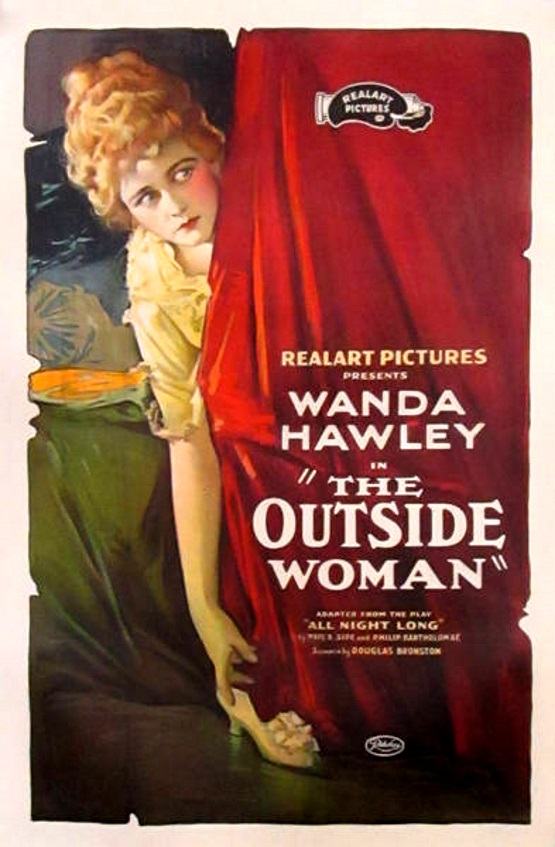
The year 1921 remains a fascinating crucible in the evolution of the American cinematic vernacular. Amidst the burgeoning opulence of the Roaring Twenties, The Outside Woman emerges as a poignant, if somewhat cynical, exploration of the domestic sphere's fragility. Directed with a steady hand and written by the collaborative prowess of Douglas Bronston and Philip Bartholomae, this film serves as more than a mere situational comedy; it is a sociological artifact reflecting the anxieties of early 20th-century consumerism and the performative nature of marital harmony.
At the heart of the narrative lies Dorothy Ralston, portrayed with a luminous yet frantic energy by Wanda Hawley. Hawley, a star whose luminosity has perhaps been unfairly dimmed by the passage of a century, captures the quintessential 'modern' woman of the era—one who is caught between the traditional expectations of household management and the burgeoning allure of personal luxury. When she trades her husband's Aztec idol for a silk shawl, the transaction is not merely a plot device; it is a profound statement on the transvaluation of values. To Dorothy, the idol is a relic of masculine obsession—ugly, dusty, and useless. The shawl, conversely, represents a tactile, immediate beauty. This clash of aesthetics sets the stage for a conflict that mirrors the period's tension between the 'old world' (the artifact) and the 'new world' (the fashion).
The cinematography, though constrained by the technical limitations of its time, utilizes the spatial dynamics of the Ralston home and the neighbor's studio to create a sense of claustrophobia. As Dorothy realizes the gravity of her error, the camera lingers on the empty space where the idol once stood, transforming a simple mantlepiece into a monument of impending doom. This mastery of silent storytelling—where the absence of an object carries as much weight as its presence—is reminiscent of the atmospheric tension found in The House of Intrigue, though here it is played for laughs rather than gothic suspense.
Enter Cambridge, the neighbor and artist, played with a delightful touch of opportunistic malice by Clyde Fillmore. In the ecosystem of silent film archetypes, Cambridge represents the 'outside' influence that threatens the sanctity of the home—hence, perhaps, a double meaning in the title. His refusal to simply return the idol, knowing full well its valuation, introduces a layer of greed that elevates the film from a simple domestic misunderstanding to a battle of wits. The interaction between Dorothy and Cambridge is a masterclass in the 'comedy of manners,' where social niceties are maintained even as the characters engage in psychological warfare.
"The Outside Woman functions as a cautionary tale for the burgeoning middle class: it warns that the objects we possess often end up possessing us, and the price of a single moment's vanity can be the total destabilization of one's social standing."
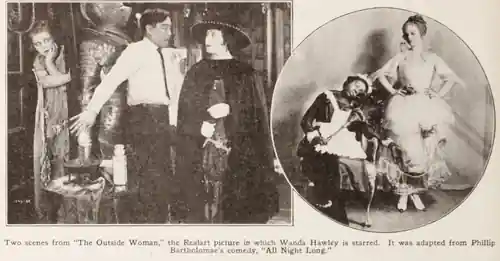
While the plot might seem lighthearted on the surface, the subtext is rife with the anxieties of the 'newlywed' status. The fear of a husband's discovery of a wife's 'incompetence' or 'betrayal' of his interests was a common trope, yet in the hands of Bronston and Bartholomae, it feels uniquely urgent. This is not the slapstick buffoonery one might find in The Kid Is Clever; rather, it is a more nuanced, character-driven anxiety that resonates with the viewer's own fears of social embarrassment.
The supporting cast provides a rich texture to the suburban landscape. Rosita Marstini and Thena Jasper offer glimpses into the social circle that Dorothy must navigate, while Misao Seki adds an interesting, if brief, dimension to the film's broader cultural palette. It is worth noting that during this era, the inclusion of diverse cast members, even in minor roles, often reflected the cosmopolitan aspirations of the production. The writing ensures that no character is purely a caricature; even the peddler who initiates the trade is a catalyst for the film's exploration of the 'mercantile gaze.'
Comparatively, when we look at contemporary works like Wives and Old Sweethearts, we see a recurring theme of the past (or the 'outside') encroaching upon the domestic present. The Outside Woman handles this with a lighter touch, focusing on the material object as the intruder. The Aztec idol becomes a silent witness to Dorothy's desperation, its stony face a stark contrast to her fluid, expressive panic. This juxtaposition is where the film finds its rhythmic heart.
The pacing of the film is remarkably modern. It avoids the languid stretches that sometimes plague early features, opting instead for a brisk, escalating series of events. The 'complications' mentioned in the plot summary are handled with a mathematical precision—each lie Dorothy tells necessitates a larger one, creating a house of cards that the audience knows must eventually tumble. This structural integrity is a testament to the script's theatrical origins, likely influenced by the writers' familiarity with the stage.
Visually, the film benefits from the high-contrast lighting typical of the early 20s. The scenes in Cambridge's studio are particularly noteworthy, using shadows to emphasize the 'greedy neighbor's' manipulative nature. The studio itself is a character—a space of art and artifice that stands in opposition to the 'honest' domesticity of the Ralston home. This duality is a common motif in films of the period, such as En kunstners gennembrud, where the artist's world is often portrayed as a place of moral ambiguity.
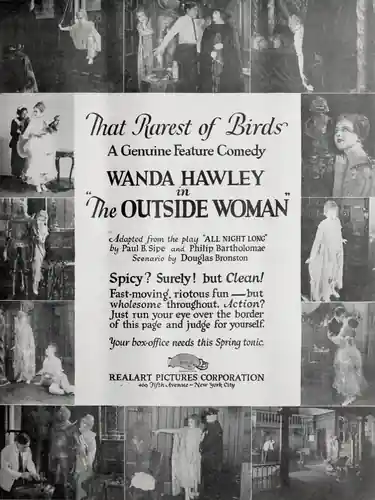
Why does The Outside Woman matter today? Beyond its value as a piece of film history, it speaks to the universal human condition of misjudging value. We have all, in some form, traded something of lasting worth for a 'silk shawl'—a fleeting trend, a momentary pleasure, or a social shortcut. Dorothy's journey is a comedic reflection of our own fallibility. The film doesn't judge her harshly; instead, it invites us to laugh at the absurdity of the situations we create when we try to maintain appearances.
In the broader context of 1921, where films like Warning! The S.O.S. Call of Humanity were tackling grand social themes, The Outside Woman chose to focus on the micro-level of the human heart and the neighborhood fence. This intimacy is its greatest strength. It doesn't need a mutiny on the high seas (like Mutiny) or a political steer (like A Texas Steer) to be compelling. It only needs a woman, a neighbor, and a very expensive piece of stone.
As the film reaches its climax, the tension between Dorothy's ingenuity and the mounting evidence of her 'crime' reaches a fever pitch. The resolution, while satisfying the generic requirements of the time, leaves the viewer with a lingering sense of the fragility of the status quo. The Ralstons may have their idol back, but the illusion of their perfect, transparent life has been irrevocably altered. This subtle shift into a more complex understanding of marriage is what elevates the work above its contemporaries.
To watch The Outside Woman in the 21st century is to engage in a form of cultural archaeology. We peel back the layers of silent film artifice to find a story that is strikingly resonant. Wanda Hawley’s performance is a revelation of comedic timing, her face a canvas of shifting emotions that requires no intertitles to be understood. The direction is unobtrusive yet effective, allowing the performances and the escalating stakes to drive the narrative forward.
While it may lack the epic scale of some of its peers, it possesses a crystalline clarity of purpose. It is a film about the 'outside'—not just the woman who finds herself outside the loop of her husband's interests, but the outside world that constantly threatens to disrupt our internal peace. It is a sophisticated, witty, and ultimately human look at the messes we make and the lengths we go to clean them up. For any aficionado of the silent era, or indeed any lover of well-crafted comedy, this film is an essential viewing experience that proves that some things—like a good story and a bad decision—are truly timeless.
© 1921 Cine-Archive | A Deep Dive into the Golden Age of Silent Comedy

IMDb 5.7
1936
Community
Log in to comment.