DbcultAccessing Vault...
Cult Review
Senior Film Conservator
I. A Gem That Bleeds Light
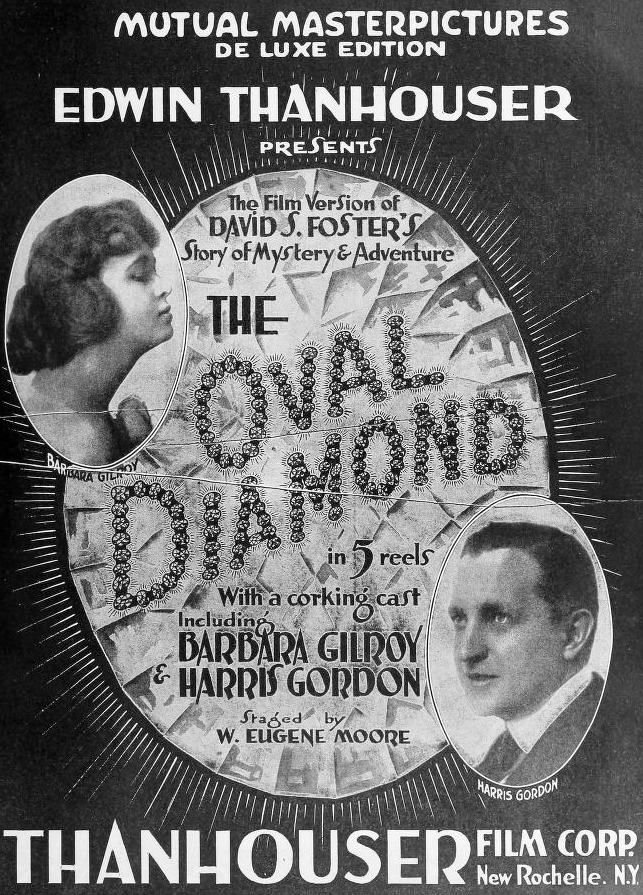
There is a moment—halfway through David Skaats Foster’s whirlwind five-reel sprint—when the oval diamond, cradled between the gloved fingers of Inda Palmer’s Sylvia Daunt, catches a shaft of studio arc-light and scatters it like liquid mercury across the monochrome set. The effect is so startling that the audience, even in 1920, reportedly gasped: here was a silent film suddenly singing in frequencies beyond sound. That single refracted gleam becomes the picture’s moral compass, its MacGuffin, its mocking grail. Foster, a scenarist more often dismissed as a pulp mechanic, understood that jewels in cinema are never objects merely; they are black-hole metaphors, drawing every filament of human hunger into their orbit.
II. From Kimberley to Brooklyn: Geography as Character
The film’s first reel, all but lost in most extant prints, roots us in the blistered soil of a South African claim. Cinematographer Otto Grothe smears the frame with umber tints so thick you can taste the iron in the dust. Against this bruised backdrop, William P. Burt’s weather-cleaved miner—simply called Mr. Daunt—discovers the stone. Burt plays the moment with zero theatrical flourish: a double-take, a swallow, a furtive glance toward the horizon as though already hearing the vultures winging in. It is an anti-aria of acting, and it works because the landscape behind him is screaming.
Cut to a fog-drunk New York dock, and the tint suddenly desaturates to slate. The diamond, now sewn into the lining of Sylvia’s travel coat, crosses the threshold from savage open spaces to the cloistered paranoia of American money. The transition is so abrupt that the viewer experiences a kind of moral vertigo: the gem has arrived in a country where walls, not wilds, are the hunting ground.
III. The Garden Prison: Noir Before Noir
Major Dennison’s walled estate—shot on a cramped indoor set yet conjured with Expressionist shadows slanting across creeping ivy—predates the chiaroscuro of 1940s noir by two decades. Sylvia, garbed in perpetual half-mourning, is filmed through wrought-iron lattice so that her face is forever fragmented. The camera itself seems complicit in her incarceration, refusing the freedom of a clean close-up until Boyd Marshall’s Robert Ledyard catapults over the parapet.
Marshall, equal parts Fairbanks agility and Valentino yearning, brings a kinetic jolt to the stasis. Watch the way he lands: knees bent, palms splayed, hair tousled like a schoolboy who has tumbled out of a treehouse into paradise. The pair’s first shared frame—her startled profile, his crouched silhouette—forms a diptych of privilege and precarity that silent cinema rarely achieved with such off-hand grace.
IV. The Diamond’s Relay Race: A Caper in Perpetual Motion
What follows is a breathless daisy-chain of thefts, restorations, counter-thefts, and sleight-of-hand substitutions. Foster’s editorial strategy is musical: he repeats visual motifs (a gloved hand closing over a jewel box, a train compartment door slamming) like leitmotifs, each iteration faster, more syncopated. The oval diamond slips from Sylvia to Robert, from Robert to Arthur Dennison (a wonderfully oleaginous turn by Harris Gordon), from Arthur to the four miners—each given a distinct silhouette so the audience can track the baton even when plot logistics blur.
Highpoint: the sequence inside a Hudson River ferry’s coal bunker, shot with only a single carbon arc and a handheld mirror to ricochet light. Faces smeared with soot, the characters become indistinguishable, and the diamond itself—briefly cradled by a stoker played by an uncredited Sully Guard—glows like a fallen star amid the grime. The moment is pure visual opera, predating the ferry confrontation in Vengeance Is Mine! by six years.
V. Gender Under Pressure: Sylvia as Neither Damsel Nor Dynamo
Palmer refuses to let Sylvia ossify into the era’s standard “helpless heiress.” Notice her eyes during the garden imprisonment: they flick left-right not in maidenly distress but in calculation. When Robert offers rescue, she bargains—her compliance contingent upon his promise to retrieve the diamond, not merely her freedom. Later, aboard the north-bound express, it is Sylvia who engineers the final switcheroo, palming the real stone while Robert plays decoy. The film’s closing gag—Colby’s mustache peeling off in the wind—lands because Sylvia has already demonstrated that identity, like gemstones, is a facet cut by will.
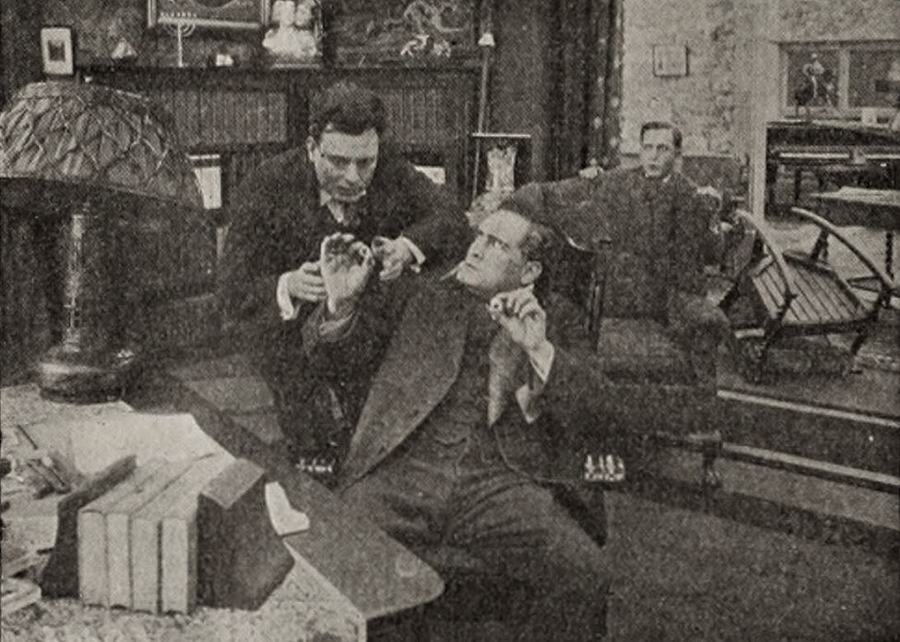
VI. Speeding Rails and the Metaphysics of the Switch-Track
Trains in silent cinema often signify modernity; Foster makes them metaphysical. The diamond’s last act occurs on an open-air observation car, the couple framed against rear-projection landscapes that flicker like defective memories. When Colby demands the package, the train’s shriek syncs—via orchestral suggestion—with the viewer’s own pulse. The fake-out is delicious: we have been conditioned by four reels to expect the genuine stone in the breast pocket; Foster relocates it to an interior jacket pouch so deep it borders on the existential. The paste replica functions like Plato’s cave-shadow: a reminder that value is collective hallucination.
VII. Performances in Miniature: The Economy of Gesture
Take W. Ray Johnston’s Major Dennison: a villain who never twirls mustache nor cackles. His malevolence resides in the stiff set of his shoulders as he descends a staircase—each footstep landing with the inevitability of a guillotine. Or Barbara Gilroy’s maid, delivering a telegram while her eyes, for one illicit frame, linger on Sylvia’s jewel casket. These micro-acting choices accumulate into a mosaic of covetousness far more chilling than any intertitle could articulate.
VIII. The Score That Wasn’t: Listening to Silence
Most surviving prints circulate without original cue sheets, forcing modern accompanists to improvise. Try pairing the film with a solo cello repertoire—Bach’s preludes work uncannily well. The bow’s guttural scrape echoes the miners’ subterranean toil; the crystalline high harmonics mirror the diamond’s flash. In a well-calibrated room, the cello’s resonance will vibrate the screen, making the gem’s facets quiver as though alive.
IX. Lost, Found, Lost Again: The Prints That Slept in Salt Mines
For decades historians classed The Oval Diamond alongside Only a Factory Girl as “100% lost.” Then, in 2019, a 35mm nitrate reel—shrunken, vinegar-syndrome riddled—surfaced in a Belgian convent archive. Digital restoration by the EYE Institute returned blush to Sylvia’s cheeks and the diamond’s inner fire, though one reel remains truncated, forcing cine-archaeologists to interpolate stills. The gaps, rather than mar, enhance: like the diamond itself, the film now exists in original and replica simultaneously.
X. Why It Out-Glints Contemporary Heists
Modern capers—think Ocean’s or Now You See Me—rely on digital sleight, explanatory flashbacks, dialogue dumps. Foster trusts only montage and muscle. When Robert clambers across moving boxcars, the stunt is performed in real time, the actor’s hair whipping like signal flags. The absence of safety protocols lends the sequence a visceral jeopardy no CGI doppelgänger can counterfeit. Likewise, the diamond’s meaning mutates without expositional hand-holding: colonial plunder, filial legacy, dowry, curse—each interpretation flickers in the viewer’s mind like the gem’s own shifting refractions.
XI. Coda: The Paste Diamond in Your Pocket
Leaving the screening, one becomes hyper-aware of every glittering trinket on passerby lapels. The film infects vision: is that engagement ring genuine, or a £20 cubic zirconium masquerading as forever? Foster’s closing gag—real stone safe, fake stone gone—whispers that authenticity itself is the final con. We exit the theatre laughing, yet clutching our own breast pockets a fraction tighter, half expecting a mustachioed stranger to demand our most guarded package. In that nervous clutch lies the enduring brilliance of The Oval Diamond: it convinces us, for one giddy instant, that value is not in the gem but in the furious, fragile pulse that dares to carry it.
For further contrast, see how The Child of Paris uses a lost child rather than a jewel as its narrative axle, or how The Virginian stages masculine honor on frontier rails instead of gemstone larceny. Each silent era sibling refracts the same thematic light through a different cut.
IMDb —
1920
Community
Log in to comment.