DbcultAccessing Vault...
5.8/10
Senior Film Conservator
A definitive 5.8/10 rating for a film that redefined the boundaries of cult cinema. The Pied Piper of Hamelin remains a cornerstone of transgressive art.
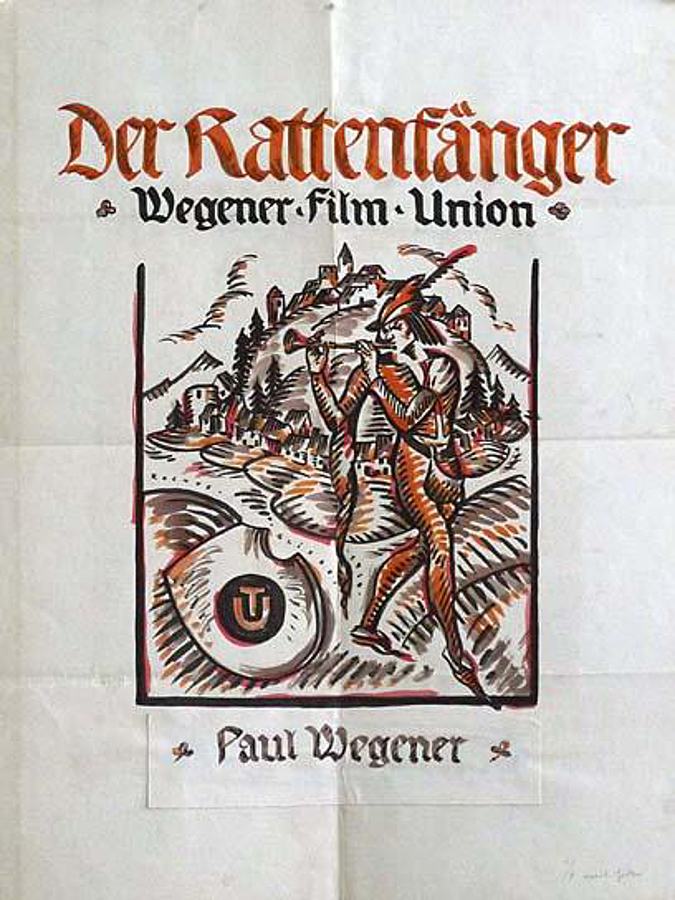
The tragedy of cinema often lies not in the scripts that fail, but in the masterpieces that vanish. Paul Wegener’s 1918 rendition of 'The Pied Piper of Hamelin' (Der Rattenfänger von Hameln) remains one of the most agonizing absences in the archives of German Expressionism.
In the nascent years of the Weimar Republic, the German film industry was obsessed with the 'Autorenfilm' movement—a push to elevate cinema to the status of high literature. Paul Wegener, the towering figure of the era whose physical presence was as monolithic as the Golem he famously portrayed, sought to breathe a visceral, chthonic life into the verses of Robert Browning and the ancient legends of the Brothers Grimm. This 1918 production was not merely a children’s fable; it was a psychological autopsy of a community rotting from within, long before the first rat ever scurried across a Hamelin cobblestone.
Paul Wegener was never an actor who merely 'played' a role; he inhabited the primordial essence of his characters. In 'The Pied Piper of Hamelin', his portrayal of the titular figure was reportedly a masterclass in ambiguity. Unlike the sanitized versions of the character we see in modern animation, Wegener’s Piper was a creature of the earth and the ether. He represented the 'Other'—the itinerant stranger who exposes the fragility of settled society. This thematic preoccupation with the outsider is a thread that runs through much of the era's work, similar to the atmospheric dread found in The Death-Bell, where the supernatural serves as a mirror to human frailty.
Wegener’s collaboration with his wife, Lyda Salmonova, added a layer of intimate intensity to the production. Salmonova, a constant in Wegener’s cinematic universe, brought a delicate but haunting vulnerability to the screen, contrasting sharply with Wegener’s rugged, almost geological facial features. The cast, featuring stalwarts like Frida Richard and Elsa Wagner, suggests a production of immense dramatic weight. These were actors who understood the language of silence, utilizing their bodies to convey the suffocating terror of a town overrun by a pestilence that was as much moral as it was biological.
While the film itself is largely lost to the ravages of time and neglect, contemporary accounts and production stills hint at a visual palette that was nothing short of revolutionary. The use of location shooting in the medieval town of Bautzen allowed Wegener to escape the artificiality of the studio, yet he treated the real-world architecture with the distorted eye of an expressionist. The crooked gables and narrow alleys of the town were framed to evoke a sense of entrapment. This wasn't the bright, stage-lit world of Liberty Hall; this was a landscape of deep shadows and sharp angles, a precursor to the jagged aesthetics of 'The Cabinet of Dr. Caligari'.
The rats themselves were not merely props. Wegener used real rodents, a decision that supposedly led to a chaotic and visceral filming process. This commitment to a terrifying realism, juxtaposed against the lyrical, rhythmic movement of the Piper, created a cinematic dissonance. The Piper’s flute was not just an instrument; it was a conduit for the irrational. In a period where films like Idle Wives were exploring social domesticity, Wegener was diving headfirst into the abyss of the collective unconscious.
The plot, as dictated by the Browning source material and Wegener’s own script, serves as a searing critique of the bourgeoisie. The townspeople of Hamelin are depicted as sycophantic and parsimonious. Their infestation is a physical manifestation of their greed. When the Piper arrives, he is a mercenary of the soul. The tragedy of the film is not the rats, but the breach of contract. The refusal to pay the Piper is the ultimate act of hubris—a denial of the value of art and the sanctity of the word. This theme of being Unjustly Accused or unfairly treated by a corrupt system was a burgeoning sentiment in post-war Germany, reflecting a society that felt betrayed by its leaders.
The second half of the film, where the Piper leads the children away, is where Wegener’s vision likely reached its most transcendental heights. Imagine the flickering black-and-white celluloid capturing a stream of innocent faces following a towering, rhythmic figure into the darkness of the Koppelberg Hill. It is an image of profound loss, a literal theft of the future. This sequence likely shared the same melancholic beauty found in the later works of the era, such as Eternal Love, where Wegener continued to explore the intersection of grand landscapes and human passion.
When we place 'The Pied Piper of Hamelin' alongside its contemporaries, its unique position becomes clear. While American cinema was often focused on comedic character studies like A Black Sheep or adventurous romps like A Motorcycle Adventure, the German 'Autorenfilm' was grappling with the grotesque. Even compared to the Swedish intensity of Hämnaren, Wegener’s work possessed a specific folkloric weight that felt ancient and inevitable.
Consider the technical ambition. In 1918, the industry was still mastering the nuances of the close-up and the tracking shot. Wegener, ever the innovator, used the camera to create a sense of scale. The Piper wasn't just a man; he was a force of nature. This contrasts with the more static, stage-bound feel of films like Telefondamen or the localized drama of Niños en la alameda. Wegener was building worlds, not just sets.
The disappearance of the negative for 'The Pied Piper of Hamelin' is a cultural wound. To understand the evolution of horror and fantasy, one must understand Wegener. Without this film, there is a missing link between the folk-horror of the 19th century and the cinematic nightmares of the 20th. It likely shared the same nautical dread found in Souls Adrift or the high-stakes tension of The Railroad Raiders, but filtered through a lens of Germanic mysticism.
The film also featured Jakob Tiedtke and Hans Stürm, actors who would go on to define the face of German cinema for decades. Their presence here, in a story about the ultimate temptation and the ultimate price, echoes the moral complexities seen in The Supreme Temptation. In Wegener's Hamelin, the temptation wasn't just the Piper's music; it was the town's belief that they could benefit from magic without paying its toll.
To watch a film like The Remittance Man or The War of the Tongs is to witness the diversity of the silent era, but to contemplate 'The Pied Piper of Hamelin' is to engage with the ghosts of cinema. Wegener’s work was a bridge. It bridged the gap between the written word and the moving image, between the medieval past and the modern future. The Piper’s tune may be silent now, but the resonance of Wegener’s vision continues to vibrate through the history of film. It remains a testament to the power of the image to haunt us, even when the image itself is no longer there to be seen. We are all, in some way, still following Wegener’s flute, searching for the lost frames of a masterpiece that defined a generation’s fears.
Rating: A Spectral Masterpiece (Historical Importance: 10/10)
IMDb —
1929
Community
Log in to comment.