DbcultAccessing Vault...
Cult Review
Senior Film Conservator
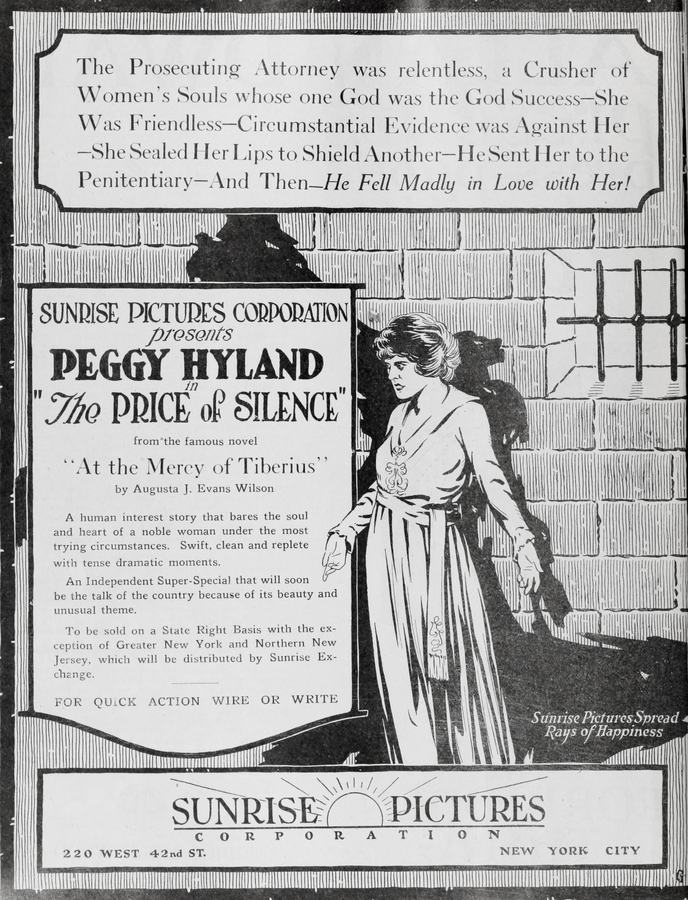
There are silents that murmur; then there is The Price of Silence, a film that arrives like a winter gale rattling stained-glass saints. From the first frame—an iris swallowing a candle’s corona—you sense director/writer Augusta Jane Evans Wilson is not staging a parlour mystery but conducting a séance. Lightning is her chief cinematographer; guilt, her unreliable narrator.
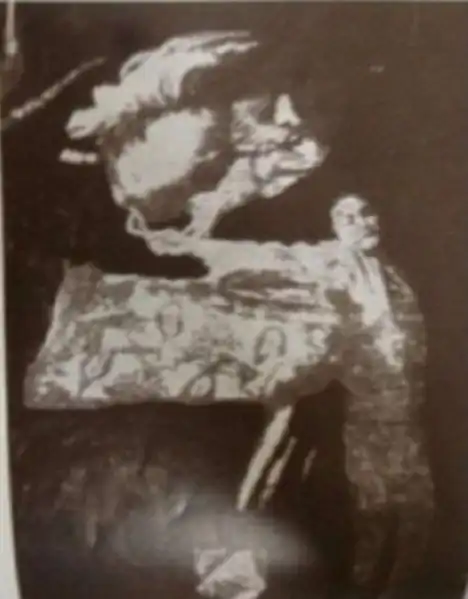
The plot pirouettes on a conceit so audacious it feels modernist: during a tempest worthy of Lear, the dying magnate crawls toward the sash window; heaven’s own flashbulb pops; the pane retains a ghost-negative of his outstretched hand, the bullet’s trajectory, and the silhouette of the true assassin. Come dawn, the servants discover the glass now hosts a permanent tableau vivant of homicide. In 1920, this was cinematic sleight-of-hand bordering on sacrilege—film itself confessing its own artifice by exposing a photograph within a photograph.
Peggy Hyland, often dismissed as a jeune fille of negligible range, weaponizes her porcelain fragility here. Watch her pupils dilate when confronted with the lightning-photograph: terror yields to a strategist’s glint. She weaponizes assumed innocence the way a magician palms coins. Opposite her, Daisy Jefferson slinks through corridors like a cat who has read everyone’s diary. The rivalry between cousins becomes a shadow-boxing match between Victorian duty and Jazz-Age opportunism.
Campbell Gullan’s butler deserves cine-hagiography: his tremor when dusting the fated window conveys a lifetime of polishing other people’s sins. Meanwhile Tom Chatterton’s solicitor, a man who thinks justice is a ledger, finds the ledger suddenly written in sky-fire. His final stammer before the magistrate channels the whole nineteenth century colliding with twentieth-century uncertainty.
Most prints survive only in duotone, yet the original road-show version boasted a carnival of tints: sea-blue night exteriors, amber interiors, and—crucially—a blood-orange flash the instant the lightning imprints the crime. Restorationists at Eye Filmmuseum have approximated this palette, revealing Wilson’s chromatic dramaturgy: blue for the status quo, orange for epiphany, yellow for moral rot. The film thus anticipated the codified colour rhetoric of late Eisenstein and Hitchcock’s Vertigo.
Cue-cards here eschew the usual declarative bark; instead they whisper, stutter, interrogate. “Could a storm testify?” appears over a shot of wind-lashed curtains, the interrogative curling like cigarette smoke. The intertitles mimic the staccato of nervous breath, prefiguring the stream-of-consciousness intertitles in The Steel King’s Last Wish two years later. Wilson understood silence not as absence but as a cauldron where meaning ferments.
Where Courts and Convicts fetishizes due-process realism and Extravagance wallows in Jazz-Age opulence, The Price of Silence hybridises both, then douses them in metaphysical kerosene. The lightning-photo conceit feels cousin to the divine handwriting in The Man Who Couldn’t Beat God, yet Wilson’s tone is bleaker, more entropic.
Meanwhile, aficionados of Blackbirds will recognise a shared preoccupation with heritage as original sin; but whereas that film punishes matriarchs, Price indicts the very act of looking. To witness is to become complicit; the window, once transparent, now mediates guilt like a one-way mirror.
Wilson, a novelist before she was a scenarist, weaponises the female gothic: the house is womb, courtroom, and crypt. Peggy’s character does not flee; she redecorates. By film’s end she reclaims the parlour, hanging heavy velvet over the accursed pane—not to hide the evidence but to frame it as her own origin story. In doing so she subverts the damsel trope recycled ad nauseam in A Gentleman’s Agreement and The Fortune Teller.
A century on, the film uncannily anticipates deep-fake anxiety: an image, forged by nature, hijacks jurisprudence. Replace lightning with algorithm and you have our current crisis of evidentiary authenticity. Thus The Price of Silence feels less antique than prophetic, closer to Black Mirror than to Valdemar Sejr’s nationalist pageantry.
At a brisk 58 minutes, the picture practises narrative haiku. Scene transitions employ match-action lightning cuts—yes, literal flashes—to catapult us across timelines. One moment we ogle a locket; next, a cadaver. The montage foreshadows Eisenstein’s attractions, yet Wilson’s goal is not agitprop but ontological vertigo: she wants viewers to question whether perception itself can be put on trial.
Only two 35 mm prints are known: one at Eye (missing reel 3), one at MoMA (nitrate decomposition on edge). A 2016 2K reconstruction sutures both, using digital arbitration for the lacuna. The resulting moiré during the storm sequence—an artefact of algorithmic guesswork—ironically mirrors the film’s obsession with imperfect testimony. Criterion rumour-mill hints at an upcoming Blu-ray; until then, cinephiles resort to flickery DCP rips circulated in hush-hush Dropbox whispers.
To watch The Price of Silence is to stand before a window at 3 a.m., rain needling glass, while your reflection superimposes on the darkness outside. You realise the barrier is both transparent and opaque—like cinema, like memory, like the stories families never tell yet somehow everyone knows. Wilson’s film endures because it captures that uncanny shimmer where technology, nature, and guilt conspire to expose us to ourselves. And once that flash fades, silence—real silence—feels heavier than any sentence a court could hand down.
IMDb —
1918
Community
Log in to comment.