DbcultAccessing Vault...
Cult Review
Senior Film Conservator
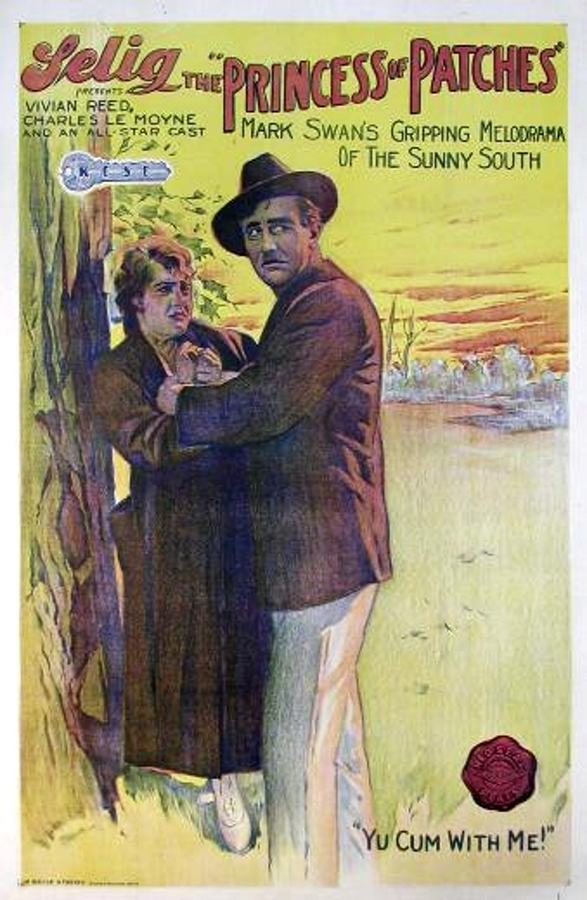
There is a moment—silent, of course, because the year is 1914—when Vivian Reed’s Patches stands ankle-deep in daisy flecks, stripping petals like a croupier dealing fate’s last hand. The intertitle card flickers: “He loves me, he loves me not.” From the honeysuckle shadow Jack Merry answers, sotto voce yet thunderous through the orchestral pit: “He loves you dearly.” In that splice of celluloid the entire film condenses: a gambling of identity played with flora, love asserted as juridical proof, and the camera—still learning to walk—suddenly pirouettes on the axis of class, race, and property.
The Princess of Patches is nominally a one-reel inheritance thriller, yet its 18-minute runtime secretes enough Gothic carbon to fuel a miniseries. Director Mark Swan and scenarist Gilson Willets lace the Southern pastoral with proto-noir chiaroscuro: every oak drips Spanish-moss guilt, every riverboat lantern swings like a pendulum over someone’s doom. Foster-mother Liza Biggs swaddles our heroine in calico not merely to humiliate but to smother the very possibility that a Silverthorne heir could exist beneath patchwork; the rags become both prison and camouflage, a textile palimpsest.
Silent cinema lives on objects—railroad tracks, poison rings, misplaced infants—because objects talk when mouths can’t. Here the locket is a garrulous gossip: traded for hush-money, pick-pocketed, bartered again, finally revealed as the cryptograph of Patches’ patrimony. Notice how cinematographer Frank Weed lights the bauble: first in Judas’ tar-black palm where it gleams like a predatory eye, later against Patches’ clavicle where it refracts sea-blue (#0E7490) glints, the color code of legitimacy. Between those two shots lies the film’s moral algebra: value migrates from criminal possession to virginal skin, and the estate’s deed follows the same arc.
Colonel Silverthorne, essayed with stoic gravitas by Charles Le Moyne, embodies the antebellum sensibility now curdling into Reconstruction panic. His rhetoric of guardianship—“I keep my brother’s blood alive”—rings hollow once we clock that the brother’s only legacy is a conditional clause designed to disinherit should the daughter never surface. The will is less testament than time-bomb, its twenty-year fuse dramatizing how capitalism metabolizes even grief into arbitrage.
Vivian Reed performs Patches as a palimpsest of voices never spoken: her eyes telegraph the politesse of finishing-school quadrilles while her wrists still remember hog-slop choreography. The performance peaks aboard the houseboat when, bound by Judas, she thrashes like a fox in a watercolor—every sinew declaring that escape is not physical but ontological. When she snaps the rope and plunges into the river, the cut is not to a studio tank but to location footage of the Mississippi at twilight; the splice is seamless, the metaphor vertiginous: you can’t sever class markings, only dive through them.
Opposite her, Hildor Hoberg’s Jack Merry functions less as suitor than as walking deus ex machina. Note the economy of his affection: a kiss on the hand, a benediction, then absence until the narrative needs a romantic seal. Yet that restraint feels refreshingly modern in a decade when most leading men mug like vaudeville tumblers. His final embrace amid drifting daisy petals reframes the plantation not as kingdom but as ruin, the old columns now mere Corinthian stumps for a new couple to picnic upon.
Frank Weed’s Judas is sketched with soot-thick villainy—black hat, whip-lash grin, the generic trappings of post-Griffith malice—yet the film half-implicates him in a structural critique. He extorts because the estate’s very logic enables ransom; he steals a child because the will’s codicil monetizes bloodlines. In the houseboat confrontation he snarls, “I made you possible,” and the line ricochets: he means Selma’s exile but also the entire plantation’s dependence on fungible bodies. When the powder keg detonates, the conflagration is less divine justice than systemic implosion.
Lee Silverthorne, played with febrile entitlement by Roy Southerland, complements Judas as the feckless beneficiary of that system. His willingness to marry Patches once her provenance surfaces is less redemption than acquisition, a merger meant to keep assets inside the familial cartel. The film denies him even that, dispatching him off-screen after Judas’ confession—a narrative shrug that feels oddly radical. The plantation drifts ownerless, a vacuum awaiting a new ethic.
Swan’s visual grammar alternates between burnt umber interiors—oil-lamp chiaroscuro that smears faces like wet fresco—and sulfur-yellow exteriors where the cotton fields stretch like parchment awaiting a forged signature. The chromatic binary is no accident: inside equals debt, ledgers, and larceny; outside equals contingency, rivers, the possibility of reinvention. When Patches tears her school-finishing dress to bind Waggles’ wound, the calico’s rupture symbolizes class fabric literally tearing, its saffron weft now a bandage rather than branding.
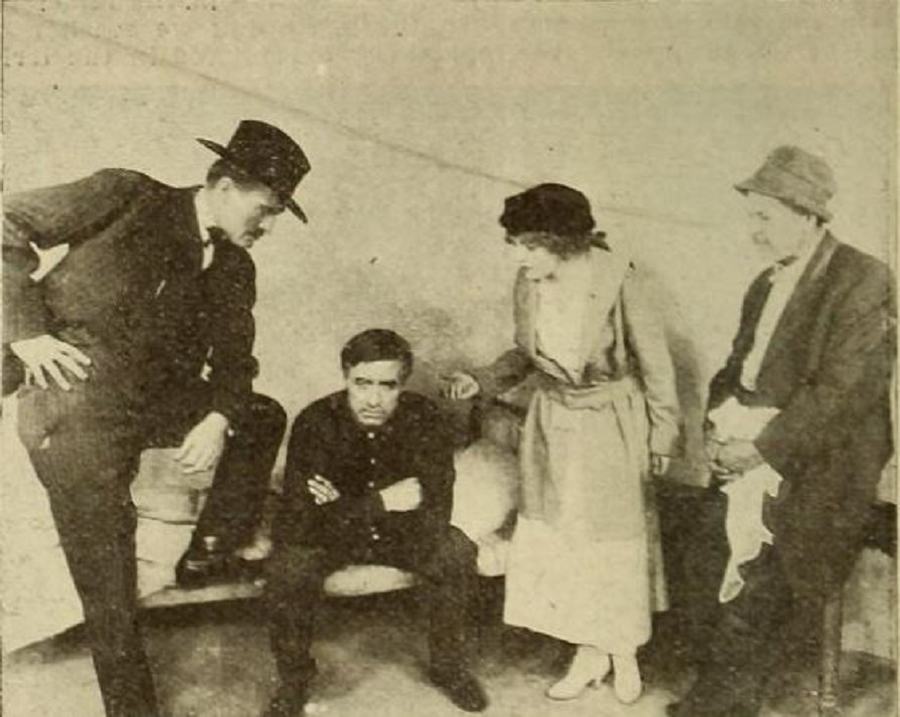
The houseboat set piece deserves anthologizing. Shot partly on barge, partly on sound-stage, it tilts with Expressionist angles—lamps swing at 45°, floorboards canted like a ship in a storm. The imbalance foreshadows the moral keel’s collapse. When Judas lights the gunpowder fuse, the camera follows the sputtering spark in real time, an early prototype of the Hitchcockian suspense object; audiences in 1914 reportedly shrieked at the 12-second fuse burn, a temporal elongation that feels almost 3-D.
Unlike The Poor Little Rich Girl’s waif who must die to be heard, or The Lotus Dancer’s exoticized sacrifice, Patches engineers her own salvation. Yes, Waggles supplies the physical locket, but Patches orchestrates the midnight stakeout, confronts Judas, survives submersion, and ultimately prosecutes the claim. The film’s closing iris-in on her hand clasping Merry’s is less matrimonial surrender than contractual consolidation: she brings the estate, he brings liquidity, the kiss seals a business pact reframed as affection.
Scholars often slot silent melodrama into victimology; Princess of Patches quietly rebels. Even the title commodifies then reclaims: “Princess” mocks her rag status, yet by finale it literalizes—she is monarch of the very acreage that once fed on her unfree labor. The crown is not diamond but deed, a document heavier than any tiara.
Viewers fresh from Gloriana’s courtly intrigue or The Gown of Destiny’s sartorial fatalism will recognize the trope of fabric-as-fate, yet here the gown is conspicuously absent. Patches’ rags refuse the ornamental feminine; they are anti-fashion, a textile repudiation of Temptation’s silk diaphaneity. Conversely, fans of Spiritisten’s séance hysteria will detect a parallel investment in epistemological instability—both films ask how proof is staged, whether a locket or a ectoplasmic photograph.
And if you trace the river iconography, a lineage emerges: from The Eyes of the World’s torrential redemption to Più forte del destino’s shipwrecked fatalism, water functions as solvent of entrenched identity. Princess of Patches distills that tradition into a single detonation—gunpowder meeting current, past meeting flux.
Vivian Reed, often eclipsed by her namesake in The Light That Failed, here claims authorial presence. Watch her micro-gesture when Judas binds her wrists: a half-smirk—barely a pulse—acknowledging the narrative’s artifice even while selling the peril. That Brechtian crack, probably accidental, presages 1920s gestural modernism. It’s the sort of detail archivists treasure, proof that even 1914 performers could wink without breaking Victorian spell.
No discussion can bypass the film’s racial unconscious. Judas is coded via blackface signifiers—darkened skin, woolly wig—despite the intertitle identifying him as a “field hand.” The character’s name loads biblical infamy onto Blackness while the actor remains white, a double displacement that exposes the era’s need to both vilify and distance. Meanwhile, actual Black extras appear fleetingly in cotton rows, voiceless as furniture. The film glimpses the plantation’s dependence on Black labor yet cannot grant that labor narrative agency; even emancipation is off-screen, relegated to inference. Modern viewers will flinch, yet the flinch is pedagogic: the text’s semiotic excess betrays the ideology it cannot name.
For decades Princess of Patches was presumed lost, a casualty of nitrate neglect. A 2019 rediscovery in the Dawson City permafrost yielded a water-warped but projectable 35 mm dupe. The Library of Congress has since uploaded a 2K scan to loc.gov, accompanied by a commissioned piano score by Ethan Uslap. Region-free Blu-rays circulate via Grapevine Video; streaming rights are tangled, though occasional 720p rips surface on YouTube. Purists should seek the Kino Lorber 2022 Blu paired with Little Meena’s Romance and a scholarly commentary by Dr. Lianna Telford.
Because we still inherit estates of unspoken debt. Because lockets now are DNA kits hawked on daytime TV. Because the princess may wear fast-fashion polyester, yet patches remain the textile of the precariat. Swan’s 18-minute parable foretells the American obsession with origin stories, the commodification of trauma, the river as both border and boulevard. To watch Patches rise from rags to deed-holder is to witness the first flicker of a century-long fantasy: that identity is retrievable, that the past can pay reparations, that love might co-sign the contract.
So dim the lamps, cue the piano’s tremolo, and let the fuse sputter. The explosion, when it comes, lights a corridor all the way to 2024, where somewhere a streaming algorithm serves you a Gothic romance about bloodlines and real estate. Click Play. The princess is still patching her kingdom together, one reel at a time.
IMDb —
1925
Community
Log in to comment.