DbcultAccessing Vault...
Cult Review
Senior Film Conservator
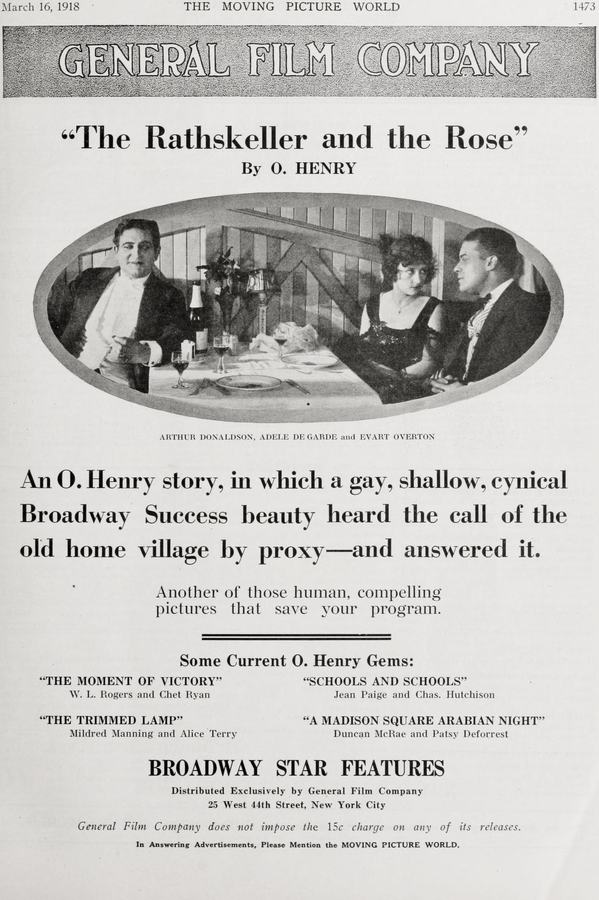
Stepping into the world of The Rathskeller and the Rose feels like unearthing a forgotten treasure, a cinematic echo from an era when storytelling relied on nuanced gestures and the evocative power of a well-crafted narrative. Based on the inimitable O. Henry's short story, this film, even through the veil of time, pulsates with a distinctly human drama, a compelling exploration of identity, ambition, and the magnetic pull of one's origins. It’s a testament to the enduring appeal of a master storyteller translated to the nascent art form of cinema, a delicate dance between the theatrical and the truly felt.
At its core, the film presents a fascinating dichotomy: the glittering artifice of the stage versus the unvarnished truth of rural life. Our protagonist, a young woman (portrayed with compelling grace by Kate Jepson) who has ascended from humble country roots to become a celebrated actress, embodies this conflict. Her journey to the bustling town, her subsequent triumph in the theatrical world, speaks volumes about the American dream of self-reinvention, a theme that resonates across many silent era narratives, much like the aspirational fervor seen in films such as Broadway Jones, albeit with a different set of stakes. Yet, beneath the success, one senses a lingering connection to the simpler life she left behind, a quiet vulnerability that becomes the fulcrum of the entire plot.
Enter the struggling actor, a character brought to life by Arthur Donaldson, whose desperation for a role in the esteemed actress's company ignites the central conceit. His plan is audacious: to immerse himself in her hometown, to become a living repository of its 'local color,' and then to weaponize that knowledge. This isn't merely about securing a part; it's about a profound act of mimicry, a performance far more intricate than anything he might deliver on stage. He doesn't just observe; he absorbs, he internalizes, he becomes a method actor of real-life deception. The narrative, under O. Henry's keen eye, elevates this to a grand psychological experiment, a testament to the power of narrative to shape reality.
The core of his deception lies in a simple yet potent symbol: a faded rose, procured from the actress's own mother. This isn't just a prop; it's a tangible link to her past, a sensory trigger for memory and emotion. The rose, a universal emblem of love and remembrance, here becomes an instrument of calculated manipulation. It’s a brilliant stroke of narrative economy, a small detail imbued with immense power, much like the symbolic objects that often drive the emotional arcs in films like A Song of Sixpence, where seemingly minor items hold profound personal significance. Donaldson’s character, by presenting himself as a familiar face from her country neighborhood, doesn’t just tell a story; he *becomes* a fragment of her lost world.
The success of his masquerade is immediate and profound. The actress, disarmed by the vivid echoes of her past and the genuine-seeming connection to her roots, cancels all her engagements. This pivotal moment underscores the film’s central theme: the irresistible allure of home, the yearning for authenticity that can trump even the most glittering professional success. It's a sentiment explored in various forms across cinematic history, often with a romanticized view of rural life contrasting with urban complexities, a dynamic one might observe, albeit in a different social strata, in works like The Greater Woman, which also grapples with societal pressures and personal choices.
Her decision to return home is not merely a plot device; it's an emotional capitulation. It speaks to a universal human desire to reconnect with one's origins, to find solace in the familiar when the demands of a public life become overwhelming. The film, through silent cinema's unique ability to convey emotion through gesture and expression, likely paints Kate Jepson's character's internal struggle with considerable pathos. Her retreat is not a failure, but a deeply human response to a carefully crafted illusion that taps into her deepest needs.
The true O. Henry twist, however, arrives not with the initial deception, but with its unexpected aftermath. The actor, having achieved his immediate goal of sending her home, then finds himself compelled to follow. This is where the narrative transcends simple trickery and delves into something far more complex. Was his initial motive purely professional, or did a genuine connection begin to form during his elaborate charade? Did the very act of immersing himself in her past, of becoming a part of her personal mythology, transform his own feelings?
This turn of events hints at the profound impact of empathy, even if initially feigned. It suggests that prolonged immersion in another's world can blur the lines between performance and reality, between calculated intent and genuine emotion. This internal shift in the actor’s motivation elevates the story beyond a mere con, injecting it with a layer of romantic complexity that is both intriguing and deeply human. It presents a fascinating parallel to narratives like Face Value, where the perception of identity is central to the unfolding drama, and the line between who one pretends to be and who one truly is becomes increasingly blurred.
O. Henry's influence on early cinema cannot be overstated. His penchant for the surprising twist, his keen observations of human nature, and his ability to craft narratives rich with irony and sentiment made his stories ideal fodder for the silent screen. The Rathskeller and the Rose is a prime example of how his literary genius translated seamlessly into the visual medium. The film, in its silent form, would have relied heavily on the actors' ability to convey complex emotions without dialogue, a strength that early cinema cultivated with remarkable success. The nuanced expressions of Kate Jepson and Arthur Donaldson would have been paramount in communicating the layers of deception, longing, and eventual shift in feeling.
The interplay between the urban 'rathskeller' (a cellar restaurant or bar, often associated with Bohemian or theatrical life) and the 'rose' (a symbol of rural innocence and home) forms a powerful symbolic framework for the entire narrative. It’s a clash of worlds, a collision of values, and the film deftly navigates the space between these two poles. This thematic depth, characteristic of O. Henry, elevates what could be a simple tale of trickery into a poignant commentary on human desire and the search for belonging.
While specific performance details for such an early film are scarce, one can infer much from the plot's demands. Kate Jepson's portrayal of the actress would have required a delicate balance between sophisticated stage presence and underlying vulnerability, a duality that allows her to be both a star and a susceptible country girl. Her eventual surrender to the lure of home would have been a masterclass in conveying emotional resonance through silent acting, a process similar to the subtle character development seen in films like Dimples, where a young girl's inner world is revealed through her actions and expressions.
Arthur Donaldson's role as the struggling actor demands a different kind of performance—one of calculated charm and subtle menace, eventually softening into something more genuine. His ability to absorb 'local color' and convincingly pose as a neighbor speaks to a theatrical dexterity that would have been compelling to watch. The supporting cast, including William J. Gross, Evart Overton, and Adele DeGarde, would have contributed to the film’s atmosphere, fleshing out the worlds of both the bustling city and the tranquil countryside. The success of the actor’s deception, for instance, hinges on the believable reactions of the mother, likely played by one of the supporting actors, whose simple trust would underscore the actress's own susceptibility.
The enduring appeal of The Rathskeller and the Rose lies in its timeless themes. It's a story about the masks we wear, the roles we play, and the often-surprising ways in which our true selves emerge or are revealed. It questions the nature of ambition, the price of fame, and the fundamental human need for connection and belonging. In an era often characterized by rapid social change and the burgeoning of new urban identities, this narrative offers a comforting, yet complex, look at the ties that bind us to our past.
Comparing it to other films of its time or even later, one finds echoes of its central conflict in various forms. The journey of a young woman from country to city and back again, grappling with identity, might draw thematic lines to films like The Perfect '36', though the specifics of their personal struggles diverge. The manipulation and psychological gamesmanship could be seen as a precursor to more complex dramatic narratives, where characters' motives are layered and often self-serving, yet can lead to unexpected emotional outcomes. The film's elegant simplicity, rooted in O. Henry's narrative economy, allows these profound themes to shine through with remarkable clarity.
Ultimately, The Rathskeller and the Rose stands as a charming, insightful piece of early cinema, a testament to the power of a well-told story, and the universal resonance of themes concerning home, ambition, and the unpredictable nature of the human heart. It reminds us that sometimes, the most elaborate performances are those played out not on a stage, but in the intricate theater of everyday life, where a faded rose can hold more power than any spotlight.
IMDb —
1926
Community
Log in to comment.