DbcultAccessing Vault...
Cult Review
Senior Film Conservator
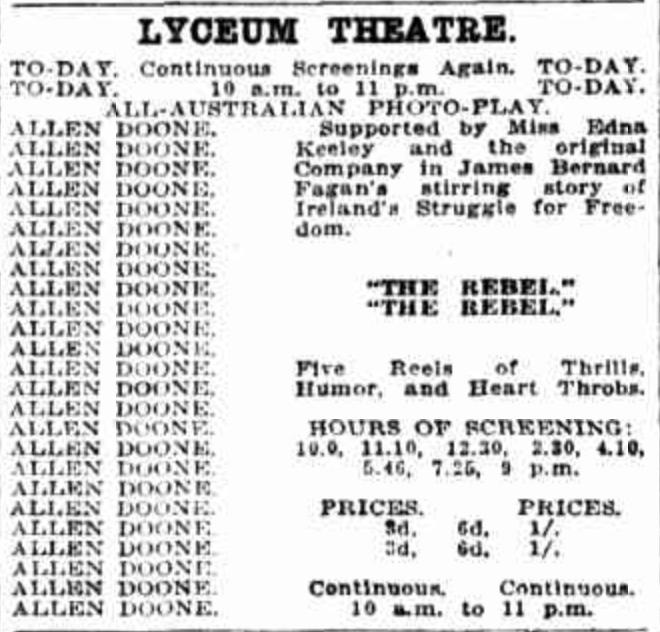
The first time I saw The Rebel I was hunting for a lost bushranger flick and stumbled instead into a sulphurous dream where theatre smoke and gun-smoke swap places. What unfurls is less a narrative than a slow-burn fuse: a political prisoner dropped like a hot coal onto Australia’s dockside, a scribbler who trades truth for type, an actress who sells sedition by the seat, and a magistrate who believes Empire is divine metre.
Frank Cullenane, face sharp as a torn postage stamp, plays the nameless insurgent with the brittle charisma of a man who has already died once and therefore fears no second exit. Watch how he enters the frame: back to camera, coat flapping like a torn flag, the harbour’s sodium dawn turning every ripple into a possible trapdoor. One senses he has memorised not only his lines but the very silences between the intertitles, as if pauses could be indicted too.
Allen Doone’s ink-stained journalist is the colonial era’s click-bait algorithm—he does not care whether the rebellion is real so long as the ink runs black and the sales run red. In a saloon scene lit by a single kerosene lamp, Doone leans across the table until the flame flattens his cheekbones into a Mephistophelian mask; the camera tilts up, capturing the moment when ethics are weighed against circulation and found wanting. The shot lasts maybe four seconds, yet it feels like the first time newspapers themselves were put on trial.
Edna Keeley owns the film’s emotional real estate. Her theatre-manager-cum-matriarch-of-mischief glides through corseted drawing-rooms and rat-infested wings with the same regal detachment, tossing off bon mots that could scalp a censor at twenty paces. When she finally tears the death warrant from the magistrate’s gloved grip, the gesture is both acting lesson and insurrection—an assertion that performance can outrank jurisprudence if the house lights are bright enough.
Onslow Edgeworth’s antagonist arrives straight from a Gilbert & Sullivan operetta, all starch and sadism, yet the screenplay (by James B. Fagan and J.E. Mathews) sneaks in a soliloquy—delivered while he buttons his gloves—that exposes the terror beneath the pomade: what if the rabble he has been sent to flog can speak in better iambs than he? Empire, the film whispers, is just another touring company, forever afraid its audience will walk out mid-show.
Budgetary penury becomes visual genius. Instead of recreating 1804 Castle Hill, the directors shoot in a sandstone alley behind Sydney’s old mortuary; the damp walls ooze such Caravaggio-like menace that history gladly moves in. Convicts wear repurposed Salvation Army greatcoats; soldiers sport uniforms borrowed from a local operatic society, the frayed braids catching the carbon-arc like miniature comets. Every fray, every patch shouts make-do, yet the cumulative effect is hallucinatory, as though poverty itself has been hired as set designer.
Lighting relies on mirrors scavenged from barber shops. In one clandestine meeting, the rebel cell gathers around a table where a hand-mirror angled towards a candle throws a sickle of light across their faces, carving cheekbones into cliffs of shadow. It is the kind of DIY chiaroscuro that would make later prestige adaptations like Les Misérables look almost bloated by comparison.
Intertitles here do not merely annotate; they accuse. "The law is a rope woven of our own breath." The sentence flashes white-on-black after a shot of a convict’s neck measured for a noose, and the visual aftershock is so potent you can almost hear the fibres tighten. Because the film predates the talkie boom, the absence of voices becomes a political negative space: every viewer supplies the accent—Irish, Cockney, Aboriginal, Scots—thereby turning the audience into an unofficial chorus, complicit, multilingual, restless.
Musical accompaniment in 1915 varied by venue, but the surviving cue sheets suggest a feverish collage: rebel ballads on fiddle, muffled drums for marching redcoats, and—during Keeley’s torching of the warrant—a sudden plunge into silence so absolute that patrons reportedly gasped, convinced the projector had broken. That engineered hush is the closest cinema gets to handing its spectators a live grenade and walking away.
Place The Rebel beside The Mill on the Floss and you see two antipodal moral universes: Eliot’s tragic determinism versus a colonial sneer that insists destiny is merely another script to be rewritten nightly. Where The School for Scandal trades barbed witticisms in drawing-rooms, this film drags satire into the gutter and makes it drink rum with bushrangers.
Stack it against Conn, the Shaughraun—both flirt with Irish insurgency—but while the latter sentimentalises exile, The Rebel weaponises it, suggesting that transportation merely enlarged the stage from county to continent.
Keeley’s character never apologises for weaponising femininity. She flirts with the magistrate while slipping seditious leaflets into his dispatch case, aware that desire can smuggle more revolutions than gunpowder. In a bravura backstage sequence she swaps her crimson gown for the rebel’s dark coat, adopts a lower vocal register (suggested through aggressive eyebrow acting and swagger), and strolls past two British sentries who salute the "gentleman." The moment is fleeting, but it queers the rigid gender lattice of Empire more overtly than many films manage in entire subplots.
Call it proto-noir, colonial noir, gaslight gothic—whatever tag you paste, the film anticipates the pessimistic undertow of 1940s Hollywood. Note the final shot: Keeley centre-stage, footlights rendering her face a mask of gold and ash, the camera pulling back until the proscenium arch resembles a noose. No triumphant kiss, no restorative embrace; only the curtain dropping like a guillotine blade, the audience left applauding their own complicity.
That downbeat DNA links The Rebel to The Doom of Darkness, yet where the latter externalises evil in cackling villains, this film locates corruption in the very act of watching, of ticket-buying, of headline-skimming.
Only fragments of the original 35mm nitrate survived the 1919 Sydney depot fire: the first and seventh reels, plus a scattering of outtakes. Enter the National Film Archive’s 2018 reconstruction—4K scans of those scorched scraps, interpolated with production stills, cue sheets, and a newly commissioned score that blends bodhrán, typewriter clacks, and harbour foghorns. Purists howl about "fake footage," but the hybrid artefact crackles with its own frankensteinian vitality, much like the rebel who refuses to stay legally dead.
Because we still live in an age where headlines commodify revolutions and algorithms sell sedition back to us as bumper-stickers. Because every time a protest sign is Photoshopped for click-bait, Keeley’s ghost strikes another match. Because the film’s central wager—that spectacle can outrun authority if the lights are bright enough—feels written for our backlit screens and doom-scrolling nights.
Watch The Rebel and you exit with the taste of printer’s ink in your mouth, half-convinced your ticket stub might be subpoenaed. That is not nostalgia; that is cinema wiring itself to your pulse and whispering: the show is not over, the script is merely waiting for your next line.
IMDb 5
1920
Community
Log in to comment.