DbcultAccessing Vault...
6.2/10
Senior Film Conservator
A definitive 6.2/10 rating for a film that redefined the boundaries of cult cinema. The Retreat of the Germans remains a cornerstone of transgressive art.
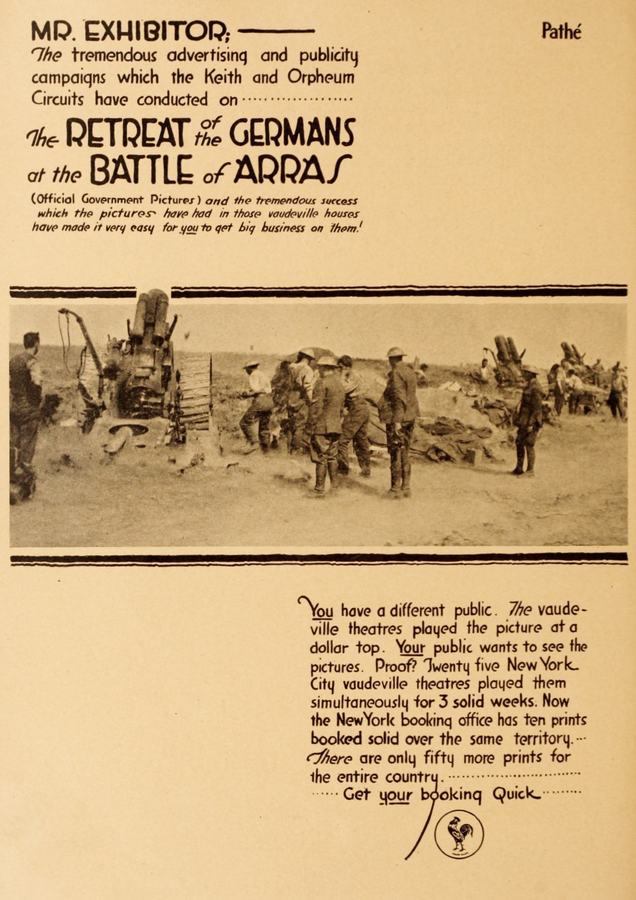
Imagine the cameraman as a ghost in puttees, lugging a wooden-bodied Moy & Bastie through corridors of chalk that smell of cordite and wet sandbags. Each forward crank of the handle is a small act of insurgency against entropy: every frame burns into celluloid the possibility that memory may outlast the marrow-freezing cold. The resultant footage—grainy, scratched, occasionally solarised by shell flashes—doesn’t merely show Arras; it inhales it. The film’s very surface trembles with the same fever that rattled the men of the 37th Division when they clambered over the parapet at zero hour, April 9th, Easter Monday.
Arras was a city that had learned to speak in subterranean tongues. Beneath its cobblestones ran galleries hewn by medieval masons, extended by New Zealand tunnellers who listened for the cough of German listeners listening back. The documentary splices these underworlds with over-ground devastation so seamlessly that collapse feels cartographic: one moment you’re staring at a cathedral spire sliced by shrapnel, the next you’re descending a rope ladder into candle-lit gloom where messages are passed in cigarette tins. The effect is cubist; space fractures and reassembles according to the front’s neurotic logic.
Because official cameramen were instructed to avoid identifiable casualties, the soldiers become archetypes refracted through repetition: a Sheffield steelworker spooning bully beef; a kilted Highlander re-wrapping a puttee with a safety-pin of thistle brass; a Gateshead clerk turned signals officer sketching Morse on a school slate. Yet the camera lingers long enough for individuality to leak through the warpaint of conformity: a chipped tooth, a half-healed dimple scar, the way a cigarette end flares crimson when its owner realises the cameraman is watching. These micro-gestures accrue into a collective portraiture more haunting than any single close-up could manage.
One entire reel is devoted to railway engineers laying a standard-gauge line across a moonscape within forty-eight hours. The sequence is hypnotic: rails hiss from flatbeds like iron serpents; gandy dancers spike plates in percussive unison; a locomotive, its funnel capped with a wire-cage against shell bursts, steams through the wasteland bearing a cargo of shells labelled ‘Easter Eggs’. Intertitles, laconic as haiku, read: “Ten miles of track, twenty hours, no rest.” This is the film’s secret spine: the argument that battles are won not by courage alone but by the abacus of supply—grams of biscuits per man per day, gallons of creosote per sleeper, number of mules whose carcasses can be rendered into glue when they founder in the mud.
Of course, being 1917, the documentary is silent; yet its silence is a presence so clamorous it vibrates in the viewer’s sternum. You supply the soundtrack yourself: the arterial thrum of blood in ear canals, the imagined 105-decibel cough of an 18-pounder, the wet crunch of chalk under duckboards. Contemporary exhibitors often accompanied the reel with colliery brass bands or Wurlitzer organs, but the most honest iteration is the unadorned hush, broken only by the projector’s mechanical hiccup—a reminder that war itself is an interruption, a tear in the fabric of the world’s projector.
Monochrome need not mean chromatic poverty. The emulsion’s silver halides render khaki as a ghost-grey shimmer, blood as tar-black varnish. Yet the mind rebels, flooding the frame with hallucinated colour: the chemical yellow of mustard-gas blisters, the bruise-violet of dawn over the Scarpe, the arterial crimson poppy that a soldier tucks behind his ear like a boutonniere. The film becomes a Rorschach test for chromatic trauma; every viewer pigments it privately, yet the shared template of suffering remains immutable.
In the same year that The Retreat of the Germans was hauled in tin cases through the Channel ports, John Barleycorn was mythologising alcohol as America’s nemesis, while The Hypocrites peeled back ecclesiastical hypocrisy with double exposures. None grapple with corporeal reality as ferociously as this documentary, yet their shared grammar—intertitles, tableau staging, the moral weight of the close-up—reveals a medium in chrysalis, learning to speak both dream and document. Contrast this with the restorative fantasies of The Model or the Symbolist detachment of En Død i Skønhed; here, cinema refuses allegory and insists on mud under fingernails.
No footage exists of the Canadian Corps’ simultaneous but separate advance on Vimy Ridge, an absence that quietly re-inscribes imperial hierarchies. Shell-shocked men, labelled ‘NYD’ (Not Yet Diagnosed) and herded to the rear, are likewise elided. Indigenous labour battalions, Chinese coolies, French civilians forced to serve as guides—each is spectrally present only in the margins, a pair of foreign eyes glancing sideways at the lens. These lacunae are not accidents; they are the negative space that shapes the official myth.
Every contemporary screening is a séance. The BFI’s 2017 restoration added a score by Laura Rossi, yet some scholars argue that any accompaniment prettifies carnage, converting slaughter into consumable heritage. Others insist that without musical prosthetics modern audiences disengage, Instagramming their popcorn during the gas-attack reel. My own rule: watch it alone on a laptop at 3 a.m., headphones off, the whirr of the hard-drive mimicking the projector’s rattle—only then does the film’s moral voltage arc across a century and jolt the nervous system.
Today the battle lives in code: laser-scanned trenches archived in Unity game engines, colourised stills circulating on Reddit, machine-learning models upscaling 35 mm scratches into 4K clarity. Yet the more we polish, the more the original celluloid’s scars matter; those scratches are autographs of survival, each tear a signature that the film, like the men it depicts, once stood under fire and refused to disintegrate.
Measured in footage, the advance at Arras reclaimed roughly twelve kilometres; measured in running time, the film lasts forty minutes. Somewhere between those two metrics lies the asymptote of human comprehension. To watch The Retreat of the Germans is to confront the paradox that cinema can archive the empirical world yet never its emotional counterweight. The film ends mid-motion: soldiers tramp toward the vanishing point, the camera tilts skyward, catching a lone lark. Cut to black. No victory scroll, no casualty tally. Just the after-echo of boots and the unspoken knowledge that for every yard gained, a corresponding yard of human film—private, unshot—was lost in the darkroom of history.

IMDb —
1932
Community
Log in to comment.