DbcultAccessing Vault...
Cult Review
Senior Film Conservator
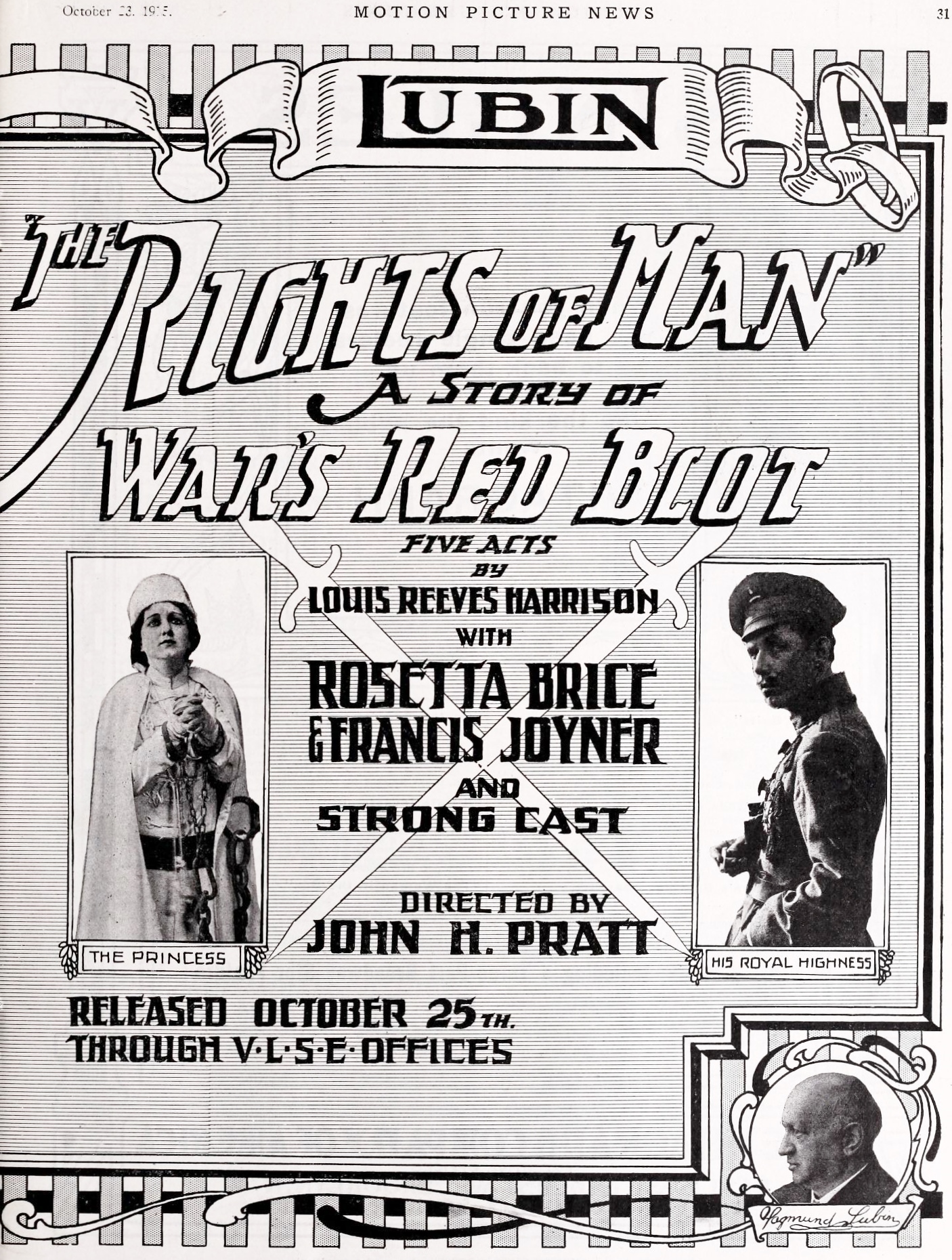
War, that voracious curator of ironies, hands a princess a scalpel and says: cut your pedigree open—see if it leaks blue or red.
Louis Reeves Harrison’s screenplay arrives like a stained field diary, its pages fluttering between trench mud and ballroom parquet. William Carr’s American doctor, introduced in a languid long-shot, carries the lanky swagger of someone who boarded the liner believing scalpels could excise history itself. Opposite him, Marie Sterling’s royal volunteer is first seen only by reflection: a gilded hand-mirror trembling in her satin grip while orderlies unload stretchers beneath her ancestral ramparts. The mirror cracks under the vibration of distant howitzers—an omen inked in silent light.
Visually the picture is a chiaroscuro master-class. Cinematographer George Clarke carves labyrinths of candle-glow inside canvas tents, letting faces hover like half-remembered saints. Note the sequence where the princess, sleeves rolled to the elbow, kneels in a puddle of peroxide that reflects the kerosene lamp above—two suns, one terrestrial, one celestial, both indifferent to rank. The silhouette of her backbone, rigid as a coronation sword, bisects the frame: sovereignty on one side, supplication on the other.
Sound, though absent, is implied through montage: the quickening alternation of gloved palms wringing water from lint, the frenzied intertitles hammering out Morse-like staccato—"Bring more ether!"—and the ever-present grind of motorized ambulances that we never see but sense via vibrating ground glass.
The supporting cast forms a fresco of early-twentieth-century archetypes. Walter Law’s portly quartermaster traffics in black-market quinine, his jowls quivering like corrupt jelly whenever the princess requests another bottle. Francis Joyner provides comic relief as a cockney stretcher-bearer who addresses the royal as "missus majesty," yet his final close-up—mouth sewn shut by a bullet he carried instead of a patient—silences every prior laugh. Margaret Moore’s Red Cross matron, eyes perpetually haloed by exhaustion, delivers the film’s most subversive line via placard: "Courage is a currency the poor spend daily; the rich only on special occasions."
Harrison’s thematic needle threads three strands: class entropy, bodily sovereignty, and the feminine annexation of spaces previously barred by iron gates or iron gender codes. The narrative refuses to coronate either lead as sole protagonist; instead it stages a dialectic. When the doctor cauterizes an artery while the princess compresses the heart, the camera alternates between their eyelines—each POV tinted by a color filter, amber for aristocracy, sea-green for republic—until the filters dissolve into neutral white, suggesting that trauma is the great leveler.
Comparative glances reveal lineage: where A Soldier’s Oath mythologizes trench camaraderie through flag-waving long shots, this film prefers surgical close-ups that smell of pus and lavender water. Salvation Nell may rescue souls in Bowery slums, yet here salvation is secular, negotiated in antiseptic inches. And while From the Manger to the Cross spiritualizes suffering, Rights insists suffering is only suffering—no halo, just an abdominal cavity that refuses to close.
Acting styles oscillate between the florid semaphore common to 1910s silent drama and shockingly modern minimalism. Sterling’s micro-gesture—two fingers brushing a soldier’s wrist to check pulse—carries more gravitas than any crown-hovering close-up. Carr, conversely, lets his shoulders do the talking: each slump registers another treaty signed between idealism and attrition.
The film’s temporal spine is nonlinear. It opens with a post-armistice tableau: a victory parade where confetti looks suspiciously like bandage lint. From there we ricochet backward via match-cuts—an exploding champagne cork becomes a mortar burst, a celebratory kiss mutates into mouth-to-mouth resuscitation. History, the editing suggests, is a palimpsest where triumph is merely the obverse side of agony.
Moral binaries topple like stretchers in a storm. The German prisoner brought in for emergency surgery is revealed to be a Berliner who once danced with the princess at a debutante ball; his subsequent death rattle is filmed in an unbroken 40-second shot, Carr’s hand resting on the enemy’s carotid as if taking the pulse of nationalism itself. No recompense, no redemption—only the wet click of a watch stopping.
Gender politics simmer beneath bandages. When the princess strips to her chemise to compress a hemorrhaging adolescent, the camera does not ogle but observes utility: linen clings because skin must breathe, not because audiences paid their nickel for flesh. In a contemporaneous landscape where Three Weeks eroticizes monarchy, this feature desexualizes it, replacing eros with trauma’s egalitarian embrace.
Yet the film is not immune to the era’s racial myopia. A Senegalese tirailleur appears briefly, grimacing in a cloud of chloride, but the narrative never grants him syllables, spoken or intertitular. His presence is atmospheric, a reminder that even progressive texts carry blind spots like embedded shrapnel.
Composer Richard Buhler—though uncredited—supplied original cue sheets for live orchestras: a waltz in B-minor that mutates into dissonant march time, mirroring the princess’s arc from ballroom to bone-saw. Modern restorations overlay astringent strings, yet I yearn for the rasp of period brass, the wheeze of an on-site harmonium gasping alongside lung-shot Tommies.
Richard Wangermann’s production design deserves encomium: the field hospital erected inside an abandoned railway shed is lit by skylight slits that turn dust motes into drifting mustard gas. Every creak of corrugated iron sounds like history itself complaining. Note the detail of a chalk outline—no corpse, merely the absent shape of a man—sketched beside an operating table, a memento mori for viewers who assume survival is the default.
Ending on neither triumph nor despair, the film closes with the princess aboard a hospital ship, hair cropped short, eyes fixed on an ocean whose horizon line is obliterated by fog. The doctor, ashore, pockets her signet ring—now threaded on a suture needle—before turning back toward rows of fresh casualties. No embrace, no promise of letters; only the shared knowledge that treaties may cease gunfire but cannot suture memory.
Criterion-quality restorations reveal nitrate scratches that resemble barbed wire, each scar a reminder that film itself is a skin stretched over ideology, prone to tear.
In the current cinematic climate—where trenches are rendered through pixelated backdrops—this 1918 artifact feels radical: it smells of real mud, tastes of expired ether, sounds like the creak of your own seat as guilt settles. Watch it not as antique curio but as living document, a red blotch on the white linen of nationalist myth. Monarchy and republic, aristocrat and commoner: all are merely vascular systems awaiting the same inevitable leak.
Community
Log in to comment.