DbcultAccessing Vault...
Cult Review
Senior Film Conservator
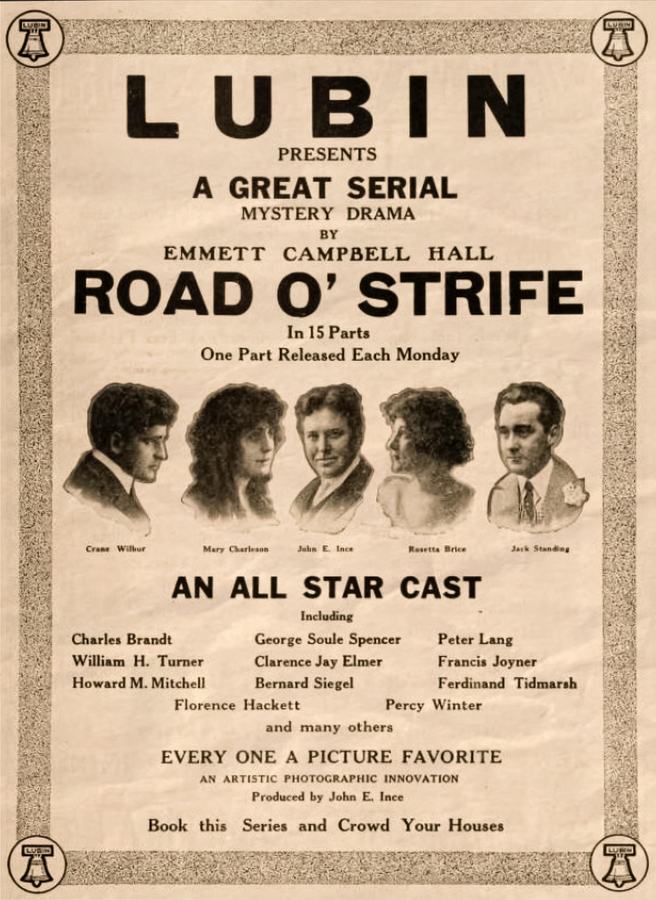
Most silent serials spoon-feed cliffhangers like penny-candy; The Road o' Strife prefers arsenic-laced sacramental wine. From the first iris-in on Elmhurst’s shuttered manse the film announces its intent to marry Grimm fatalism with dime-novel velocity. Gershom’s tower, stuffed with retorts and star-charts, feels cribbed from Fantômas’ laboratory, while the later ballroom where Gilbert prowls in white tie reeks of the same decadence that poisoned the Grandee’s Ring. Yet unlike those continental cousins, this American curiosity roots its gothic in Appalachian mud: a silver cup hung beside a mineral spring nobody visits because the water tastes of rust and graves.
Fifteen episodes, twenty-eight reels, and not a single recap wasted—Emmett C. Hall’s script treats each chapter like a stanza in an oral epic that must survive the telephone game of weekly memory. Notice how the motif of the ring migrates from Abner’s innocent finger to Clara’s gloved hand to the scaffold’s shadow: a bauble becoming a noose becoming a wedding band. The film’s true protagonist is not Alene nor Dane but circulation itself: documents shuttled in hollow chalices, bodies freight-trained across state lines, gossip traveling faster than Western Union. When Caleb Jerome sees Gershom’s corpse in every passer-by, the hallucination literalizes capitalism’s guilty conscience: capital always imagines the victim it liquidated is still walking beside it, collar turned up, asking for interest.
Betty Brice’s Alene could teach The Spitfire’s vamps the difference between naïveté and vapidity. Watch the micro-shift in episode 4 when Gilbert first strokes her wrist: her pupils dilate like a night-blooming cereus, half terror, half curiosity, the exact moment instinct recognizes the predator. John Ince’s Robert Dane, meanwhile, carries the slump of a man who has read too many chemical treatises and too few hearts; his climactic lie—“I do not love you”—is delivered with the hollow crispness of a beaker shattering under its own vacuum. The standout, though, is Bernard Siegel’s Professor Gershom, toggling between Lear-on-the-heath and village crackpot without ever tilting into burlesque; his resurrection scene, backlit by hospital argon lamps, feels like watching a daguerreotype develop in reverse.
Directors Webster & C. Ince exploit orthochromatic stock’s hunger for ultraviolet: moonlight on the millpond turns the water into obsidian glass, while the yellow sulphur of the spring glows sulfurous against Alene’s Grecian-white robe. Double-expositions render Clara’s jealousy as a literal doppelgänger looming over Gilbert’s shoulder, a trick Behind the Scenes would borrow months later. The editing rhythm deserves a semester unto itself: episodes 11-13 intercut Dane’s blood-spattered experiment, Daisy’s rooftop odyssey, and Alene’s death-cell prayers through match-action cuts—water drips from faucet to cup to scaffold beam—creating a triptych of desperation that anticipates The Tide of Death’s montage but with Eisensteinian torque.
Every union in this narrative is a transaction brokered by peril. Alene marries Abner to annul her testimony, a legal loophole the film presents with chilling nonchalance: connubial bliss as gag order. Gilbert’s intended marriage is straight-up asset consolidation—princess plus fortune minus messy murder charges. Even Dane’s eventual proposal arrives only after both parties have been denuded of net worth, as though love can be spoken only when the balance sheet reads zero. The film’s most subversive whisper: romance flourishes only after dynastic capital has been annihilated.
Why hollow the base? Why lace the alloy with poison neutralized only by terroir-specific water? On the surface it’s a nifty contraption to ensure that documents survive attempted destruction. Peel back a layer and you find a moral theorem: wealth itself is toxic unless tempered by communal memory—the spring being the village’s sole public commons. When Gilbert removes the cup he isn’t merely stealing heirlooms; he’s severing capital from its geographic conscience, and the ensuing auto-intoxication plays like a medieval morality play staged in a banker’s ballroom.
Trace the cup’s genealogy forward and you land in The Grandee’s Ring where signet seals swap poisons; follow the scaffold suspense and you collide with Fantômas’ guillotine. Yet Road o' Strife is more than a footnote; it is the missing link between Victorian stage melodrama and the noir fatalism of the forties. The moment Daisy volunteers to drink from the cup she’s re-writing the self-sacrificing courtesan trope that would echo from The Shepherd of the Southern Cross to Mildred Pierce.
No complete 35 mm print is known to survive; the BFI holds a 9-chapter abridgement struck on Eastman 2-blush stock, riddled with vinegar syndrome. The final reel—Alene’s renunciation of the throne—exists only in a 1922 Pathescope home-use 28 mm, its sprocket holes warped like cathedral glass. Yet even in fragmentary form the film vibrates with uncanny power: the image of Dane clutching the perforated cup while blood seeps through his waistcoat feels as contemporary as any prestige-television anti-hero. Archives list it under the unsearchable keyword “Uranian monarchy serial”, which explains why cinephiles keep rediscovering it by accident, the way characters keep stumbling upon the mineral spring.
Because her choice—throne or heart—anticipates every modern franchise finale where world-saving duty dukes it out with personal desire. Because the film insists that the only kingdom worth claiming is the one where testimony cannot be compelled against your chosen partner. Because when Alene whispers, “Now I am only a girl,” she is not diminishing herself but rather acknowledging that identity is negotiable, love a republic where sovereignty is shared. And because sometimes the most radical act is to walk away from a narrative scripted before your birth, even if the exit door opens onto an unpaved road that vanishes into Appalachian fog.
“The cup is empty, the scaffold dismantled, the throne unclaimed. What remains is the long road, the strife, and two silhouettes merging into one against the sunrise—an ending so quiet it feels like a beginning.”
Seek this battered epic not for antiquarian bragging rights but for its raw voltage: a reminder that every era, no matter how monochrome, thrums with color waiting for our gaze to ignite it.
IMDb —
1916
Community
Log in to comment.