DbcultAccessing Vault...
Cult Review
Senior Film Conservator
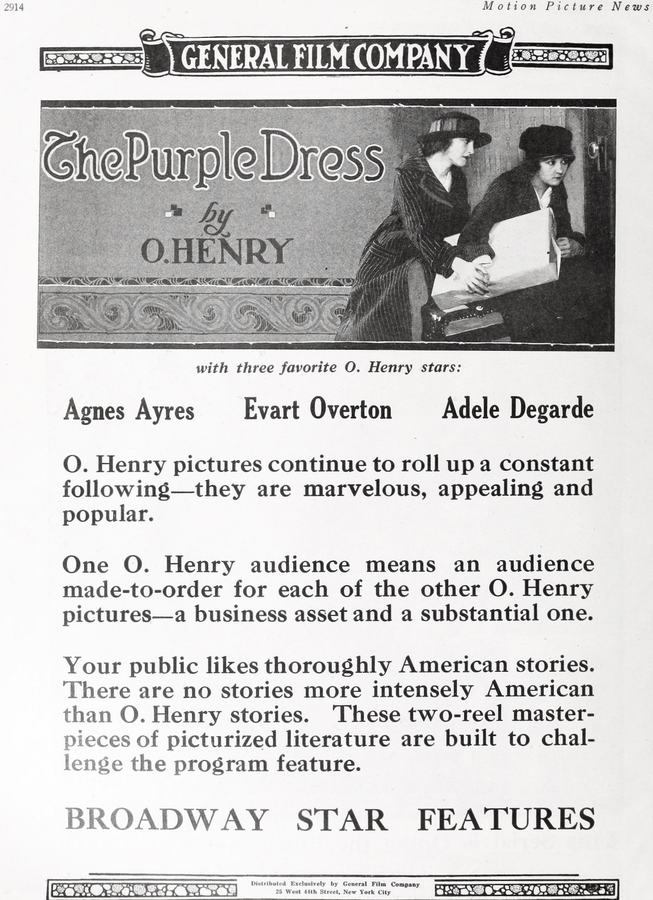
In the grand, often understated, tradition of early cinema, 'The Purple Dress' emerges as a compelling vignette, a narrative thread woven with the very fabric of human desire, sacrifice, and the often-unpredictable hand of fate. Penned by the masterful F.R. Buckley and the legendary O. Henry, whose narrative fingerprints are unmistakably pressed into its concise yet profound plot, this film, though perhaps brief in its runtime, manages to distill an astonishing amount of emotional complexity and social commentary into its unfolding frames. It's a testament to the power of storytelling that even without spoken dialogue, the moral quandaries and personal aspirations of its characters resonate with a surprising depth.
The setting, the bustling Busy Bee Department Store, is more than just a backdrop; it's a microcosm of early 20th-century urban life, a vibrant arena where economic necessity intertwines with social ambition. Here, Maida and Grace, two saleswomen, navigate their daily routines, their camaraderie underscored by a subtle, yet palpable, rivalry. Their shared object of affection, Mr. Ramsey, the store's head clerk, embodies the era's ideal of upward mobility. His impending partnership makes him an exceptionally eligible bachelor, a prize not merely for love but for the promise of a more secure, elevated existence. This dynamic immediately establishes a relatable tension, a timeless exploration of how personal relationships are often inextricably linked to socio-economic aspirations.
Maida, portrayed with a quiet dignity by Adele DeGarde, becomes the emotional anchor of this narrative. Her meticulous planning for the Thanksgiving dinner, particularly her acquisition of the material for the titular purple dress, speaks volumes about her character. This isn't just about fashion; it's about aspiration, about presenting oneself in the best possible light for a crucial social event that could alter the course of her life. The dress symbolizes hope, a tangible representation of her desire for acceptance, for love, and for a better future with Mr. Ramsey. The four dollars she owes Schlegel, the tailor, isn't just a sum; it's the culmination of careful saving, a small but significant investment in her dreams.
The true heart of the story, however, beats in Maida’s selfless act towards Grace. When Grace, played by Agnes Ayres, finds herself in dire straits, having spent her rent money on a dress for the same dinner, Maida faces a profound moral dilemma. To keep her own dream alive means potentially seeing her friend cast out, a stark and cruel reality of the time. Maida's decision to advance Grace the very four dollars she had set aside for her own dress payment is an act of extraordinary generosity. It’s a moment that elevates the film beyond a simple romantic comedy or drama, imbuing it with a genuine sense of human empathy and altruism. This isn't just a friendly gesture; it's a sacrifice of her own aspirations for the immediate well-being of another, a choice that resonates with the poignant dilemmas often found in O. Henry's short stories, where characters frequently make significant personal sacrifices for the sake of others, sometimes with ironic or unexpected outcomes.
This theme of self-sacrifice, particularly by a female character in a challenging social climate, echoes in other films of the era. One might draw a parallel to certain aspects of An Alabaster Box, where characters grapple with the implications of their choices and the weight of moral obligation. While the specific circumstances differ, the underlying current of a protagonist putting another's needs before their own, often at great personal cost, is a powerful and recurring motif in these early narratives, highlighting societal values and the often-limited agency of individuals, particularly women, in shaping their destinies without significant personal cost.
The genius of O. Henry, whose name is synonymous with the surprise ending, shines brightly in the film's climax. After the Thanksgiving dinner, Maida, resigned to her circumstances, visits Schlegel the tailor. The expectation is that she will explain her inability to pay, perhaps to retrieve her old dress or simply to postpone her dream. Instead, in a moment that feels both earned and serendipitous, Schlegel, perhaps touched by an unseen hand or simply a stroke of human kindness, presents her with the finished purple dress, demanding no payment. This unexpected act of grace – a different kind of grace than her friend's – transforms Maida's evening and, ultimately, her fate.
This plot twist is quintessential O. Henry, reminiscent of the delightful irony and heartwarming resolutions found in his literary works. It’s a narrative device that not only provides a satisfying conclusion but also reinforces the idea that good deeds can, in unexpected ways, be repaid. The purple dress, once a symbol of thwarted ambition, suddenly becomes an emblem of vindication and renewed hope. It’s a moment of pure cinematic magic, a silent affirmation that sometimes, the universe conspires to reward virtue.
The moment Maida discards her old dress and steps out in the new purple beauty is pivotal. It’s a metamorphosis, not just sartorial, but psychological. The dress doesn't just change her appearance; it changes how she carries herself, how she perceives herself. It imbues her with a confidence and radiance that were perhaps obscured by her earlier sacrifice. This transformation is crucial because it directly leads to her encounter with Mr. Ramsey. His decision to marry her, spurred by the impression she makes, is not merely superficial. It's an acknowledgment of the newfound aura she projects, an aura born not just of the dress, but of the quiet strength and inherent goodness that the audience has witnessed through her actions.
The performances, even in the absence of spoken dialogue, are key to conveying these subtle emotional shifts. Adele DeGarde as Maida manages to project both vulnerability and an inner fortitude that makes her sacrifice believable and her eventual triumph resonant. Bernard Siegel as Mr. Ramsey, while perhaps a more conventional romantic lead, represents the societal aspiration of stability and a good match. His character's ultimate decision, influenced by Maida's radiant appearance, cleverly ties into the film's broader themes about perception, social status, and the surprising ways in which destiny can unfold.
The film also offers a fascinating, albeit brief, glimpse into the social fabric of the era. The department store as a workplace for women, the importance of social events like the Thanksgiving dinner, and the precarious financial situations faced by characters like Grace all paint a vivid picture of early 20th-century life. The contrast between Maida's careful planning and Grace's impulsive spending highlights different approaches to navigating economic realities, a common theme in films that explore the lives of working-class individuals. This could be loosely compared to the social commentary present in a film like The Good for Nothing, which also delves into the lives and struggles of ordinary people within their specific social strata, though perhaps with a different comedic or dramatic bent.
The concept of a 'good catch' like Mr. Ramsey speaks to the limited options available to women at the time. Marriage was often a route to economic security, making the competition between Maida and Grace not just about love, but about survival and social advancement. This underlying tension adds a layer of seriousness to what might otherwise appear as a simple romantic rivalry. The film subtly critiques, or at least observes, these societal pressures without heavy-handedness, allowing the audience to infer the broader implications of the characters' choices and aspirations.
What makes 'The Purple Dress' enduring is its ability to tap into universal themes: the desire for love and acceptance, the complexities of friendship and rivalry, and the unexpected rewards of kindness. It’s a narrative that, despite its silent origins, speaks volumes about the human condition. The film, in its quiet way, suggests that true beauty and worth are not solely found in outward appearance, but in the character and moral choices that define an individual. While the dress itself is the catalyst for the final romantic resolution, it is Maida's prior act of generosity that truly makes her deserving of such a happy ending. This thematic depth is a hallmark of good storytelling, transcending the limitations of its medium and era.
The film’s brevity, typical of many productions from the 1910s, forces a tight narrative focus. Every scene, every gesture, must contribute directly to the plot's progression and character development. There's no room for extraneous detail; the story moves with an efficiency that many modern films could learn from. This economy of storytelling, combined with the emotional resonance of Maida’s journey, makes 'The Purple Dress' a miniature masterpiece of its time. It’s a film that leaves the viewer with a sense of warmth and satisfaction, a belief in the inherent goodness of people, and the sometimes-magical way that life can unfold.
Comparing it to other silent films, 'The Purple Dress' holds its own as a charming and morally rich narrative. While it lacks the grand scale of some epics or the overt social commentary of a film like Strike, its strength lies in its intimate portrayal of everyday struggles and triumphs. It shares a certain narrative economy with films like The Accomplice, where character motivations and interpersonal dynamics drive the plot forward with a focused intensity. The emotional impact, despite the lack of spoken words, is palpable, a testament to the actors' expressions and the clarity of the visual storytelling.
The collaboration between F.R. Buckley and O. Henry is particularly noteworthy. O. Henry's influence is evident in the film's structure and its ultimate message of poetic justice. His stories often feature ordinary people facing extraordinary circumstances, with twists that reveal deeper truths about human nature. 'The Purple Dress' fits perfectly within this tradition, offering a narrative where an act of selfless love is ultimately rewarded, not through direct reciprocation, but through an unexpected turn of events that feels both deserved and delightful. It’s a reminder that sometimes, the greatest gifts come not from what we expect, but from the unlooked-for kindness of others.
The film's exploration of appearance versus reality is also quite sophisticated for its time. While the purple dress is instrumental in catching Mr. Ramsey’s eye, the audience knows that it is Maida's underlying character, her compassion and integrity, that truly makes her worthy. The dress merely allows her inner radiance to shine through, making her visible in a way she wasn't before. This nuance prevents the ending from feeling superficial, grounding it instead in the moral foundation established earlier in the story. It’s a subtle yet powerful statement on the nature of attraction and the qualities that truly make a person desirable.
In conclusion, 'The Purple Dress' is more than just a silent film curiosity; it's a beautifully crafted story that speaks to timeless human experiences. It showcases the quiet power of sacrifice, the allure of aspiration, and the delightful unpredictability of life. For aficionados of early cinema, or anyone interested in the enduring appeal of O. Henry's narrative style, this film offers a charming and thought-provoking experience. It reminds us that even in the simplest tales, profound truths can be found, wrapped perhaps in the elegant folds of a purple dress, waiting to be discovered.
The performances, particularly DeGarde's nuanced portrayal of Maida, elevate the material, allowing the audience to connect emotionally with her journey. The film's direction, even if uncredited in the plot details provided, must have been adept at conveying these emotions through visual cues and character blocking, a crucial skill in the silent era. The use of close-ups, if present, would have further amplified the emotional impact of Maida's dilemma and her subsequent joy. While we don't have the luxury of dissecting the directorial choices in detail without viewing the film, the strength of the narrative and character arcs suggests a competent hand guiding the story to its satisfying conclusion.
The film serves as a quaint, yet powerful, artifact of its time, reflecting the social mores, romantic ideals, and narrative conventions prevalent in early 20th-century American cinema. It's a reminder that even in an age of rapid technological change and evolving artistic forms, the fundamental human stories—of love, loss, hope, and generosity—remain constant, capable of moving and inspiring audiences across generations. 'The Purple Dress' is a small gem, sparkling with the quiet brilliance of a well-told tale, a testament to the enduring magic of cinema.
IMDb —
1933
Community
Log in to comment.