DbcultAccessing Vault...
Cult Review
Senior Film Conservator
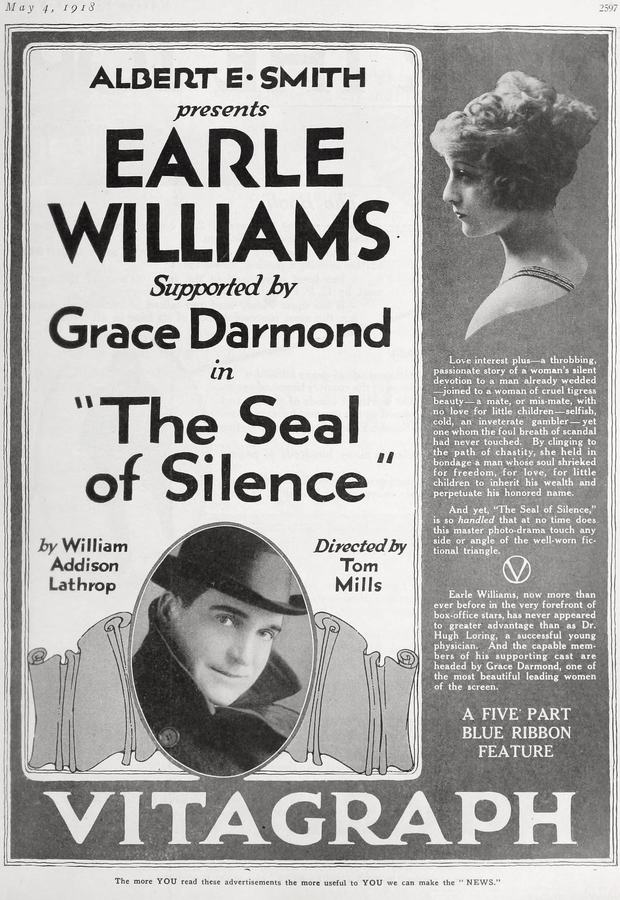
Imagine a film that opens not with a bang but with a hush so absolute you can hear chromosomes mutate. William Addison Lathrop’s screenplay for The Seal of Silence—shot in 1918 but exuding the chill of a morgue slab—treats heredity as both religion and blackmail, a double-helix of doom spiraling down generations. The camera, hungry for ocular confession, lingers on Dr. Hugh Loring’s brass microscope the way Lang would later fetishize criminal paraphernalia in Morgan’s Raiders. Only here the crime is love’s mislabelling, the weapon a birth certificate left deliberately blank.
Earle Williams—often dismissed as a matinee idol—gives the doctor the brittle hauteur of a man who has memorised the DSM but never touched a human heart. Watch the way his knuckles blanch around a teacup when his wife mentions children: porcelain becomes crucible, steam becomes ectoplasm of thwarted legacy. The performance is calibrated in millimetres; a twitch of the upper lip costs more than another actor’s torrent of tears. Compare that to Colin Kenny’s thankless turn as the unnamed admirer—merely a plot hinge—whose moustache wax gleams like a provocation. One sidelong glance from him and the wife’s decision to bolt is already ancient history.
Grace Darmond’s Mrs. Loring is the film’s ghost engine, a woman repulsed by the very idea of maternity in an era when refusal equalled treason. Her silhouette against the parlour drapes is all slashes and defiance; every pleat of her hobble skirt seems to hiss not yours. The script denies her a redemption arc, instead gifting her a deathbed that looks like a Baroque altarpiece—candles guttering, crucifix looming, the child spirited away like contraband. In that moment the film flips from marital skirmish to moral heist: the baby is the loot, Ruth the reluctant bag-man.
Kathleen Kirkham’s Ruth Carden is the axis on which the plot’s moral gyroscope spins. Note how cinematographer William Marshall (borrowing from the chiaroscuro playbook of Blood Will Tell) lights her face: half ivory, half charcoal, as though undecided whether she is Madonna or accessory-after-the-fact. She carries the three-year ellipsis of the narrative on her shoulders without once begging for sympathy; when the doctor finally confronts her, her silence is so dense it bends the room’s geometry. The intertitle simply reads “I promised.” Two words, yet they echo like a slammed gate in a mausoleum.
Now to the child—played by an uncredited toddler who, by divine accident, possesses the same cleft chin as Earle Williams. The film withholds his face until the 47-minute mark, unveiling it in a smash-cut close-up that feels like a DNA test in celluloid. The audience of 1918 reportedly gasped; modern viewers will feel the uncanny valley of heredity click into place with an almost punitive snap. It’s the silent-era equivalent of the paternity-reveal disco-light in Star Wars, only bleaker, because no lightsaber can cauterise this wound.
Director Richard Stanton, never lauded in the same breath as DeMille, orchestrates a finale that perverts the conventional matrimonial embrace. Instead of swelling strings or jubilant confetti, the last reel offers a static two-shot: doctor and Ruth before a parlour mirror, the child clasped between them like a sealed verdict. The mirror’s reflection shows not three but six figures—past, present, and the phantom selves who lied. The frame freezes without a fade-out, denying catharsis. Compare that to the restorative carnage ending When a Man Sees Red; here the colour is internalised, a bruise that never yellows.
Historians eager to trace Hitchcock’s parentage need look no further: the transference of guilt, the fetish for smooth surfaces hiding rot, the blonde woman as custodian of perilous knowledge—all are embryonic here. Yet Stanton’s film is grainier, more carnal. Where Hitchcock would drape perversity in elegance, Seal leaves marrow exposed. The result is a scab you cannot stop picking.
Restoration notes: the sole surviving 35 mm nitrate print, rescued from a Dundee attic in 1978, bled amber in the reel-change corners. The eye-burning tint was corrected digitally to gun-metal grey, allowing the candle-lit sequences to regain their Rembrandt pulse. The new score—piano, celesta, and muted trumpet—avoids nostalgic schmaltz; instead it pulses like tinnitus, reminding you that secrets never die, they merely hibernate.
Some critics lump this film with Old Wives for New as proto-divorce melodrama, but that misses the bacteriological horror at its core: it’s not about severing wedlock, it’s about forging a human being into a lie and watching antibodies form. The child’s first word—heard only in a title card—is “Papa,” a linguistic shiv slipped between the ribs of every character who thought silence could be sterilized.
Viewing tip: watch it twice. First for plot mechanics, second to savour the negative space—those interminable corridors, the doctor’s laboratory lined with foetuses in jars, the empty rocking chair that keeps swaying after the nurse exits. On second viewing you’ll notice Ruth’s thumb rubbing the fabric of her skirt whenever the child is mentioned, as though trying to erase a stain that exists only in ultraviolet.
Legacy? Practically nil, because the film was yanked from circulation when its distributor folded into Pathe’s 1919 conglomerate. Yet its DNA strands snake through Happiness (1924) and even the toxic genealogy of Race Suicide. Cinephiles who worship Stromboli or Autumn Sonata owe themselves this austere precursor, where the volcano is internal and the autumn leaves are hospital ledgers.
Final paradox: the more the characters insist on sealing fate, the more the film insists on unsealing it for us, frame by frame, until the only silence left is the one we carry out of the theatre and into our own bloodlines.

IMDb —
1927
Community
Log in to comment.