DbcultAccessing Vault...
5/10
Senior Film Conservator
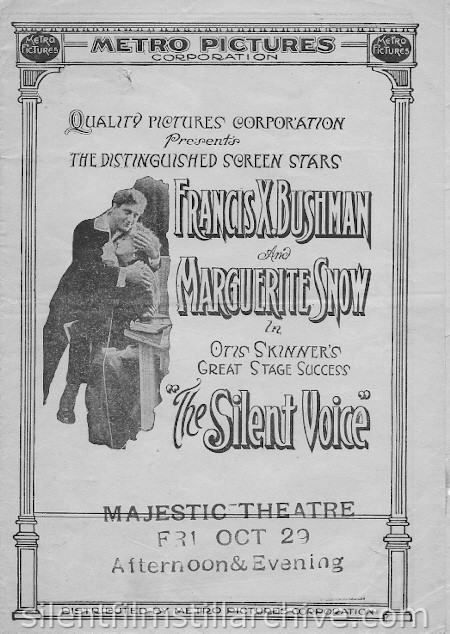
A definitive 5/10 rating for a film that redefined the boundaries of cult cinema. The Silent Voice remains a cornerstone of transgressive art.
The 1915 cinematic landscape was a crucible of evolving narrative techniques, and The Silent Voice stands as a testament to the era's burgeoning interest in psychological complexity. Directed by William Rolfe and featuring the legendary Francis X. Bushman, the film moves beyond the simplistic moralizing of its contemporaries to provide a visceral study of sensory deprivation and the subsequent erosion of the human spirit. Unlike the more sprawling social epics like The Absentee, this work focuses its lens inward, examining the claustrophobia of a mind trapped in eternal silence.
Francis X. Bushman, often remembered for his Herculean physique and 'King of the Movies' status, delivers a performance here that is startlingly restrained. As Franklyn Starr, he must navigate the transition from a man of rhythmic vitality to a shadow haunting his own estate. The loss of his mother is not merely a plot point; it is the severance of his last tether to a world that makes sense. When his hearing vanishes, the silence is portrayed not as a lack of sound, but as an intrusive, heavy presence. Bushman utilizes his entire frame to convey this weight, his movements becoming jagged and defensive, a stark contrast to the fluid grace seen in The Rival Actresses.
The film’s early acts are drenched in a gothic sensibility. Starr’s retreat to the country isn't a pastoral escape but a descent into a self-constructed purgatory. His faithful servant, the only one permitted to witness his decay, serves as a bridge to a humanity Starr no longer wishes to claim. This dynamic echoes the isolation found in Les Misérables, Part 2: Fantine, where the protagonist is similarly stripped of societal standing and forced into a corner by an unforgiving reality.
The turning point of the narrative—the explosion—is a masterstroke of irony. Starr, wandering the woods in a fugue state, is deaf to the frantic warnings of the workmen. It is his very disability that leads to his physical shattering, yet this trauma serves as the catalyst for his social resurrection. The entry of Marjorie Blair (Marguerite Snow) into the frame shifts the film's palette from the murky grays of despondency to something approaching hope. Snow provides a necessary counterpoint to Bushman’s intensity; her Marjorie is not a mere damsel but a woman of agency who recognizes the genius flickering beneath Starr’s misanthropic exterior.
The courtship and subsequent marriage are handled with a delicacy that avoids the saccharine traps of 1910s romance. There is a sense of mutual salvation that feels earned, reminiscent of the emotional stakes in Captivating Mary Carstairs. However, the screenplay, penned by the formidable Eve Unsell and her collaborators, refuses to grant the audience a simplistic resolution. The introduction of Bobby Delorme (William Clifford) injects a poison into the domestic bliss that is far more devastating than the initial loss of hearing.
What makes The Silent Voice particularly harrowing is its depiction of how easily a traumatized mind can be manipulated into self-destruction. Bobby Delorme’s exploitation of a past 'innocent flirtation' is a calculated strike at Starr’s greatest insecurity: his perceived inadequacy as a husband due to his deafness. The film brilliantly captures the internal monologue of a man who cannot hear the truth and thus becomes a prisoner of the lies he imagines. This psychological warfare is as tense as any thriller of the era, such as The Vanderhoff Affair.
Starr’s regression into bitterness is a painful sequence to behold. The joy he found with Marjorie is discarded with a speed that highlights the precariousness of his recovery. He doesn't just doubt her; he loathes himself for ever believing he could be whole again. This theme of the 'unreliable reality' is a sophisticated touch for 1915, suggesting that our disabilities are often the lenses through which we distort the world's intentions.
William Rolfe’s direction emphasizes the spatial isolation of his characters. He frequently uses wide shots that swallow the actors, making Starr appear like a small, broken figurine in a vast, uncaring landscape. The use of intertitles is sparse but impactful, allowing the visual storytelling to carry the emotional burden—a necessity for a film centered on the theme of silence. The lighting, particularly in the scenes of Starr’s country hermitage, utilizes deep shadows to mirror his internal gloom, a technique that would later be perfected in German Expressionism but is seen here in an embryonic, effective state.
The supporting cast, including Frank Bacon and Helen Dunbar, provide a solid foundation for the central drama. Bacon, in particular, offers a warmth that prevents the film from becoming an unremitting exercise in nihilism. The screenplay avoids the frantic pacing of contemporary shorts like Reporter Jimmie Intervenes, opting instead for a slow-burn character study that demands the viewer's patience and empathy.
When compared to other releases of the same period, such as the whimsical Cinderella or the swashbuckling The Spitfire, The Silent Voice feels remarkably modern. It shares a certain grim realism with The Ticket-of-Leave Man, particularly in its focus on how a man's past and physical condition can become a cage. While films like Marse Covington or King Charles II: England's Merry Monarch looked to the past for inspiration, Rolfe and Unsell looked into the fractured psyche of the contemporary man.
The film also touches on class dynamics, though less overtly than The Arrival of Perpetua. Marjorie’s status as a 'society woman' is crucial; her descent into Starr’s world of silence is a form of social martyrdom that the villain Delorme seeks to exploit. The tension between her public persona and her private devotion to a 'broken' man provides a rich subtext that elevates the film above standard melodrama.
In the final act, the film grapples with the concept of forgiveness—not just of others, but of oneself. Starr’s journey is a cycle of destruction and reconstruction. The 'silent voice' of the title refers not just to his inability to hear music or speech, but to the inner voice that he eventually has to reconcile with reality. The resolution of the conflict with Delorme and the restoration of his trust in Marjorie is handled with a gravity that avoids the easy 'happily ever after' tropes. It is a hard-won peace, much like the resolution in Far from the Madding Crowd, where the characters are irrevocably changed by their ordeals.
The film’s legacy is one of daring. It dared to present a matinée idol like Bushman in a state of utter vulnerability. It dared to spend long stretches in contemplative silence, forcing the audience to occupy the same psychological space as its protagonist. In an era where many films were content with broad gestures and clear-cut villains, The Silent Voice offered a nuanced exploration of how grief and physical loss can distort the human heart.
For the modern viewer, the film serves as a poignant reminder of the power of silent cinema to convey complex emotional states through pure visuality. It stands alongside works like The Morals of Marcus or the intense On the Fighting Line as a crucial piece of the 1915 cinematic puzzle. The Silent Voice is not merely a tragedy of deafness; it is a profound meditation on the resilience of love in the face of a world that has gone suddenly, terrifyingly quiet.
Final Thought: If you seek a film that captures the intersection of physical disability and psychological terror with a sophisticated, early-century touch, this is an essential viewing. It remains a haunting echo from the past, proving that the most powerful stories are often the ones that don't need a single spoken word to be heard.
IMDb —
1932
Community
Log in to comment.